
First, a VPN gets you in the OnlyFans door
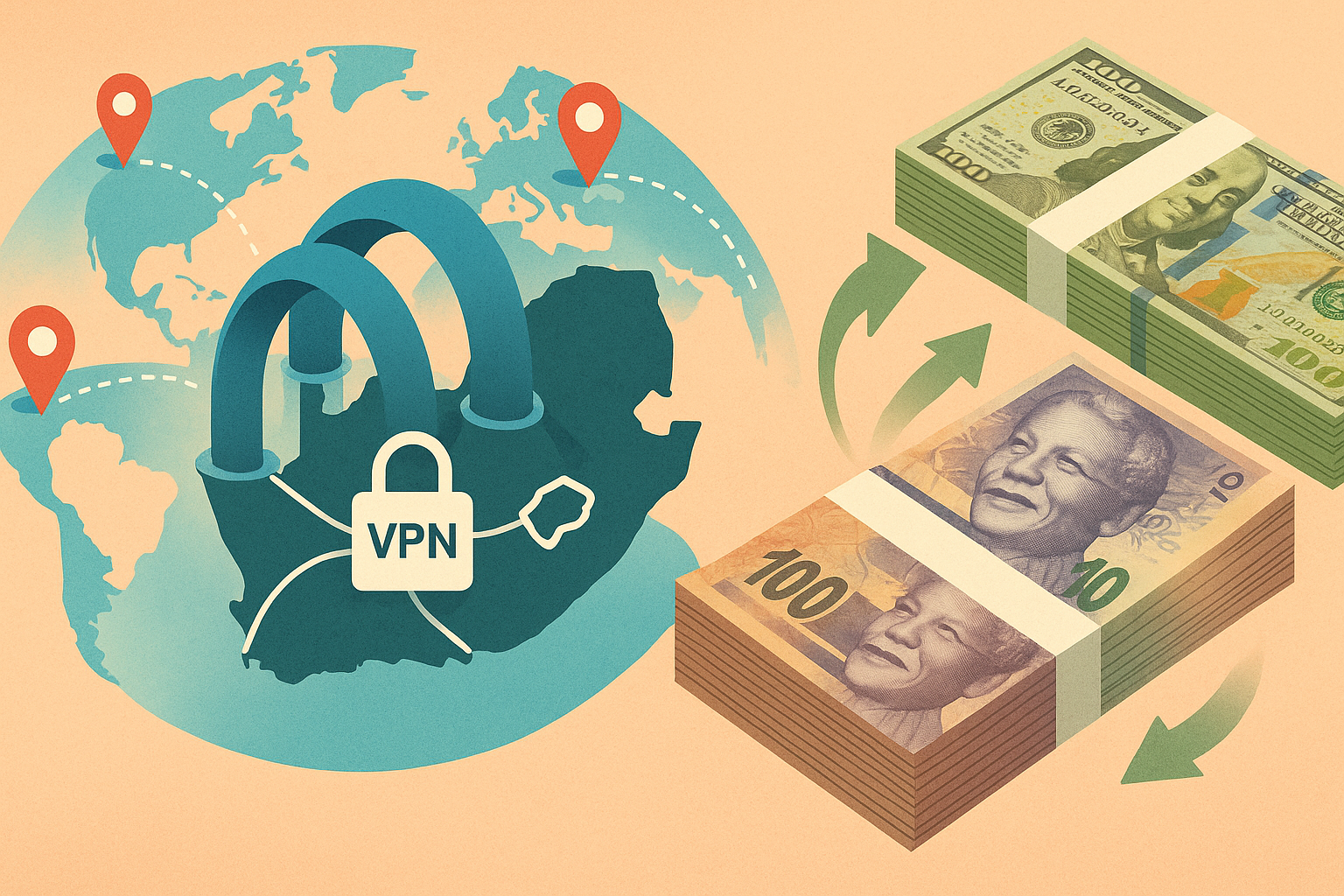
Explore South Africa's thriving OnlyFans economy, driven by VPNs, weak rand, and innovative financial workarounds.
South African OnlyFans creators are cleverly using technology to make money. They use special internet tools to trick the system, making it seem like they're in other countries, which helps them get around local rules. The weak South African money actually helps them earn more from international customers. They also use special online banks to get their payments, avoiding problems with local banks. Even with new tax rules coming, creators are finding smart ways to keep more of their earnings.
How do South African OnlyFans creators bypass local restrictions and financial barriers?
South African OnlyFans creators use VPNs to appear as if they're in other countries, bypassing geographical content restrictions. They leverage the weak rand to offer competitive pricing, and use international payment platforms like Wise, Payoneer, and Paxum to circumvent local banks' content-related payment blocks, allowing them to receive earnings.
Get Cape Town news in your inbox
Stay updated with the latest stories from the Mother City.
The eleven-minute on-ramp no law can touch
South Africa is absent from the platform’s country dropdown, yet traffic from local IP addresses has doubled every year since 2020. The trick is embarrassingly simple: a mid-range Android handset and a R49 monthly VPN tunnel turn a bedroom in Bloemfontein into a node that looks - geographically - like a flat in Amsterdam. Once the exit IP flips, the neon-pink “CREATE ACCOUNT” button appears, no passport scan or geoblocked bank card required. Creators say the journey from app-store download to first upload averages eleven minutes, faster than queuing for a cappuccino.
Regulators have watched the curve shoot upward - ICASA’s 2023 report shows VPN consumption up 340 % - yet they have no painless way to intervene. Outlawing consumer VPNs would also cripple parliamentary remote-work security, corporate treasury portals and every major bank. The upshot is a silent, state-sanctioned blind spot that doubles as an on-ramp for a shadow export sector worth millions of dollars a month.
How the weak rand became a secret weapon
OnlyFans’ ranking engine is currency-blind: every subscription is converted to dollars, then back to the creator’s chosen payout coin. For South Africans, the battered rand is an accidental super-power. A $9.99 sub - loose change for a subscriber in Los Angeles - lands as R185 in a Durban digital wallet, enough to buy bread, milk and a week’s worth of vegetables. Local accounts deliberately undercut U.S. prices by 30–50 % and still pocket “first-world money” once exchanged.
The revenue funnel is textbook freemium: a free page for discovery, a $5–$8 VIP tier and premium pay-per-view bundles at $25–$60. Screenshots circulating in private Telegram rooms reveal that 72 % of local earnings come from the United States, 9 % from Britain and only 4 % from the rest of Africa. In practice, the platform has become an invisible assembly line that exports digital services at export-parity rates, something the treasury normally celebrates only in gold or citrus statistics.
Wise, Paxum and the cottage industry keeping cash flowing
Local banks auto-reject card descriptors that contain “Fenix” or “OFGP,” fallout from the 2020 FICA tweak that dumped liability for adult-content payments onto South African lenders. Creators therefore graft on a three-step middleware layer: open a U.S. “borderless” account via Wise, Euro via Payoneer or dollars via Paxum; let OnlyFans pay that account in ACH or SEPA; then sweep the balance into a local current account or a Luno USDC wallet.
Timing and cost vary: Paxum settles in one business day but skims $5 plus 1 %; Wise is free above $300 yet needs three days. High-volume creators split traffic - Paxum for speed, Wise for bulk - then rotate banks so no single institution sees more than R120 000 a month. A new cottage trade of “e-wallet concierges” has blossomed in Cape Town student flats; for 2 % they will verify your passport, set up the middleware stack and even file the Balance-of-Payments codes when the money hits home.
SARS, VAT and the ring-fence that ended the R1-m exemption
Since April 2025 the revenue service treats every digital-service supplier as a VAT vendor once South-African-sourced turnover tops R1 million a year. OnlyFans adds 15 % at checkout, remits the cash to Pretoria and mails the buyer a tax invoice most will never open. Creators themselves fall under the “independent personal-service provider” label, the same basket as locum surgeons and foreign DJs.
Personal rates for the 2025/26 tax table start at 18 % and top out at 45 % plus a 3 % COVID-era solidarity levy once taxable income passes R1.8 million. Because the platform withholds nothing, every earner must register as a provisional taxpayer and file IRP6 estimates in August and February. Miss the target by more than 10 % and SARS tacks on penalties at repo plus 1 %. The new “influencer” ring-fence means foreign income that touches a local bank is pre-populated on your return; the old R1 million foreign-exemption is auto-disallowed if the underlying activity is flagged as digital-content creation.
Deduction hacks that cut 45 % to 25 %
Production costs scale with ambition, and SARS Interpretation Note 60 gives surprisingly wide berth. Fibre upgrades under R7 000 can be written off in year one; cosmetic surgery is allowed if “directly and necessarily” tied to content and documented with before-and-after frames plus a shoot logbook. Audit-case ITC 2348 (2024) approved 80 % of a breast augmentation on those grounds. Platform fees are already netted off, but credit-card charge-backs qualify as irrecoverable debts. VPN subs, cloud backup, Telegram admin tools and even a pro-rated slice of rent for the room used to film have all survived audit. Creators who store raw footage for five years and colour-code every receipt routinely push effective tax rates from 45 % down to the mid-twenties.
Red flags, shelf companies and the R10 million window
The Financial Intelligence Centre has warned banks about “structuring” - splitting R199 900 withdrawals to duck the R200 000 single-transaction reporting line. FNB’s engine now flags more than four Wise deposits in thirty days and will de-risk an account within forty-eight hours. The counter-move is to rotate across three banks and keep monthly inflows below R120 000 per institution. Shelf companies are the next layer: channel income as “marketing services,” unlock business-banking limits and enjoy the small-corporation 27 % rate instead of 48 % personal. The trade-off - monthly VAT201, audited financials, CIPC filings - only makes sense once annual turnover clears R1.5 million.
National Treasury’s little-advertised “single-capital” dispensation lets individuals move R10 million offshore every calendar year without Reserve Bank approval, provided SARS issues a tax-clearance pin. A handful of top creators now park dollars in Jersey 32-day notice accounts yielding 5.2 %, turning flirtatious selfies into hard-currency reserves. Treasury insiders admit the take-up by influencers is “materially higher than projected,” a hint the loophole could slam shut in 2026.
Algorithm secrets, campus pipelines and the avatar revolution
A UCT working paper that scraped 11 000 geo-tagged South African accounts found black creators charge 22 % less on average yet earn 34 % more in total revenue, thanks to volume and aggressive PPV upsells. Afrikaans bios dominate the “fetish” tag, commanding European premiums, while accounts that mention “university student” convert 2.7 times better than those that say “entrepreneur.” Posting times cluster between 02:00 and 05:00 SAST - prime time in Los Angeles - another micro-adaptation to the invisible export market.
Stellenbosch Business School now runs an evening class titled “Digital Creator Ventures,” syllabus packed with OnlyFans pricing psychology and charge-back defence. One WITS residence has rebranded itself “The OnlyFans Dorm” after 03:00 electricity spikes gave the game away. Looking forward, Tygerberg start-up SoulMesh is beta-testing an AI diffusion engine that spits out endless 4K “custom nudes” after training on 500 selfies; creators keep 70 % while asleep. SARS has yet to rule whether synthetic content still qualifies for lighting-and-lingerie deductions, but a draft note suggests the expense must tie to a “recognisable human performer,” a clause that could either crown or kill the avatar gold-rush.
Horizon 2026: levies, loyalty and the pivot playbook
Treasury’s next Budget Review may drop the foreign-e-services VAT threshold from R1 million to R250 000 and impose a 2 % digital-services levy on gross turnover. A mid-tier creator billing $5 000 a month would then cough up an extra R1 600 in tax, erasing the rand-weakness edge. WhatsApp focus groups are already flirting with alternatives like Fansly and PocketStars, but smaller traffic pools mean weaker lifetime value. The consensus mirrors Uber driver logic: milk the giant until unit economics flip, then pivot fast. Until that moment arrives, the neon-pink button remains the simplest export conduit South Africa has ever seen.
How do South African OnlyFans creators bypass local restrictions and financial barriers?
South African OnlyFans creators use VPNs (Virtual Private Networks) to mask their true geographic location, making it appear as though they are operating from countries where OnlyFans is readily accessible and without local regulatory hurdles. This circumvents the platform's native geoblocking of South African IP addresses. Furthermore, they utilize international payment platforms like Wise, Payoneer, and Paxum to receive their earnings, bypassing local South African banks that often reject transactions linked to adult content due to FICA regulations.
How does the weak South African Rand benefit OnlyFans creators?
The depreciated value of the South African Rand compared to stronger international currencies like the US Dollar acts as a 'secret weapon' for South African OnlyFans creators. OnlyFans converts all subscription payments to USD, and then back into the creator's chosen payout currency. This means a relatively small dollar amount from an international subscriber translates into a significantly larger sum in Rand, allowing creators to offer competitive pricing (often 30-50% lower than US creators) while still earning substantial 'first-world' income in their local currency. This effectively makes their content more attractive and affordable to a global audience.
What payment methods do creators use to receive their earnings?
To navigate the refusal of some South African banks to process adult content-related payments, creators employ a multi-step financial middleware. They open 'borderless' accounts with international payment services such as Wise (for USD), Payoneer (for Euro), or Paxum (for USD). OnlyFans then pays into these accounts via ACH or SEPA transfers. Subsequently, creators sweep these funds into their local South African bank accounts or Luno USDC wallets. To avoid triggering red flags with local banks, high-volume creators often split their income across multiple platforms and rotate banks, keeping individual bank inflows below R120,000 per month.
How are South African OnlyFans creators handling tax obligations with the new regulations?
Since April 2025, South African tax regulations (SARS) treat digital service suppliers, including OnlyFans creators, as VAT vendors once South African-sourced turnover exceeds R1 million annually. Separately, creators are classified as 'independent personal-service providers'. They are required to register as provisional taxpayers and file IRP6 estimates twice a year. The new 'influencer' ring-fence automatically disallows the R1 million foreign income exemption for digital content creation. However, creators are finding ways to reduce their taxable income through various deductions, effectively pushing their tax rates from a potential 45% down to the mid-twenties.
What kind of deductions can OnlyFans creators claim to reduce their tax burden?
SARS Interpretation Note 60 allows for a surprisingly broad range of deductions for content creators. These include production costs like fibre upgrades (under R7,000 in year one), a pro-rated portion of rent for filming space, VPN subscriptions, cloud backup services, and Telegram admin tools. Notably, cosmetic surgery can be deducted if 'directly and necessarily' tied to content creation and properly documented with before-and-after frames and a shoot logbook, as per audit case ITC 2348 (2024). Platform fees are automatically netted off, and credit card charge-backs can be claimed as irrecoverable debts. Creators who maintain meticulous records, such as storing raw footage for five years and color-coding receipts, are better positioned to utilize these deductions.
What are the future challenges and potential workarounds for creators?
Future challenges include potential changes in tax policy, such as Treasury possibly lowering the foreign e-services VAT threshold and imposing a 2% digital-services levy, which could erode the rand-weakness advantage. Creators are already exploring alternative platforms like Fansly and PocketStars, although these currently have smaller traffic pools. To manage banking scrutiny, creators rotate across multiple banks and may resort to using 'shelf companies' to channel income as 'marketing services,' which allows for higher business banking limits and a lower corporate tax rate (27%) compared to personal rates, though this involves more administrative overhead. A small number of top creators are also utilizing the 'single-capital' dispensation to move up to R10 million offshore annually without Reserve Bank approval, parking dollars in high-yield foreign accounts – a loophole that may close in 2026.

Lerato Mokena is a Cape Town-based journalist who covers the city’s vibrant arts and culture scene with a focus on emerging voices from Khayelitsha to the Bo-Kaap. Born and raised at the foot of Table Mountain, she brings an insider’s eye to how creativity shapes—and is shaped by—South Africa’s complex social landscape. When she’s not chasing stories, Lerato can be found surfing Muizenberg’s gentle waves or debating politics over rooibos in her grandmother’s Gugulethu kitchen.
View all articles →