
Cape Town’s infrastructure push sets national pace
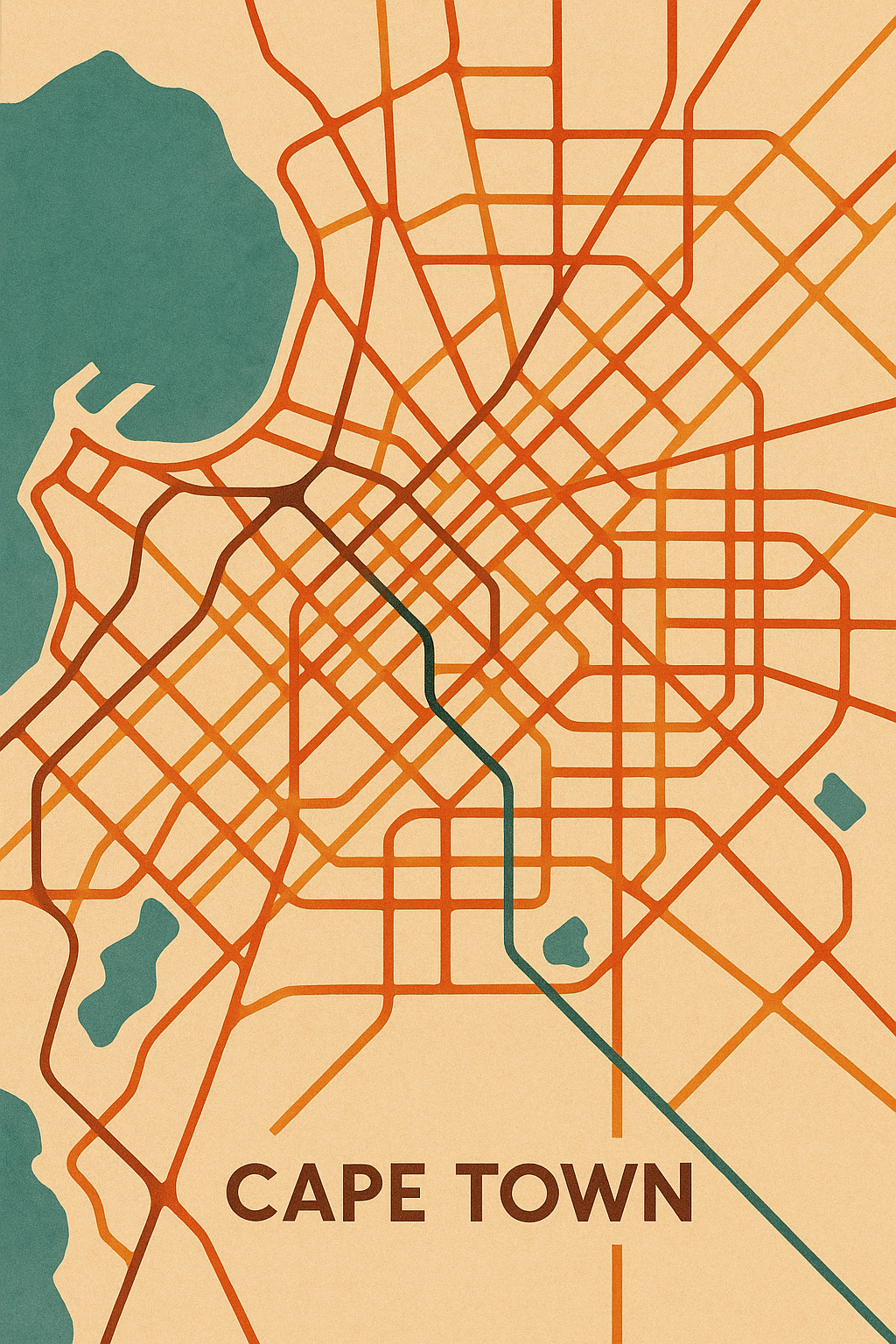
Cape Town transforms into a 21st-century African urbanism lab, pioneering innovative solutions in water, transport, housing, energy, and digital infrastructure.
Cape Town is becoming a super cool city in Africa by trying out new, smart ideas. They're fixing their water, making travel easier, and building strong power and internet systems. The city is like a big lab, always learning and making sure everyone gets a fair shot. They are doing all this while also protecting against climate change, showing other cities how to do it right.
How is Cape Town transforming into a leading African metropolis?
Cape Town is transforming into a leading African metropolis by implementing innovative strategies across various sectors. These include adopting a venture-capital approach to urban development, revolutionizing water management through demand-side initiatives and private partnerships, rewiring apartheid-era geography with integrated transport and housing solutions, and building a resilient energy and data infrastructure. The city focuses on project discipline, community equity, and climate-resilient designs.
Get Cape Town news in your inbox
Stay updated with the latest stories from the Mother City.
1. From Crisis Lab to Venture-Metro
Cape Town is no longer content to be the postcard city at the continent’s tip; it is rebranding itself as a real-time test site for what an African metropolis can become. Beneath the eye-catching rand signs - R120 billion within a decade, 130 000 construction pay-slips, a capital programme that will soon outspend Johannesburg, Ekurhuleni and Tshwane combined - lies a deeper experiment: can a local government fuse hard-nosed project discipline, born in the planet’s most competitive cities, with redistributive politics forged by apartheid’s spatial wounds, and still move faster than a slow-motion national state?
Inside the Civic Centre, 735 live projects are tracked through seventeen sequential “deal gates.” A project only graduates when it scores at least 80/100 on an “investment-logic canvas” that mixes orthodox cost-benefit ratios with metrics rarely spotted in municipal ledgers - exposure to gender-based violence, minutes of travel-time poverty, grams of carbon locked-in per resident, extra rands flowing through spaza tills. Under-performers are culled before year-end and their capital re-allocated to higher-yield schemes, mimicking a venture-capital playbook rather than the usual pork-barrel public-works queue.
The numbers are striking, yet the cultural shift matters more. Engineers, accountants and community liaisons sit side-by-side in open-plan “war-rooms,” each wall plastered with Kanban boards that track everything from methane extraction rates to graffiti response times. The mantra is simple: “Kill quickly, recycle faster, learn always.” Failure is not hidden; it is time-stamped, blockchain-sealed and used as a tutorial for the next cohort of interns.
2. Water: Turning Scarcity into Tradable Units
The Day-Zero panic of 2018 still echoes, but it also unlocked Africa’s cheapest municipal loan in a generation: R11.4 billion from the New Development Bank priced 1.2 % below Pretoria’s own borrowing rate. The catch was dual: add 150 million litres a day of new supply while slicing per-capita use by 40 %. Treasury tied every draw-down to quarterly milestones, forcing the city to treat demand as a resource in its own right.
Council did not reach for bigger dams; it sharpened the tariff curve. After 6 000 litres a month, water pricing turns hockey-stick steep, and a green-bond rebate shaves rates for households that install grey-water loops or rain-fed washing machines. Upper-income suburbs responded with a 27 % consumption drop - enough to free 35 megalitres daily, the yield of a desal plant that was never built. Engineers call it a “virtual dam” that cost zero bricks, mortar or political theatre.
On the supply side, five private water producers (IWPs) will soon feed the grid under 20-year offtake deals modelled on Eskom’s renewable rounds. The flagship Zandvliet recycling facility delivers its first 40 Mℓ/day in 2026, pre-sold to 16 vineyards and two SAB breweries that agreed to quit aquifer drilling in exchange for a 30 % discount. Cape Town keeps a 15 % equity kicker in every IWP, earning board seats and a maintenance endowment - an elegant dodge around the “fix-it-later” trap that crippled peer metros.
3. Transport & Housing: Rewiring Apartheid Geography
MyCiTi is not just a bus project; it is an attempt to re-code the city’s daily pulse. The next R4.5 billion phase pours 122 km of median busways, but the sleeper hit is dynamic tolling that nudges solo drivers off peak shoulders. Tags already in windscreens debit fees that fall in real time as bus occupancy rises; proceeds land in a “mobility wallet” redeemable for Uber-Bolt credits, bike-share passes or grocery vouchers. Early pilots on the Symphony Way–Claremont spine shifted 19 % of car users in six months, liberating 1.3 hectares of curb for 4 200 informal traders who now trade under solar canopies that return spare power to the station micro-grid.
Informal-settlement budgets usually dissolve in consultant quicksand. Cape Town flips the script by underwriting resident cooperatives through a R480 million project-finance pool run by neighbourhood NGOs. The city installs bulk pipes, roads and title-deed guarantees; cooperatives add two- or three-storey walk-ups with ground-floor commerce. The first 212 units in Mfuleni’s Extension 6 clocked in at R172 000 each - 38 % below the national benchmark - and were bonded within eight weeks through a specialist affordable-lending desk. Every unit carries a prepaid smart meter that doubles as a credit bureau: buy electricity consistently for six months and you unlock a micro-loan for night classes or a hair-salon chair, turning shelter into a springboard asset.
4. Power, Data & the 100-MW Club
National licences still cap any single municipal generator at 100 MW, so Cape Town stitches together a virtual plant already above the ceiling. Thirty-eight landfill-gas engines, 14 hospital rooftop fleets and 97 neighbourhood battery-sharing rings are scheduled as one trading block that harvests Eskom’s time-of-use gap. Coastal Park and Vissershok tips are lined with geomembranes that vacuum methane 1.8 times faster than legacy boreholes; scrubbed gas feeds 1 MW Jenbachers whose waste heat keeps leachate at 38 °C, turbo-charging bugs that make more biogas. The 32 GWh annual surplus is sold at peak and the profit cross-subsidises free-basic-power to the poor, slicing the effective cost to 88 c/kWh - 40 % cheaper than the average cash-strapped metro.
A 1 600 km city-owned fibre spine - longer than the water-pipe swap programme - runs in the same trenches to obey a “dig-once” rule that has cut broadband back-haul costs by 63 %. Low-orbit satellite gateways parked at the Culembourg data centre provide failover if subsea cables snap, keeping minibus-taxi tap-and-go fares and smart-meter cash alive. Maintenance tickets are hashed onto an internal blockchain, creating an immutable log that insurers now accept for 12-year warranty bonds - one reason the City priced R3.8 billion in green bonds 0.9 % below the JSE all-bond index.
5. Jobs, Cash & Community Equity
The 130 000 construction jobs are modelled in four waves - earth-works (30 000), assembly (45 000), digital commissioning (15 000) and 15-year maintenance (40 000). Bricklayers who lay manholes today can re-certify as CCTV-pipe pilots tomorrow; drone graduates from a township aviation school - bank-rolled by congestion-tolling profits - show a 78 % permanent-placement rate at wages 2.4 times the national minimum.
Only 38 % of the R120 billion pipeline leans on conventional rates. Sovereign and multilateral debt chips in 27 %, private water equity 19 %, development-finance institutions 11 %, impact funds 5 %, and an unexpected R6.4 billion royalty stream from leasing the City’s 800 MHz spectrum wraps up the balance. By auctioning the licence - originally earmarked for smart sensors - to mobile carriers for 12 years, Treasury banked an upfront lump sum that de-risks the entire first burst of transport corridors.
Risk itself has been democratised. Every project above R400 million births a community SPV that owns 5–10 % of the contingency reserve. Finish on time and residents cash out at an 8 % internal rate; overspend and their slice is diluted first. The grass-roots oversight has already trimmed median contract variance by 11 %, while community audit committees - trained by the Institute of Directors - now sit on payment boards once reserved for technocrats.
6. Climate Hedges & Exportable Know-How
Instead of betting on one climate future, the City runs asset models for 1.5 °C, 2.4 °C and 4 °C warming, then designs to the toughest result. Coastal trunk sewers sit 0.9 m above projected sea-level rise, while inland bridges gain extra clearance for 100-year flood levels. Bulk orders with the Port of Saldanha made 42 % fly-ash concrete and 550 MPa re-bar cost-competitive, slicing R1.2 billion off combined steel bills.
Unit costs already undercut global peers: BRT kilometres are 28 % cheaper than Bogotá and 41 % below Jakarta in purchasing-power terms. Non-revenue water is down to 15 % - approaching Singapore’s 12 % - thanks to micro-payments for residents who geo-tag leaks for a mechanical-turk AI. Nairobi, Lagos and Dakar are licensing the software, flipping Cape Town from template importer to municipal-knowledge exporter.
Locked-in milestones keep the drumbeat steady: potable-grade recycled water (20 Mℓ/day) by July 2025; Khayelitsha–Wynberg trunk completion (27 minutes peak-to-peak) by December 2026; 50 000 micro-developer homes on a blockchain title registry by March 2027; 85 % city-wide fibre penetration by September 2028; and landfill-gas exports (60 GWh) by June 2029 that may push wholesale power prices negative at off-peak hours. Each date is insured, penalty-clad and SPV-hedged, turning political headwinds into mere background noise as the city prototypes the next African century.
1. How is Cape Town innovating its urban development approach?
Cape Town is adopting a "venture-metro" approach to urban development. This means they are treating urban projects like a venture capitalist would, with a strong focus on project discipline, data-driven decision-making, and quickly reallocating resources from underperforming projects to higher-yield schemes. They use an "investment-logic canvas" to evaluate projects, considering not only financial returns but also social and environmental impacts like reduced gender-based violence exposure or travel-time poverty.
2. How is Cape Town addressing its water scarcity challenges?
Following the

Tumi Makgale is a Cape Town-based journalist whose crisp reportage on the city’s booming green-tech scene is regularly featured in the Mail & Guardian and Daily Maverick. Born and raised in Gugulethu, she still spends Saturdays bargaining for snoek at the harbour with her gogo, a ritual that keeps her rooted in the rhythms of the Cape while she tracks the continent’s next clean-energy breakthroughs.
View all articles →