
Cape Winelands Airport nears final approval, landowner appeals pending
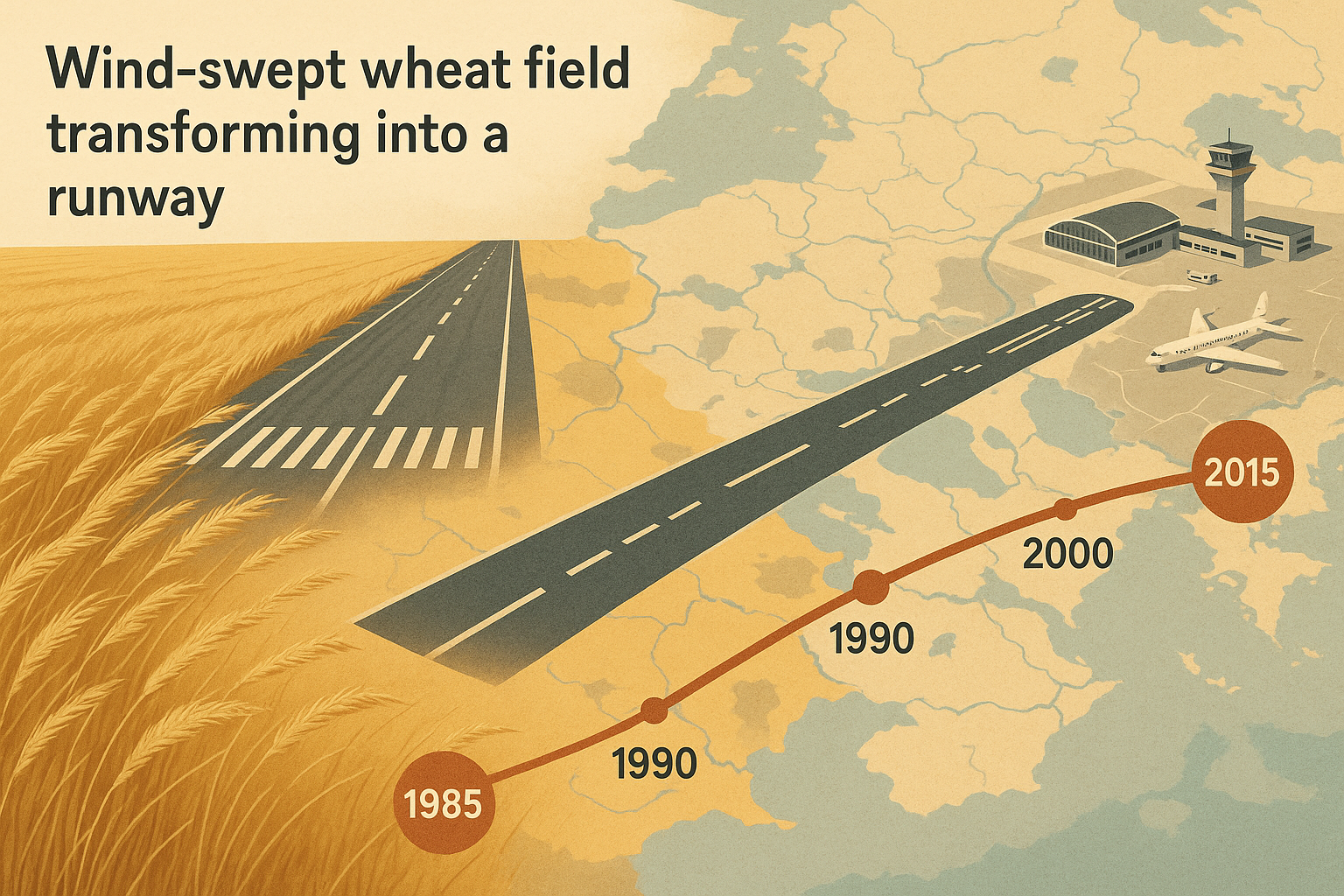
Uncover how Cape Winelands Airport's 3200m runway is transforming South Africa's aviation, from design to economic and environmental impact.
A quiet farm in Karoo is turning into a huge airport. It will have a massive runway and and bring lots of planes and goods to Southern Africa. This new airport will change how people travel and move things around, making the area a big hub for flights. It's a huge change from wheat fields to a busy transport center.
What is the new "strategic transport node" in the Karoo?
The new "strategic transport node" is a former agricultural holding in the Karoo, now being developed into a major airport. This 1,617-hectare site, near Vleiplaas, will feature a 3,200m runway, aiming to become a logistics hub for Southern Africa and significantly increase regional air traffic.
Get Cape Town news in your inbox
Stay updated with the latest stories from the Mother City.
1. The field that learned to think like a runway
Stand on the northern edge of what used to be Vleiplaas at harvest time and the silence feels almost theatrical: pale stubble stretches away, a lone tractor putters along the R101, yet the dirt beneath your shoes is already denser than many fully-fledged runways. Contractors have rammed it to 98 % MOD AASHTO - the same benchmark used for the Dreamliner strip at Ethiopia’s Bole - while 55 km of geotextile lies stitched through the sub-grade like mesh under skin grafts. Ground crews talk about “pre-loading” and “differential settlement” the way vintners discuss malolactic fermentation.
The title deed still labels the place “agricultural holding,” but the provincial spatial-data portal tells a different story. In September 2025 the polygons flicked from ochre to bright blue: “strategic transport node.” Overnight, 1 617 ha bought for just over a billion rand in 2017 is expected to quadruple in value - the same alchemy that juiced KwaZulu-Natal’s Dube TradePort sixteen years earlier.
Behind the scenes sits Paternoster Properties, an odd-couple marriage of retired Sanlam structural engineers and Stellenbosch venture capital that saw farmland and pictured a logistics vertebrae for the continent’s south-west corner. Their bet is that the first spray of asphalt will merely formalise what the soil already knows.
2. Three kilometres of concrete aimed at the Indian Ocean
Length alone seldom thrills airport planners - South Africa already boasts 138 strips - but 3 200 m of CAT 9F pointing 09/27 is another conversation. The bearing aligns almost perfectly with the summer south-easter that barrels across False Bay, shaving average cross-wind to under 12 knots for 94 % of daylight. Airbus performance geeks ran the numbers and discovered an A350-900 regional could top up 65 t of fuel, punch into a 40-knot head-wind and still reach Mumbai without cooking the tyres on lift-off. No inland runway south of OR Tambo can match the claim.
RSA Aero, the special-purpose vehicle steering the build, has already asked IATA to reserve slots for winter 2028. The wish-list is short, regional and point-to-point: eighteen daily shuttles to Cape Town, four to Plettenberg Bay, three up to Walvis Bay, a pair to Maputo and a daily hop to Livingstone. None exist today from the Winelands basin, and leaked ACSA modelling suggests George could kiss goodbye to 22 % of its transfer traffic within three years if even half the routes survive the first balance-sheet winter.
Critics call the business case a gamble on leisure traffic; supporters argue it is a calculated move to peel off the coast-hugging traveller who currently back-tracks 450 km to reach the Garden Route. Either way, the map of southern skies is about to tilt inland.
3. Decibels, drought and dendrology: the battles you don’t see from 35 000 ft
Noise came first on the objection roll. The 55 DNL contour blankets only 14,3 km² - an aviation teardrop that barely licks the edge of Greenville Garden City, a 1990s low-cost housing scheme. Of 1 047 residents inside the contour, 82 % signed up as I&APs; six lodged formal appeals. What seldom makes headlines is that chickens stood to lose more sleep than people: Sovereign Foods’ nearest abattoir sits 1,8 km beyond the 45 DNL line, yet studies from São Paulo show layers exposed to 78 dB(A) fly-overs drop 4 % fewer eggs. The fix is a night curfew (23:00-05:30) and a preferential departure path over the uninhabited quartzite spine of Paarl Mountain - already baked into a notarial deed that survives any future sale.
Water triggered the next brawl. A single wide-body turnaround can swallow 18 000 ℓ - catering, toilets, de-ice drills - so 24 peak-hour movements could drain four Olympic pools daily. The Berg River system is closed to new allocations until 2035, forcing developers to craft a closed-loop wetland: 2,4 ha of engineered reed cells fed by storm water and treated effluent, scrubbing ammonium down to <0,3 mg/ℓ before it sees the pumps again. Boreholes into the Table Mountain aquifer will top up the remaining 35 %, provided real-time telemetry keeps the Department of Water & Sanitation in the loop for the life of the asset.
Then came the oak. A 37 m English oak planted in 1842 - older than the first Afrikaans Bible translation - squats where the GA access road wants to bend. Geofoam might save it, say the engineers; soil asphyxia will slowly kill it, counters a Belgian dendrologist. A single clause in the National Forests Act, untested in two and a half decades of planning law, lets the forestry minister slam the brakes if a tree bears “spiritual significance.” A ruling is due within sixty days; lose the case and RSA Aero must reroute, sacrificing a R54 million slice of commercial real estate and triggering weekly penalties of R1,7 million. Insurance brokers are chewing antacids.
4. Jobs, bytes and barrels of Pinotage: the ripple no spreadsheet predicted
Forget the tired promise of 17 000 construction boots. The number that turns heads is 120 - agricultural science graduates who will earn R28 000 a month hunting foreign-object debris, ICAO certificate in hand, ready to staff airports from Dubai to Singapore. Another 68 former Klapmuts farmhands have already logged 240 hours of North-American-certified solar training inside a Franschhoek wine cellar; they will bolt together the 11 000 m² PV carport, panels sourced from ART Solar down the road to keep Treasury’s local-content auditors smiling.
Data, not grapes, may yet be the runway’s shiniest crop. A 144-fibre spine tucked under the first 600 m of pavement will hook a modular Tier-III server room to Google Cloud’s Brackenfell edge node, trimming EUROCONTROL latency to 78 milliseconds. Every kilogram shaved from an optimised cruise level saves 4,2 US cents per hour; on a daily Emirates uplift that micro-commission funds the entire fire-station payroll before the wheels leave the ground.
And then there is the wine. A 2 400 m² walk-through vinothèque - think Munich’s beer hall with terroir - will crush, ferment and bottle airside while passengers queue for passport stamps. Because the EU partnership agreement rebates 1,7 % duty on exports, a bottle sealed beyond security could undercut Waterfront duty-free by 11 % and still leave margin for the airport. Lourensford, Meerlust and Kanonkop have applied for bonded status; the first harvest flight may well be toasted with its own produce.
First concrete is already spoken for. On 3 March 2028 a Dash 8-400 will thunder off at dawn bound for Plettenberg Bay, every seat pledged: investors, journalists, influencers and four charity bidders who pushed past R180 000 for the privilege of having their names stencilled on the inaugural bag-loader. A former wheat field will officially graduate to gateway - quietly, thoroughly, and on its own terms.
[{"question": "What is the new \"strategic transport node\" in the Karoo?", "answer": "The new \"strategic transport node\" is a former agricultural holding in the Karoo, now being developed into a major airport. This 1,617-hectare site, near Vleiplaas, will feature a 3,200m runway, aiming to become a logistics hub for Southern Africa and significantly increase regional air traffic. \n\nThe project, driven by Paternoster Properties, is transforming what was once farmland into a crucial transport link, with the provincial spatial-data portal officially designating it a \"strategic transport node.\" This development is expected to quadruple the property's value, echoing the success of KwaZulu-Natal's Dube TradePort."}, {"question": "What are the key features and capabilities of the new airport's runway?", "answer": "The new airport will boast a 3,200m CAT 9F runway, oriented 09/27, which aligns perfectly with the prevailing summer south-easterly winds, ensuring cross-winds are under 12 knots for 94% of daylight hours. This impressive length and orientation allow for an A350-900 regional aircraft to be fully fueled (65 tons) and reach Mumbai even against a 40-knot head-wind, a capability unmatched by any other inland runway south of OR Tambo International Airport.\n\nGround preparation involved compacting the dirt to 98% MOD AASHTO, the same benchmark used for Ethiopia’s Bole airport's Dreamliner strip, and laying 55 km of geotextile for sub-grade stability."}, {"question": "What kind of air traffic and destinations is the new airport expected to handle?", "answer": "RSA Aero, the special-purpose vehicle managing the build, has requested IATA to reserve slots for winter 2028. The airport aims to offer short, regional, and point-to-point routes, including eighteen daily shuttles to Cape Town, four to Plettenberg Bay, three to Walvis Bay, two to Maputo, and a daily flight to Livingstone. These routes currently do not exist from the Winelands basin. \n\nACSA (Airports Company South Africa) modeling suggests that George Airport could lose 22% of its transfer traffic within three years if even half of these new routes become operational, indicating a significant shift in regional air travel patterns."}, {"question": "What environmental and logistical challenges did the airport project face, and how were they addressed?", "answer": "The project faced several challenges. Noise pollution was addressed with a night curfew (23:00-05:30) and a preferential departure path over the uninhabited Paarl Mountain, legally enshrined in a notarial deed. Water consumption, with wide-body turnarounds potentially using 18,000 liters, led to the creation of a closed-loop wetland system, treating stormwater and effluent, and supplementary water from the Table Mountain aquifer with real-time telemetry oversight.\n\nA significant challenge involves the 37-meter English oak planted in 1842, located where a GA access road is planned. Its potential \"spiritual significance\" under the National Forests Act could force a costly rerouting, with a ruling pending."}, {"question": "Beyond direct aviation, what economic and social impacts is the airport projected to have?", "answer": "The airport is expected to create 120 jobs for agricultural science graduates trained in foreign-object debris hunting, and 68 former farmhands trained in solar installation for the 11,000 m² PV carport. A 144-fibre spine will connect a modular Tier-III server room to Google Cloud’s Brackenfell, significantly reducing EUROCONTROL latency. \n\nNotably, a 2,400 m² walk-through vinothèque will allow for airside wine production and sales, leveraging an EU partnership agreement for a 1.7% duty rebate on exports, potentially undercutting duty-free prices elsewhere. The first harvest flight is anticipated to be toasted with its own produce, showcasing a unique integration of local industry with the new transport hub."}, {"question": "When is the airport expected to become operational, and what is its long-term vision?", "answer": "The first concrete is already allocated for use, with the inaugural flight - a Dash 8-400 bound for Plettenberg Bay - scheduled for dawn on March 3, 2028. This flight will carry investors, journalists, influencers, and charity bidders, marking the official transition of the former wheat field into a functional gateway. \n\nThe long-term vision positions the Karoo airport as a \"logistics vertebrae for the continent's south-west corner,\" aiming to redraw Southern Africa’s air map, serve as a major hub for flights, and stimulate regional economic growth by attracting leisure and business travelers, as well as facilitating efficient cargo movement."}]

Sizwe Dlamini is a Cape Town-based journalist who chronicles the city’s evolving food scene, from boeka picnics in the Bo-Kaap to seafood braais in Khayelitsha. Raised on the slopes of Table Mountain, he still starts every morning with a walk to the kramat in Constantia before heading out to discover whose grandmother is dishing up the best smoorsnoek that day.
View all articles →