
City partners with SANRAL to enhance traffic signal management in Cape Town
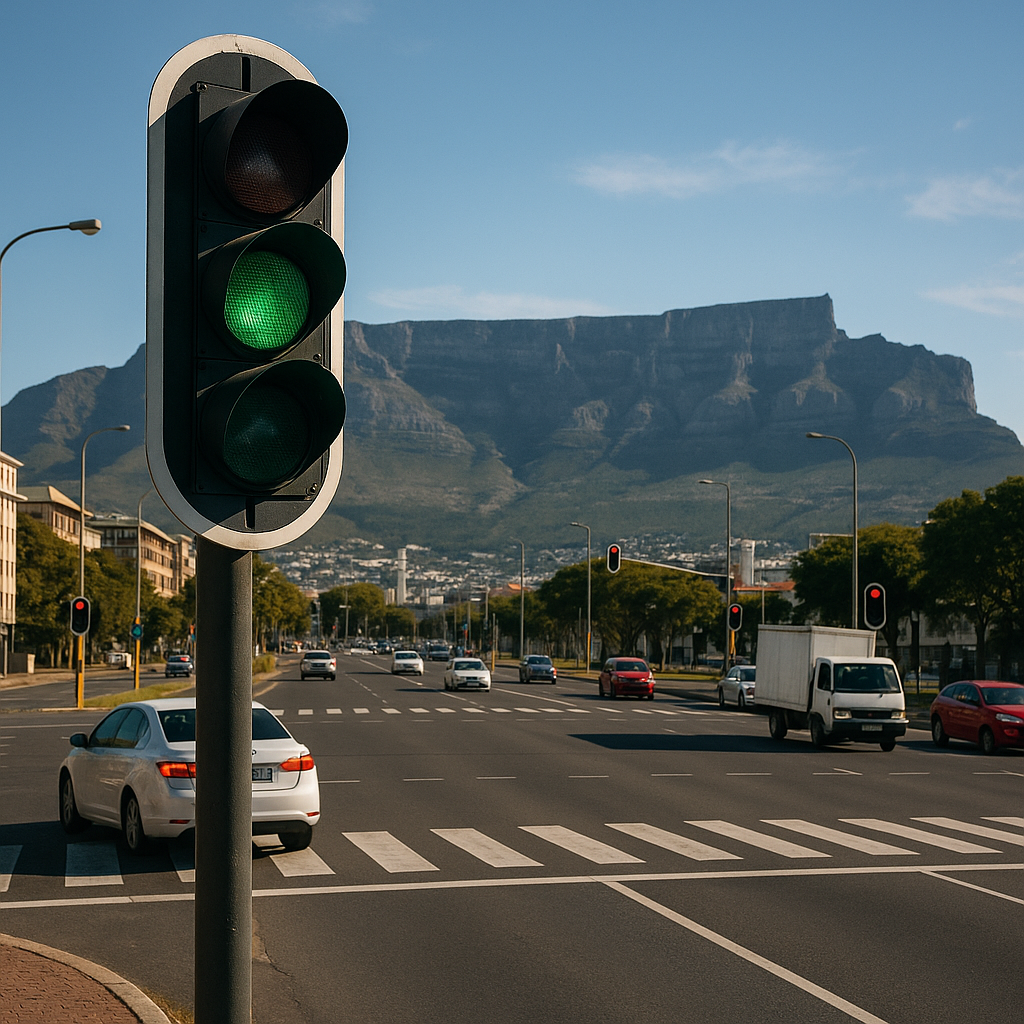
Cape Town & SANRAL partner to re-engineer city traffic. 32 key intersections get upgrades, improving flow, tech & data.
Cape Town is handing over 32 important traffic lights to SANRAL for maintenance and upgrades. This will bring in cool new tech to control traffic, share information better, and save the city money. These changes will make traffic smoother, roads safer, and help Cape Town's transport flow much better for everyone.
What changes are happening to Cape Town's traffic lights?
Cape Town is transferring 32 key traffic lights to SANRAL for maintenance and upgrades. This agreement will bring advanced traffic control technology, improve data sharing for better traffic management, and free up municipal funds. These changes aim to reduce congestion, improve safety, and enhance the city's overall traffic flow.
Get Cape Town news in your inbox
Stay updated with the latest stories from the Mother City.
1. Dawn Congestion: The Living Network That Never Sleeps
At 06:45 the city exhales: a single ribbon of tail-lights unfurls from Philippi to Paarden Eiland, stretching 19 km like a lazy cat. By 17:15 the same organism snaps shut, ramming 2.3 million daily vehicle movements into 6 400 kilometres of black-top. Directing this daily drama is a lattice of 1 560 traffic lights whose heartbeat is timed by the Area Traffic Control bunker tucked beneath the decommissioned Woodstock hospital. Thirty-two of those signals - strung along the R300, N2 and N1 - are about to swap municipal parentage for national guardianship. A three-year maintenance and upgrade compact between the City of Cape Town and SANRAL moves the purse-strings from City Hall to the national roads agency, releasing budgets, brain-power and data pipes neither side could unlock solo. The number sounds trivial - barely two percent of the metro’s robot population - yet the chosen nodes straddle almost every journey that begins or ends on the Cape Flats, the Atlantic seaboard or the Winelands corridor.
Trace the hand-over on a map and you’re staring at Cape Town’s income fault-lines. Begin at the R300’s northern hinge where it kisses the N1 near Brackenfell and cruise south: the freeway slices through packed townships (Khayelitsha, Mitchells Plain), middle-income belts (Eerste River, Strand) and smoke-stack zones (Blackheath, Airport Industria) before curling west to meet the N2 at Somerset West. Along this 42 km spine perch eighteen of the thirty-two signals, including the high-pressure crossing at Mew Way where taxis, BRT buses and school buses wrestle for 42 seconds of green every two minutes. East of the R300 the N2 itself hosts another eleven robots, among them the Junaid Alley off-ramp - scene of forty-seven rear-end smashes last year blamed on mistimed late-night phasing. The final trio hug the N1’s eastern shoulder, funnelling freight from the Huguenot Tunnel into the city’s last fresh-produce market at Epping. In short, the list is no random grab-bag; it is the capillary web through which Cape Town’s labour, food and visitors flow.
2. Money, Chips and Code: What Actually Shifts on 1 July?
Once Council ratifies the memorandum the money story flips. SANRAL already allocates R78 million a year to keep lights alive on Western Cape national roads. Until now it reimbursed the City case-by-case, a paper trail that could idle for ninety days between fault log and vendor payment. Under the new pact SANRAL swallows the entire life-cycle bill - power, bulb swaps, loop repairs, trenching, even the 4G data contracts that squirt occupancy counts to the ATC. Officials reckon off-loading thirty-two robots will free roughly R12 million over three years, enough to resurface 4.5 kilometres of collector roads or erect eighteen pedestrian-activated crossings outside schools.
Next comes the tech refresh. Every intersection will graduate to SANRAL’s Next-Generation Traffic Controller, a Linux box stuffed with adaptive algorithms cooked up by the CSIR and Stellenbosch University. Field trials on Gauteng e-roads since 2019 show the software can shrink or stretch cycle lengths in four-second ticks using live Bluetooth, Wi-Fi and magnetic signatures. A pilot at the R300/Stellenbosch Arterial chopped afternoon queues by nineteen percent and trimmed average delay from sixty-eight to forty-nine seconds within six weeks. NGTC racks also carry UPS bricks that keep the sequence alive for eight hours during load-shedding - the same gremlin that fed 1 300 crashes city-wide in 2022, says the RTMC.
Third, a data commons emerges. SANRAL’s Freeway Management System already chews on 450 CCTV streams, 180 variable-message signs and 110 vehicle-detection stations. Folding thirty-two extra controllers into that cloud gives the City a real-time reflection of what happens on the ramps that feed its arterials. When the FMS clocks a stall on the N2 westbound near the airport, the ATC can pre-emptively lengthen green on the outbound Borcherds Quarry ramp, bleeding pressure away from the runway tunnel. Conversely, if City cameras sniff a protest flare-up on Mew Way, SANRAL can cascade the alert onto Bluetooth travel-time boards as far west as Century City, letting drivers bail early to the R302 or Voortrekker Road.
3. Jobs, Frogs and Trucks: The Sparks beneath the Asphalt
The hardware swap is only half the plot. Behind the curtain the two bureaucracies are testing a governance template other metros have debated for a decade: a “concession-lite” where the road reserve stays state-owned while operations and performance risk migrate to the agency that bags the toll rand. SANRAL pockets about R3.8 billion a year from the Gauteng Freeway Improvement Project and smaller plazas; cross-subsidising thirty-two urban signals is small change, yet the precedent is mammoth. If Cape Town proves that national procurement can deliver cheaper, faster, greener kit inside a municipal border, Durban, Gqeberha and Polokwane could follow. National Treasury already tags eighty-seven signalised intersections on the N3, N4 and N14 that fit the same “high-volume, national-road, metro-adjacent” label.
Still, friction flickers. SAMWU asks why everyday repairs - once handled by City electricians - must now be tendered to private contractors screened by SANRAL. In a Council submission the union warns the deal “exports public expertise” and could trim posts among the 270 municipal artisans in Electricity and Urban Mobility. City bosses reply that no jobs will be scrapped; staff will shift to the remaining 1 528 signals where the maintenance backlog tops R420 million. To soften the blow SANRAL vows to draft sixty percent of its new maintenance crew from the City’s existing payroll and to bankroll fifteen bursaries a year for ITS diplomas at CPUT.
Green lobbyists spy a different angle. The thirty-two lights skirt eight wetlands and three critical biodiversity pockets mapped by the City’s Environmental Management branch. Because the upgrade swaps 150 W incandescent bulbs for 42 W LEDs - cutting draw by seventy-two percent - SANRAL is chasing carbon credits under the UN Clean Development Mechanism. Each junction should save 1.9 tCO₂e a year; bundled, they could spit out 365 credits over three years worth about R220 000 on the voluntary market. Modest, yes, but the loot will fund pedestrian fixes: 2.1 km of raised sidewalks along the R300 service road and a 3 m-wide footbridge at the N2/M5 split, linking Langa’s Joe Slovo settlement to the Metrorail stop and ending the dusk dash that claimed eleven lives in 2023.
Freight hauliers whisper another clause into the mix: priority phasing for heavies during the pre-dawn window when 2 200 trucks exit the harbour and march toward the N1, N7 and N12. Trials in Australia and Brazil show that granting trucks an extra six to eight seconds of green each cycle between 03:00 and 05:30 can flatten the morning peak by dispersing queues before commuters wake. SANRAL is modelling the idea, but admits it needs tamper-proof mass detection and a noise exemption because longer greens shunt truck acceleration closer to bedrooms.
4. Digital Twins and Invisible Dividends: The Quiet Pay-off
Look further out and the data harvested from the thirty-two nodes will nourish the City’s fledgling Digital Twin - an ESRI-powered 3-D mesh that fuses aerial photos, IoT pings and BIM layers to mirror traffic, power and water in real time. Once calibrated, planners can game policies such as congestion pricing, low-emission zones or a harbour curfew without pouring concrete. Early runs hint that a R7.50 toll on the N2 inbound between 06:30 and 08:30 could slice peak demand by fourteen percent, but only if Metrorail capacity jumps forty percent - insight that once demanded months of spreadsheet agony.
For the everyday commuter the earliest dividend will be almost invisible: fewer pings on the “Traffic – Cape Town” WhatsApp group lamenting “the robots at Borcherds Quarry & N2 are dead again.” Instead, fault tickets will auto-spawn in SANRAL’s SAP the instant voltage dips below 220 V, tripping a level-1 response SLA of forty-five minutes by day, ninety by night. Gauteng experience shows mean-time-to-repair drops from thirty-eight hours to eleven, translating into roughly 900 fewer vehicle-hours of delay per incident. Multiply that across 120–150 annual faults per robot and the city wins back the equivalent of eighteen working days of human productivity each year - an unseen pulse that keeps the economic heart beating, one green light at a time.
[{"question": "What are the main changes happening to Cape Town's traffic lights?", "answer": "Cape Town is transferring 32 key traffic lights to SANRAL for maintenance and upgrades. This initiative aims to integrate advanced traffic control technology, enhance data sharing for improved traffic management, and reallocate municipal funds. The expected outcomes include reduced congestion, increased road safety, and a more efficient overall traffic flow in the city. SANRAL will take over the full life-cycle costs, including power, maintenance, and data contracts."}, {"question": "Which specific traffic lights are being transferred and why are they important?", "answer": "Thirty-two traffic lights are being transferred, primarily located along the R300, N2, and N1. These nodes are strategically important because they facilitate almost every journey originating or ending on the Cape Flats, the Atlantic Seaboard, or the Winelands corridor. They serve as critical arteries for the city's labor force, food supply, and visitors, including high-pressure intersections like Mew Way and the Junaid Alley off-ramp, which has seen numerous accidents due to mistimed phasing."}, {"question": "What technological upgrades will be implemented with this change?", "answer": "Every transferred intersection will be upgraded to SANRAL's Next-Generation Traffic Controller, a Linux-based system utilizing adaptive algorithms developed by the CSIR and Stellenbosch University. These controllers can dynamically adjust traffic light cycle lengths based on real-time traffic data from Bluetooth, Wi-Fi, and magnetic signatures. They also include UPS units to maintain operation for up to eight hours during load-shedding, addressing a common cause of traffic incidents."}, {"question": "How will data sharing improve under this new agreement?", "answer": "The integration of these 32 controllers into SANRAL's Freeway Management System (FMS) will create a comprehensive data commons. The FMS already processes data from 450 CCTV streams, 180 variable-message signs, and 110 vehicle-detection stations. This expanded data will provide the City with real-time insights into traffic conditions on ramps feeding its arterial roads, allowing for proactive adjustments like lengthening green lights to ease congestion or re-routing traffic during incidents."}, {"question": "What are the financial and economic benefits of this transfer?", "answer": "SANRAL will fully cover the maintenance and upgrade costs, freeing up approximately R12 million over three years for the City of Cape Town. This saving can be reinvested into other municipal infrastructure, such as resurfacing roads or building pedestrian crossings. While SANRAL's annual budget is substantial, this agreement sets a precedent for other metros to potentially adopt similar 'concession-lite' models, leveraging national procurement for more efficient, cost-effective infrastructure upgrades."}, {"question": "Are there any environmental or social impacts to consider?", "answer": "Environmentally, the upgrade involves replacing 150 W incandescent bulbs with 42 W LEDs, cutting power consumption by 72%. This will save 1.9 tCO₂e per junction annually, potentially generating carbon credits that could fund pedestrian infrastructure improvements, like raised sidewalks and a new footbridge, addressing safety concerns in high-risk areas. Socially, there are concerns from SAMWU about job security for municipal electricians, though the City states no jobs will be cut, and SANRAL plans to recruit existing staff and offer bursaries. Additionally, there are considerations for priority phasing for freight trucks during off-peak hours to ease congestion, requiring careful planning to manage noise and ensure effectiveness."}]

Liam Fortuin is a Cape Town journalist whose reporting on the city’s evolving food culture—from township kitchens to wine-land farms—captures the flavours and stories of South Africa’s many kitchens. Raised in Bo-Kaap, he still starts Saturday mornings hunting koesisters at family stalls on Wale Street, a ritual that feeds both his palate and his notebook.
View all articles →