
Could the Foreshore Freeway become a rail corridor?
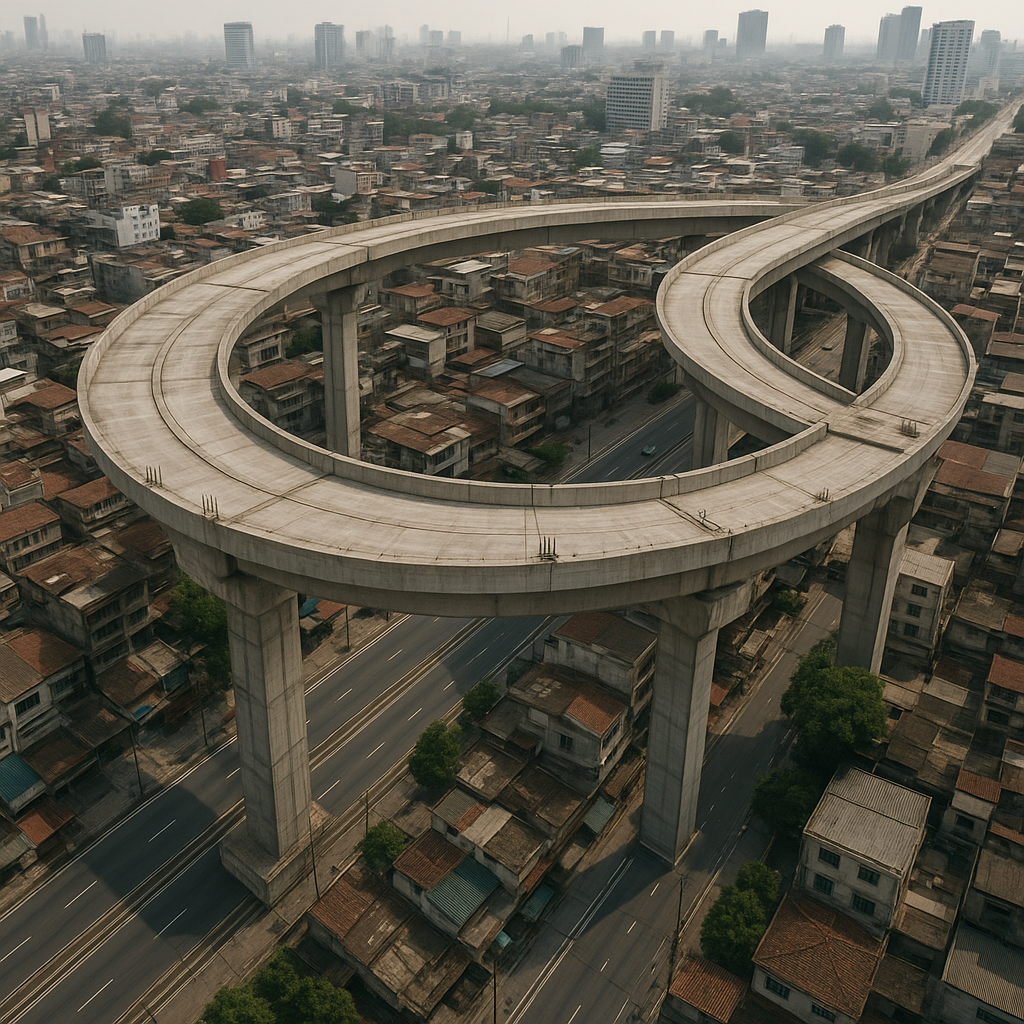
Cape Town's unfinished Foreshore Freeway could be transformed into a groundbreaking rail system, redefining urban mobility in South Africa.
Cape Town's unfinished Foreshore Freeway, a symbol of stalled ambition for decades, is now at the heart of a bold new vision for urban mobility. A proposal called CapetrainExpress suggests turning these concrete skeletons into an elevated heavy rail system. This isn't just about trains; it's a revolutionary idea to connect divided communities, create economic opportunities, and tackle climate change. By transforming this ghost highway into a modern rail network, Cape Town could lead South Africa towards a greener, more equitable urban future.
What is the main reason Cape Town's Foreshore Freeway was never completed?
Cape Town's Foreshore Freeway halted construction in the early 1970s primarily because officials couldn't agree on its termination point and integration with existing street networks. This uncertainty reflected deeper ambivalence about urban spatial organization during apartheid, leaving the structures incomplete and frozen in time for decades.
Get Cape Town news in your inbox
Stay updated with the latest stories from the Mother City.
Perched above the city's bustling harbor district, the truncated concrete pillars and abruptly terminated viaducts of Cape Town's Foreshore Freeway have stood as perhaps the most photographed symbol of incomplete infrastructure in the Southern Hemisphere. For nearly half a century, these skeletal remains of 1970s urban planning have provoked curiosity, frustration, and endless speculation about what might finally complete the picture. Yet emerging from the digital discourse of concerned citizens comes a provocative reimagining that threatens to transform this monument to stalled ambition into the cornerstone of South Africa's most ambitious public transportation revolution.
The proposal, circulating through social channels under the CapetrainExpress banner, represents something far more significant than a simple infrastructure alternative. It constitutes a fundamental philosophical pivot in how African cities might confront the enduring legacy of automobility-centric development that has characterized urban expansion across the continent since independence.
The Ghost Highway: Understanding Apartheid's Abandoned Legacy
To comprehend the revolutionary nature of this proposal, one must first understand the peculiar circumstances that birthed this concrete ghost. The Foreshore Freeway project commenced in the early 1970s as part of a comprehensive highway scheme designed to modernize Cape Town's central business district connectivity. However, the initiative encountered obstacles that transcended mere budgetary constraints or engineering challenges.
The construction halted primarily because officials could not resolve fundamental questions about where precisely the highway should terminate and how it would integrate with existing street networks. This uncertainty reflected deeper ambivalence about urban spatial organization during apartheid's twilight years, when international isolation and domestic resistance increasingly complicated grandiose state projects. The unfinished structures became frozen in time, neither demolished nor completed, occupying a liminal space that somehow outlasted the political system that conceived them.
In the decades since, various administrations have periodically revived completion studies, typically estimating costs in the multibillion-rand range. Meanwhile, the structures have acquired unexpected cultural significance, serving as backdrop for films, photography exhibitions, and even extreme sports endeavors. Their very incompleteness became aesthetically compelling, a concrete poem about the limits of technocratic ambition.
From Asphalt to Rails: Technical Superiority of the Conversion Vision
The proposed conversion to elevated heavy rail infrastructure presents compelling technical arguments that extend beyond mere ideological preference for public transportation. Contemporary rail viaduct construction can achieve significantly greater capacity per unit of infrastructure investment than highway expansion. A dedicated heavy rail corridor along the foreshore alignment could accommodate twelve to sixteen trains per hour in each direction, potentially moving 50,000 passengers hourly during peak periods.
This capacity substantially exceeds what even a completed six-lane freeway could provide, given that private vehicles typically carry average occupancies below 1.5 persons during commuting periods. The rail proposal thus addresses capacity constraints through spatial efficiency rather than territorial expansion, a crucial consideration in densely developed coastal cities where land availability commands premium valuations.
Moreover, the existing structural foundations, while designed for highway loading specifications, potentially offer adaptive reuse opportunities. Geotechnical assessments would determine precise retrofitting requirements, but the vertical support infrastructure represents sunk capital that any rational infrastructure planning should evaluate for repurposing rather than abandonment.
Connecting the Divided City: Transit Justice and Economic Opportunity
The proposal's most sophisticated dimension involves its integration with transit-oriented development principles that have reshaped urban planning discourse globally. The foreshore precinct, currently characterized by surface parking facilities and underutilized industrial parcels, presents exceptional opportunities for higher-density mixed-use development should high-capacity rail connectivity materialize.
This development potential carries particular significance given Cape Town's acute affordable housing crisis and its infamous status as one of the world's most spatially unequal cities. The apartheid legacy bequeathed a metropolitan structure wherein black and coloured populations remain concentrated in peripheral townships - Khayelitsha, Mitchells Plain, Gugulethu, Langa - separated from economic opportunity by distance and inadequate transportation.
The proposed rail corridor would directly connect these communities to the central employment district, potentially reducing average commuting times that currently exceed ninety minutes each way for many residents. This temporal redistribution constitutes a form of economic redistribution, liberating hours currently lost to transportation for productive or recreational purposes.
Furthermore, the development potential around new station locations could generate value capture mechanisms to finance affordable housing mandates. International precedents from Hong Kong's MTR Corporation to London's Crossrail demonstrate how transportation infrastructure can generate development premiums that subsidize social objectives, breaking the false dichotomy between financial sustainability and equitable access.
Climate Action and Environmental Justice: The Green Imperative
South Africa's transportation sector constitutes approximately one-tenth of national greenhouse gas emissions, with private vehicles representing the fastest-growing component. The country's commitments under the Paris Agreement and its own National Development Plan establish ambitious targets for emissions reduction that cannot be achieved without fundamental transformation of urban mobility patterns.
The rail proposal aligns with these imperatives through electrification potential that leverages South Africa's existing heavy rail manufacturing capabilities and could eventually integrate with renewable energy procurement. Electric rail systems achieve energy efficiencies per passenger-kilometer that exceed internal combustion automobiles by factors of four to eight, depending on occupancy and generation sources.
Beyond direct emissions, the modal shift from private vehicles to rail reduces urban heat island effects, particulate pollution, and noise pollution that disproportionately burden communities adjacent to transportation corridors. These environmental justice considerations complement the climate calculus, demonstrating how infrastructure decisions cascade through multiple dimensions of urban quality.
Building the Possible: Governance, Finance, and Global Lessons
Realizing this vision requires navigating complex institutional terrain involving national rail operator Transnet, metropolitan transportation authority Transport for Cape Town, provincial government, and private sector partners. The current fragmentation of transportation governance in South African cities presents obstacles that have historically compromised integrated planning.
However, recent regulatory developments, including the expansion of municipal competencies for rail infrastructure and the emergence of public-private partnership frameworks for transportation, create enabling conditions that did not exist during previous decades of foreshore planning. The proposal's proponents would need to construct sophisticated financing structures potentially incorporating green bonds, development impact bonds, or infrastructure development zones that capture incremental tax revenues from precinct revitalization.
International financial institutions, including the Green Climate Fund and multilateral development banks with South African operations, have demonstrated growing appetite for urban rail projects that demonstrate climate co-benefits and equitable development outcomes. The proposal's alignment with Sustainable Development Goals concerning sustainable cities, reduced inequalities, and climate action positions it favorably for concessional financing that could offset capital requirements.
Cities worldwide have confronted similar decisions regarding abandoned or underutilized elevated infrastructure, generating precedents that inform Cape Town's deliberations. New York's High Line, perhaps the most celebrated example, transformed disused railway viaduct into linear park, though critics note its role in accelerating gentrification rather than addressing transportation needs.
More relevant perhaps are cases where highway-to-rail conversions have occurred. Seoul's removal of the Cheonggyecheon elevated expressway, while replacing it with surface waterway rather than rail, demonstrated how freeway removal could proceed without catastrophic traffic impacts. Paris's conversion of the Petite Ceinture railway to recreational use, conversely, illustrates how transportation infrastructure can evolve toward alternative public benefits.
Most instructive may be the experience of Latin American cities that confronted automobile-centric development patterns during comparable periods of democratic transition and urban growth. Medellín's Metrocable system, Bogotá's TransMilenio bus rapid transit, and Santiago's expanding metro network all demonstrate how high-capacity public transportation can reshape urban spatial structure and social inclusion when pursued with sufficient political commitment and technical sophistication.
The Path Forward: From Viral Idea to Urban Transformation
The social media response to the CapetrainExpress proposal, as reported, reveals predictable polarization between advocates of automobile accessibility and proponents of public transportation investment. Yet this apparent binary obscures more nuanced questions that serious deliberation must address.
What combination of complementary measures - demand management, paratransit integration, active transportation infrastructure - would optimize the rail investment? How can community participation shape station area development to prevent displacement of existing residents? What phasing strategy minimizes disruption during construction while delivering early benefits?
These questions cannot be resolved through viral advocacy alone. They require sustained engagement among urban planners, transportation engineers, community organizations, environmental scientists, and financial specialists. The proposal's value lies less in its specific technical configuration than in its demonstration that alternatives exist to the default option of completing a highway conceived in radically different social and environmental circumstances.
The foreshore structures have waited decades for resolution. Perhaps their ultimate purpose was never to carry automobiles but rather to provoke precisely this reconsideration of urban futures. In their stubborn persistence, they have outlasted the political and economic assumptions that created them, standing ready to serve purposes that their original designers could not have imagined.
What is the CapetrainExpress proposal?
CapetrainExpress is a bold new vision to transform Cape Town's unfinished Foreshore Freeway into an elevated heavy rail system. This proposal aims to connect divided communities, create economic opportunities, and tackle climate change by establishing a modern rail network in place of the dormant highway structures.
Why was Cape Town's Foreshore Freeway never completed?
The Foreshore Freeway halted construction in the early 1970s primarily because officials could not agree on its termination point and how it would integrate with existing street networks. This uncertainty reflected deeper ambivalence about urban spatial organization during apartheid, leaving the structures incomplete and frozen in time.
What are the technical advantages of converting the freeway to heavy rail?
Converting the freeway to an elevated heavy rail system offers significant capacity advantages, potentially moving 50,000 passengers hourly during peak periods, which far exceeds what a completed six-lane freeway could provide. It also offers spatial efficiency and the opportunity to reuse existing structural foundations, representing sunk capital that can be repurposed.
How would CapetrainExpress address social inequality and economic opportunity in Cape Town?
The proposed rail corridor would directly connect peripheral townships, where black and coloured populations reside, to the central employment district, significantly reducing long commuting times. This would liberate hours for productive or recreational purposes, acting as a form of economic redistribution. Additionally, development around new stations could generate value to finance affordable housing.
What are the environmental benefits of the CapetrainExpress proposal?
The CapetrainExpress proposal aligns with climate action goals by offering an electrified transportation solution. South Africa's transportation sector is a major contributor to greenhouse gas emissions, and electric rail systems are far more energy-efficient than private vehicles. A modal shift to rail would also reduce urban heat island effects, particulate pollution, and noise pollution.
What challenges does the implementation of CapetrainExpress face?
Realizing this vision requires navigating complex institutional terrain involving various government bodies and private sector partners, as transportation governance in South African cities is often fragmented. Financing is another challenge, though the proposal's alignment with climate and equitable development goals makes it favorable for green bonds, development impact bonds, and international concessional financing.

Isabella Schmidt is a Cape Town journalist who chronicles the city’s evolving food culture, from Bo-Kaap spice merchants to Khayelitsha microbreweries. Raised hiking the trails that link Table Mountain to the Cape Flats, she brings the flavours and voices of her hometown to global readers with equal parts rigour and heart.
View all articles →