
Deadline extended for public input on controversial Pinelands development
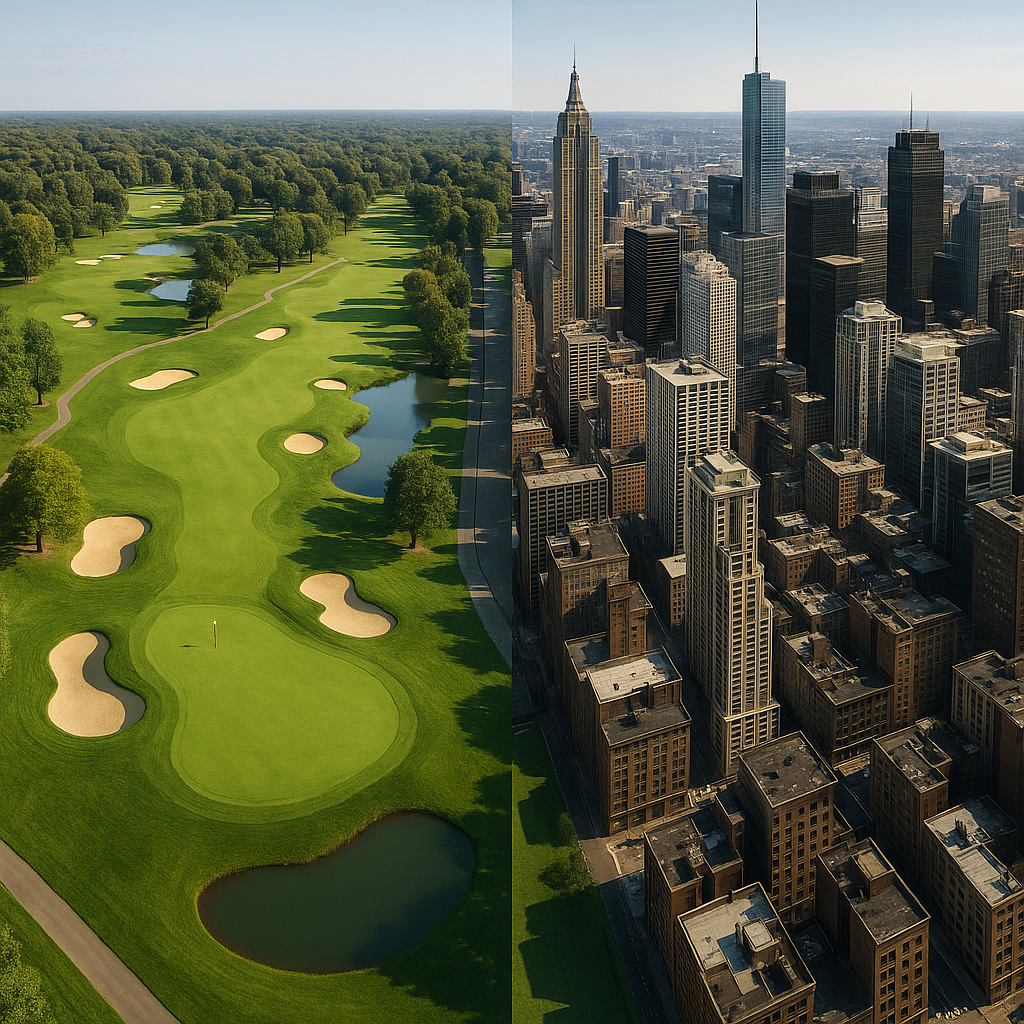
Cape Town's King David Mowbray Golf Club faces redevelopment into a mini-city, sparking fierce debate over housing, ecology, and heritage.
Cape Town's King David Mowbray Golf Club is at the heart of a huge fight. Developers want to build thousands of homes and shops on the green space, but people are angry. They worry about not enough truly affordable homes, hurting nature, crazy traffic, and kicking out disabled sports and a historic soccer club. It's a big mess, with everyone from neighbors to politicians taking sides, making it a fiery battle for the city's future.
What is the controversy surrounding the King David Mowbray Golf Club redevelopment?
The King David Mowbray Golf Club (KDM) redevelopment plan in Cape Town is controversial due to contested land ownership, lack of genuinely affordable housing, environmental concerns over green space loss and aquifer impact, increased traffic, and the potential displacement of disabled sports and a historic football club. The proposal faces significant local opposition and regulatory hurdles.
Get Cape Town news in your inbox
Stay updated with the latest stories from the Mother City.
The Deadline That Ignited a City
Cape Town's Planning and Environment Department published a brief announcement on 28 June that would ripple far beyond its modest wording. The notice extended public participation for the King David Mowbray (KDM) Golf Club precinct plan by 31 days, ostensibly to permit more thorough civic examination. What followed exposed every fault line in post-apartheid urban politics: contested land ownership, desperate housing needs, environmental fragility, and sporting identity in a metropolis branding itself "Africa's golf capital."
Within two days, five neighbourhood associations, two disability-rights practices, and former Springbok rugby players submitted new objections. WhatsApp coalitions mushroomed from 30 to 1,300 participants. Estate agents in Pinelands recorded a 17% surge in property viewings as speculators positioned themselves. The City's digital services platform temporarily collapsed under 6,000 simultaneous document uploads. Rather than simply granting additional time, the extension transformed smouldering discontent into an inferno of civic mobilisation.
The Blueprint for a Mini-Metropolis
Mowbray Gateway (Pty) Ltd - an investment vehicle 40% controlled by a Swedish infrastructure fund - seeks to transform 117 hectares of fairways and greens into a dense urban settlement. Their vision encompasses 6,700 residential dwellings concentrated at 180 units per hectare across an 18-hectare central zone, 150,000 square metres of commercial, life-science and logistics accommodation, an artificial lake rising 12 metres to serve dual purposes as water retention and stormwater management, 4,200 vehicle parking spaces, and a two-kilometre cycling boulevard branded an "active mobility spine."
The housing proposal contains no dedicated social housing whatsoever. While developers label 30% of apartments as "inclusionary housing" with price caps of R950,000, this threshold remains inaccessible to typical Pinelands domestic workers seeking mortgages. The mathematics reveal a gap between development rhetoric and genuine affordability that critics argue renders the inclusionary label essentially cosmetic.
Pinelands: From Segregation Buffer to Urban Lung
Richard Stuttaford designed Pinelands in 1919 drawing from Ebenezer Howard's garden-city philosophy, reserving it exclusively for white residents until 1976. When Group Areas legislation fell, the suburb retained its unusual concentration of recreational grounds - golf courses and bowling greens - that had historically insulated white householders from neighbouring Langa and Bonteheuwel. This buffer, originally engineered for separation, now functions as something quite different: among the final significant green spaces in a metropolitan region providing merely four square metres of vegetation per resident against United Nations recommendations of eighteen.
Professor Sheetal Kasan, an urban climatologist at the University of Cape Town, warns that stripping away this turf could elevate nighttime temperatures across a three-kilometre radius by as much as 2.1°C through lost evaporative cooling. For a city confronting days exceeding 42°C by 2035, this constitutes not an incidental concern but a pressing health crisis affecting vulnerable populations.
Infrastructure Already at Breaking Point
The N2/M5 interchange adjacent to KDM currently handles 183,000 vehicles each weekday. Developer projections anticipate 26,000 additional morning peak trips, yet SANRAL's 2022 capacity assessment places existing traffic at 0.92 saturation - any figure surpassing 0.90 produces what engineers term "recurrent breakdown flow." The practical consequence: Mowbray and Langa on-ramps seizing 35 minutes earlier daily, diverting overflow through Pinelands' narrow heritage streets with their 30 km/h limits.
Mike Flax's observation that "this won't affect just golfers, it will hit anyone who breathes exhaust fumes on the N2" understates rather than exaggerates the situation. Municipal transport planners acknowledge privately that necessary upgrades - a collector-distributor network and tidal-flow bus priority - lack funding until 2031/32, four years after the initial 2,300 residences are slated for occupation.
An Unsung Arena for Adaptive Sport
South Africa's disabled golf community punches internationally above its weight: the nation remains Africa's sole medal-winner at the World Disabled Golf Championship (2019, Trilby Tour). This entire talent pathway funnels through KDM. Its accessible pathways, modified tee positions, generous fairway widths, and single-level clubhouse - upgraded with R2.3 million from the National Lotteries Commission - enable 1,100 competitors with amputations, visual impairments, cerebral palsy and Down syndrome to compete equitably.
Enver Hassen, chairing the South African Disabled Golf Association, details their reach: "We train 84 coaches across seven provinces; 62% come from Quintile 1–3 schools. Remove the course and you orphan an entire ecosystem." The nearest comparable facility sits at Humewood Golf Club in Gqeberha - 700 kilometres distant. Redevelopment would effectively banish disabled golf from the African continent.
The Football Legacy Nobody Wants to Evict
Clyde Pinelands FC competes in SAFA's Second Division, distinguished as the country's only amateur outfit to have produced three national team captains (1924, 1937 and 1955). Their stone grandstand, constructed in 1902 by Italian prisoners of war, accommodates 2,000 spectators and carries provincial heritage status. The club holds lease rights to the golf course's southern reaches until 2034, though Mowbray Gateway has inserted a "precautionary termination" clause permitting eviction upon construction commencement.
Secretary Gavin October emphasises their contribution: "We've produced 18 players who signed professional contracts overseas. The pitch is our life. You cannot manufacture 122 years of soil composition and neighbourhood children's aspirations." The emotional and developmental value embedded in this unassuming ground resists easy quantification.
The Housing Numbers That Don't Add Up
Cape Town confronts a queue of 365,000 families awaiting homes. The KDM proposal advertises 2,010 "affordable" apartments, yet the financing reveals structural inadequacy. A 55-square-metre two-bedroom unit priced at R875,000 demands monthly bond repayments of R12,000 - triple what an R18,000-earning household (the proposal's target demographic) can manage after essential expenses. The City's own 2023 housing framework concedes that "affordable" without bridging subsidies amounts to "market-rate by stealth."
Municipal records meanwhile identify 14 underexploited City-owned plots within eight kilometres of KDM - collectively 190 hectares - already zoned for mixed use with services in place. Activists pose an obvious question: why not prioritise construction there?
Hidden Environmental Liabilities
The golf course sits atop the Cape Flats Aquifer, a sandy underground reservoir of 630 cubic kilometres supplying eight million cubic metres annually to municipal water networks. Eliminating 60% of grass cover, compacting soils for basement construction, and installing 37 kilometres of new stormwater infrastructure will, according to World Wide Fund for Nature modelling, reduce aquifer recharge by up to 11%. During 2018's catastrophic drought, this identical aquifer sustained Cape Town; forfeiting 88 million cubic metres across the coming decade represents hydrological recklessness.
A second overlooked cost involves biological diversity: fairways harbour seventeen indigenous geophytic orchid species, three found nowhere else on the Cape Flats. The environmental impact report dismisses these as "locally common" - terminology borrowed from a 1966 botanical survey since superseded by SANBI's 2009 Red List, which classifies them as vulnerable.
Foreign Capital, Local Facade, Century-Long Lease
Mowbray Gateway's ownership structure nests carefully: 40% Länsförsäkringar Liv (Swedish insurance), 35% local property consortium Ardentown, 25% KDM members' trust. The trust's involvement proved decisive in securing a 99-year lease over "surplus" municipal land in 2004, when valuation reached R35 million. That same parcel now commands an estimated R1.8 billion.
Observers characterise this as textbook "financialisation of green space": acquire cheaply through trust mechanisms, hold strategically, then monetise through special-purpose vehicles following zoning upgrades. The City receives merely a one-off "development contribution" of R197 million - roughly 1% of projected end value of R18 billion.
Regulatory Obstacles and Legal Entanglements
Pinelands carries dual heritage protections: a Grade A urban conservation zone and a Conservation-worthy Garden City Precinct. Any modification demands approval from the Provincial Heritage Resources Agency. The developer submitted only a "Section 38(8) notification," asserting new massing remains "compatible" because the clubhouse façade will survive as a "memory wall."
Save Our Spaces has prepared a 41-page objection invoking Section 27 of the National Heritage Resources Act, mandating automatic heritage impact assessment. Additionally, 73 mature Norfolk pines (Araucaria heterophylla) rim the fairways; each enjoys protection under the National Forests Act, with removal permits from the Department of Forestry, Fisheries and the Environment currently delayed eighteen months. Should the City approve the precinct plan, litigation could stall environmental authorisation beyond the developer's 2026 groundbreaking target.
Political Calculations at City Hall
Cape Town's Mayoral Committee fractures along predictable lines. Human Settlements Portfolio Chair Councillor Rob Quintas champions "aggressive inclusionary housing targets," treating KDM as proving ground for March's draft Inclusionary Housing Policy. Spatial Planning Chair Councillor Eddie Andrews reportedly fears establishing precedent where "every golf course becomes a bull's-eye for opportunistic densification."
The African Christian Democratic Party and minor opposition formations scent electoral opportunity approaching 2026 municipal polls. Sources suggest the comment extension emerged from eleventh-hour caucus rebellion by ward councillors in wards 54, 55 and 56 - all held by margins below 3%. The arithmetic is unsentimental: over 18,000 voters in these wards enjoy direct sightlines to the golf course; their alienation threatens council control itself.
The Campaign for Narrative Dominance
By 1 August, opponents had submitted 4,800 distinct objections - already doubling the previous municipal record (Riverside Estate, 2021). Objectors deploy sophisticated tools: GIS heat-mapping, drone-captured traffic footage, even three-dimensional visualisation from Vincent Pallotti Hospital's helipad perspective. Supporters countered with 2,100 templated emails, many generated through Young Communist League's #DensifyJustly initiative.
Social media warfare rages between "YIMBY - Yes in my back yard - end spatial apartheid" messaging and opponents' juxtaposition of Pinelands' jacaranda canopies against dystopian computer-generated imagery of forty-storey towers. Voice messages in isiXhosa and Afrikaans circulate through congregations; attorneys describe "the most sophisticated public participation campaign Cape Town has witnessed since Fight the Toll."
Alternative Futures Already Mapped
Open City urbanists have drafted four scenarios:
-
Green Wedge* preserves the course while permitting 600 units on existing clubhouse parking plus sixty-bed aged care - achieving 16% housing targets without fairway incursion.
-
Split Fairway* reconfigures holes 4–7 into linear parkland, accommodating 2,200 units across 12 hectares while protecting aquifer recharge, including a fully subsidised social housing block financed through R400 million municipal bonds.
-
Golf + Agrihood* converts half the turf to climate-adapted urban agriculture alongside 800 low-rise cooperative dwellings, adapting Detroit's City Commons model.
-
No Go* rejects the precinct plan entirely, accelerating release of 14 City-owned alternative parcels generating 9,000 fully subsidised Breaking New Ground units through phased delivery.
Each carries costed infrastructure schedules; Scenario D actually produces R1.3 billion net benefit to municipal finances through land-sale arbitrage, according to University of Cape Town's African Centre for Cities analysis.
The Road Ahead
Comments conclude at 23:59. Legislation grants environmental consultant Infinity Environmental thirty days to compile a Comment-and-Response Report, subsequently transferring records to the City's Spatial Planning Department. The Director: Land-Use Management must decide within 107 days among approval, refusal, or supplemental environmental impact assessment request.
Approval triggers twenty-nine days for judicial review application at Western Cape High Court. Heritage and forestry licence appeals proceed through separate, slower channels. Simultaneously, any affected party may petition the Public Protector or file Human Rights Commission complaint regarding exclusionary housing practices. The forthcoming 180 days promise multi-front legal confrontation.
Making Your Voice Heard
Submit comments via www.infinityenv.co.za/mowbray, accepting PDFs up to 20 MB. Include full name, physical address (establishing affected-party standing), and specific statutory references to SPLUMA, NEMA, or Heritage Resources Act provisions. Hard copy delivery reaches 15th-floor reception, Tower Block, Civic Centre, 12 Hertzog Boulevard, Cape Town 8001. Certified mail provides legally recognised timestamping.
Community organisations convene guided comment-writing workshops at Pinelands Library Hall weekday evenings through 5 August, 18:00–20:00. Attendees should bring identification, residence verification, and laptops where possible. Complimentary wi-fi and expert reviewers attend.
[{"question": "
What is the core issue fueling the controversy at King David Mowbray Golf Club?
\nThe core issue is a proposed redevelopment plan by Mowbray Gateway (Pty) Ltd to transform the green space into a dense urban settlement. This plan has ignited widespread opposition due to concerns over genuinely affordable housing, environmental impact, traffic congestion, and the displacement of important community facilities like disabled sports programs and a historic soccer club."},{"question": "Who are the main stakeholders involved in this conflict?
\nMany stakeholders are involved: Mowbray Gateway (Pty) Ltd (the developer, 40% owned by a Swedish infrastructure fund), residents and neighborhood associations in Pinelands, disability-rights groups, former Springbok rugby players, environmentalists, local politicians, and community organizations like Clyde Pinelands FC and the South African Disabled Golf Association. The City of Cape Town's various departments are also key players in the regulatory and decision-making process."},{"question": "What are the major concerns regarding affordable housing in the redevelopment plan?
\nThe redevelopment proposes 6,700 residential dwellings, with 30% labeled as \"inclusionary housing\" capped at R950,000. However, critics argue this price point is not genuinely affordable for the target demographic, such as typical Pinelands domestic workers, as it would require monthly bond repayments far exceeding what an R18,000-earning household can manage. There is no dedicated social housing included, and activists point to 14 underexploited City-owned plots nearby that could offer truly affordable housing solutions."},{"question": "How might the redevelopment impact the environment and local infrastructure?
\nEnvironmentally, the plan involves stripping 60% of the golf course's grass cover, which sits atop the Cape Flats Aquifer. This could reduce aquifer recharge by up to 11%, a critical concern for a water-stressed city. Urban climatologists warn of a potential 2.1°C increase in nighttime temperatures across a three-kilometer radius due to lost evaporative cooling. Infrastructure-wise, developer projections anticipate 26,000 additional morning peak vehicle trips on the already saturated N2/M5 interchange, leading to severe traffic congestion and delays for which upgrades are not funded until 2031/32."},{"question": "What is at stake for disabled sports and local football?
\nThe King David Mowbray Golf Club is a vital hub for disabled golf in South Africa, serving as the sole talent pathway for national and international competitions. Its accessible facilities, upgraded with significant funding, support 1,100 competitors with various disabilities. Redevelopment would effectively banish disabled golf from the African continent. Additionally, Clyde Pinelands FC, a historic amateur soccer club with a provincial heritage-status grandstand, faces eviction despite its long legacy and role in developing professional players. The club holds lease rights until 2034, but the developer has included a \"precautionary termination\" clause."},{"question": "What are the regulatory and legal challenges facing the proposed development?
\nPinelands has dual heritage protections, requiring approval from the Provincial Heritage Resources Agency. The developer's submission has been challenged by heritage groups asserting the need for a full heritage impact assessment. Furthermore, 73 protected Norfolk pines on the fairways require specific permits for removal, which are currently delayed. If the City approves the plan, litigation is expected, potentially stalling environmental authorization. There are also ongoing political considerations within the City Council, and affected parties may pursue judicial review, public protector petitions, or Human Rights Commission complaints regarding exclusionary housing practices."}]
Sizwe Dlamini is a Cape Town-based journalist who chronicles the city’s evolving food scene, from boeka picnics in the Bo-Kaap to seafood braais in Khayelitsha. Raised on the slopes of Table Mountain, he still starts every morning with a walk to the kramat in Constantia before heading out to discover whose grandmother is dishing up the best smoorsnoek that day.
View all articles →