
How Cape vineyards are preparing for wildfire season
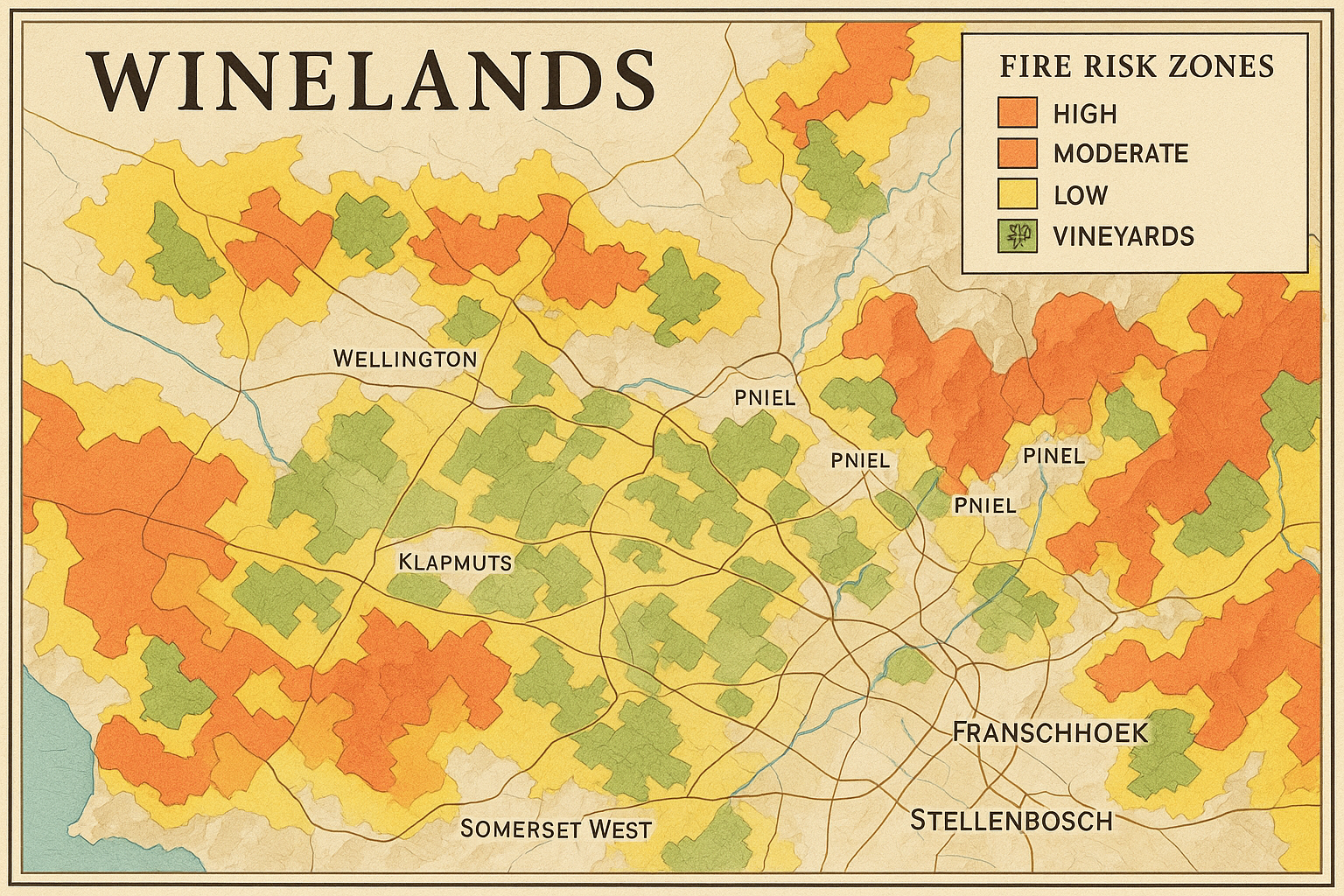
Western Cape wine country re-engineers itself for the Pyrocene, rewriting the fire playbook before the 2026 flame-front arrives.
The Western Cape wine industry is bravely fighting wildfires with cool new ideas. They're using drones and smart sensors to spot fires early, turning pesky weeds into eco-bricks, and creating special insurance plans. This smart approach helps them stay strong and keep their delicious wines flowing, even as the climate changes. They're basically rewriting the rulebook for a fiery future!
How is the Western Cape wine industry adapting to increased wildfire risks?
The Western Cape wine industry is employing innovative strategies to combat wildfires, including integrating fire prevention into daily operations, utilizing advanced tech like drones and smart sensors, transforming alien vegetation into eco-bricks, and developing specialized insurance and community-based training. This holistic approach ensures resilience and sustainability in a changing climate.
Get Cape Town news in your inbox
Stay updated with the latest stories from the Mother City.
The New Almanac: Cellars That Run on Fire Time
Step inside any winery between Stellenbosch and Hermanus this June and your eye will catch a second wall-chart nailed beside the familiar harvest timetable. It is printed on fire-proof paper - nobody finds the joke funny. Colour bands tell a new story: emerald for volunteer axe drills, tangerine for cooperative burns, scarlet for drone-led infra-red sweeps. Grapes once ruled the labour calendar; pyro-rhythms now share the throne. “We pick leaf-pluck dates around the fire moon,” admits Liesel van der Merwe, viticulturist on a 220 ha farm above Franschhoek. She means it: the local brigade asks her to keep the north-west mid-rows lusher because those vines may serve as green brakes if the wind turns.
Night-shift cellar hands swap pump-over schedules for hose-pressure checklists; pruning gangs finish blocks in sequence of ember-risk rather than sugar accumulation. Even the traditional April barbecue has moved to May - an autumn burn-off where staff toast marshmallows over prescription flames they helped ignite. Children of vineyard workers learn to read the second calendar before they know harvest brix levels. In tasting rooms, visitors scan QR codes that open with a satellite image of yesterday’s hotspot map - an appetiser served before the first sip.
The irony is not lost on anyone: a sector famous for patience and long ageing now relies on 30-minute updates. Winemakers who once quoted vintages in decades now speak of “yesterday’s NDVI delta.” Yet the emotional pivot is less about speed than about respect; fire is no longer an unpredictable guest but a co-author of the annual plan.
From Seasonal Threat to Living Culture
Last summer’s infernos torched 14 300 ha inside the Cape Winelands, halting 400 m from three classified wards and destroying R 1.1 billion worth of fruit that never reached crush. The surprise was not that scientists saw it coming but that the embers outran a 19-lane highway and torched pine windbreaks 8 km ahead of the main wall. In the aftermath, producers stopped cursing wildfire as an outside calamity and began courting it as an everyday language, as integral to place as granite soils or maritime cloud cover.
Jeremy Rose, operations director of Volunteer Wildfire Services, frames it bluntly: “If you can pronounce ‘ferricrete,’ you’d better master ‘fuel ladder’ and ‘spot-ignition arc’ with equal ease.” Tasting-room staff rattle off evacuation nodes the way they once recited barrel origins. Estate gardens host Saturday classes where retirees practice drip-torch patterns on donated pallets while sipping chilled rosé - an oenological twist on neighbourhood watch.
Culture shift shows in budgets too. Marketing managers divert 4 % of annual spend to fire-communication campaigns; social-media managers post burn-prep reels that out-perform sunset harvest shots. The new badge of honour is not a 95-point score but a green tick on the CSIR dashboard that reads: “Ignition probability < 30 % - block secured.” Wine clubs receive certificates listing hectares cleared, hours trained, litres of foam deployed - merchandise for the climate age.
Water Thieves Turned Bio-Bricks: Alien Plants Meet their Match
A single Port Jackson or black wattle can exhale 60 L of water into the air daily, leaving vines gasping and, once desiccated, spitting 1 200 °C flames hot enough to melt clay irrigation pipes. Unmanaged ribbons of these invasives quadruple fire-spread speed, a statistic that finally rattled treasury doors. The historic “Working for Water” initiative hacked away 1.4 million ha since 1995, yet budget plateaus stalled progress.
March 2026 saw the birth of “Wines & Weeds,” a public-private purse into which 42 estates pay R 8 per hectare. Contributions unlock matching state labour and, crucially, generate tradable carbon credits for the voluntary market. Year-one goals look tasty: 5 700 ha liberated, 2.3 million litres of daily water returned to the catchment, 18 000 t of chipped biomass trucked to Paarl eco-brick plants where pomace binds the dust into clean-burning briquettes. The loop closes neatly: yesterday’s torch-fodder becomes tomorrow’s braai-starter, minus the smoke that ruined the 2025 vintage.
Labourers benefit too. Each hectare cleared equals one paid training day toward a wild-land qualification, stacking credits into a formal diploma. Women now run half of the new chainsaw crews, childcare pop-ups funded by case-sales of a crowd-blended “No-Wattled Rose.” Alien vegetation, once the silent vineyard thief, now funds its own demise while financing education, childcare and low-carbon energy - all without touching a taxpayer grant.
Tractors, Drones and WhatsApp: Tech that Outruns the Flame
Remember the farm bakkie fitted with a kluged water cannon? It has morphed into a tractor-compatible skid that any mechanic can bolt on in twelve minutes. Designed by Stellenbosch engineering students, the 1 800 L tank, 15-bar pump and 18-m throw boom cost R 28 000 - one-tenth of a factory slip-on. A QR on each frame links to a living manual; growers upload hacks the way coders commit to GitHub. Orders already passed 65, proof that open-source beats tender queues.
When towers burn, Franschhoek’s hyperactive WhatsApp group keeps humming through LoRa repeaters piggy-backed on weather stations. Wind-speed data zip every 30 seconds to CSIR servers, trimming ignition-probability updates from one hour to five minutes. Price tag: R 47 000, cheaper than a single juice-lot of tainted Merlot. Messages auto-translate into isiXhosa, Afrikaans and English; voice notes convert to text for deaf users - firefighting that meets inclusion standards.
Add a field fluorimeter that slides over a smartphone lens and 90 seconds later a grower knows whether guaiacol levels doom the pick. Combine that with yeast bred from post-fire fynbos soils that happily ferments at 38 °C while pumping 22 % more glycerol, and even a blackout afternoon no longer panics a winemaker. Technology is erasing the old lament that nature happens while you stare at spreadsheets; now spreadsheets update before the smoke even clears.
Cash, Cover and Community: Finance that Douses Risk
Traditional insurers slap a five-year surcharge on any vineyard within a five-kilometre burn scar. Lloyd’s syndicate Cat-4 flipped the script: sign up for “Firebreak Plus” and the moment a MODIS pixel flags 100 m² inside your two-kilometre buffer, your bank account pings - damage or no damage. Premiums shrink 8 % for every 10 % drop in alien cover, verified by orbital NDVI. First-quarter uptake covered 8 400 ha and threw R 50 000 toward volunteer brigades when the CSIR model flashed red. Capital now buys rations, radios and resilience instead of waiting to count ruins.
Meanwhile, architects at Wolff designed a 240 m² pavilion that pours harvest lunches December through March and becomes a certified Safe Zone the moment December winds rise. A 45 000 L roof bladder, intumescent glue-lam cladding and polycarbonate heat shields hide 200 evacuation mats, potable water and Starlink. The maiden unit guards the Helderberg Wine Route, sheltering 180 people and 30 dogs with automatic next-of-kin alerts - tourism architecture drafted into civil defence duty.
Even storytelling earns its extinguisher. Back-label “Fire Codes” link to drone footage, lab reports and TikTok reels of crews saving the block. Early data show a 17 % willingness-to-pay premium, especially among Gen-Z shoppers who equate transparency with activism. The moral is no longer triumph over flame but co-existence with evidence, a narrative arc investors, insurers and drinkers can all swallow.
Ash to Anthocyanin: The Circular Economy of a Hotter Future
Hydrophobic soils meet their match in biochar, cooked at 500 °C in a kiln nicknamed “the Dragon” that roams farms turning slash into 350 kg of carbon-rich grit per tonne. Mixed with compost and fungi, the black dust boosts soil moisture 18 % and anthocyanin 11 % - colour and flavour from catastrophe. Swedish grocers pre-purchase credits to offset imported Sauvignon, proving a northern supermarket can bankroll southern topsoil while meeting its climate pledge.
Looking forward, researchers plant succulent firewalls of euphorbias whose 95 % moisture content self-extinguishes radiant heat. A two-metre strip drops kilowatts by 60 %; baboon-proof fencing is the last puzzle piece. Climate models predict 6 % more winter rain yet 14 % extra drought days - fatter springs, fiercer summers. Living heat sinks and winter-filled quarry bladders covered in floating solar panels that power irrigation and drone stations knit water, energy and defence into a single earth-moving contract.
Recruitment keeps pace with innovation. Every Saturday tasting room visitors pay R 450 for a “burn & blend” crash course: lecture, vineyard walk, blending session and a 375 ml “Fire Edition” miniature sealed with red flame-shaped wax. Six weeks filled 312 slots; four in ten graduates signed up for advanced fire training. Wine tourism quietly doubles as a volunteer pipeline, ensuring that by the time the 2026 front arrives 800 extra boots will stand ready.
The Western Cape is packaging the entire playbook - mesh networks, parametric policies, fire-adapted yeast, prescribed-burn co-ops, biochar kilns, living firewalls - under a Creative Commons licence. Delegations from Mendoza and Sonoma have already touched down; almond orchards will trial the tractor skid next summer. If a region famous for leisure and long lunches can armour a R 50 billion sector and 300 000 livelihoods against a pyro-dystopian forecast, it may gift the whole wine planet a survival manual for the age of fire.
How is the Western Cape wine industry adapting to increased wildfire risks?
The Western Cape wine industry is employing innovative strategies to combat wildfires, including integrating fire prevention into daily operations, utilizing advanced tech like drones and smart sensors, transforming alien vegetation into eco-bricks, and developing specialized insurance and community-based training. This holistic approach ensures resilience and sustainability in a changing climate, moving from simply reacting to wildfires to actively co-existing with them as part of their annual planning.
What technological advancements are being used to fight fires?
The industry is leveraging technology such as drones and smart sensors for early fire detection, with real-time updates on ignition probability. They've also developed open-source, cost-effective tractor-compatible fire-fighting skids and utilize LoRa repeaters for WhatsApp communication during tower outages. Field fluorimeters aid in grape quality assessment post-fire, and specialized yeasts can ferment effectively even in high temperatures, ensuring wine production continues despite challenges.
How are alien invasive plants being repurposed in this new approach?
Alien invasive plants like Port Jackson and black wattle, which consume vast amounts of water and fuel fires, are being tackled through the "Wines & Weeds" initiative. These plants are removed, freeing up millions of liters of water, and their biomass is then chipped and transformed into eco-bricks. These briquettes provide a clean-burning fuel source for local communities, creating a circular economy where a former fire hazard becomes a sustainable energy solution.
How has the industry's culture and community engagement evolved?
The Western Cape wine industry has embraced a significant culture shift, viewing fire not as an external threat but as an integral part of their environment. This is reflected in new "pyro-rhythms" influencing vineyard management and labor calendars. Community engagement is strong, with tasting rooms hosting fire safety classes, staff trained in evacuation protocols, and marketing efforts dedicated to fire communication. Wine tourism also plays a role, with "burn & blend" courses doubling as volunteer recruitment for fire training.
What financial and insurance innovations are supporting this resilience?
New insurance models, such as Lloyd’s syndicate Cat-4's "Firebreak Plus," offer immediate payouts upon detection of potential fire threats within a buffer zone, irrespective of actual damage. Premiums are reduced for estates actively managing alien vegetation. Furthermore, marketing budgets are being redirected towards fire-communication campaigns, and a new "Fire Codes" initiative on wine labels links to digital content, showing transparency and an increased willingness-to-pay premium from consumers.
What long-term sustainable practices are being implemented?
Beyond immediate fire fighting, the industry is focusing on long-term sustainability. This includes using biochar, produced from vineyard waste, to improve soil moisture and grape quality, and planting succulent firewalls like euphorbias to naturally resist heat. They are also integrating water management with energy solutions, using winter-filled quarry bladders covered in floating solar panels to power irrigation and drone stations, creating a holistic and resilient system for a hotter future.

Zola Naidoo is a Cape Town journalist who chronicles the city’s shifting politics and the lived realities behind the headlines. A weekend trail-runner on Table Mountain’s lower contour paths, she still swops stories in her grandmother’s District Six kitchen every Sunday, grounding her reporting in the cadences of the Cape.
View all articles →