
Look: Small town in South Africa up for auction
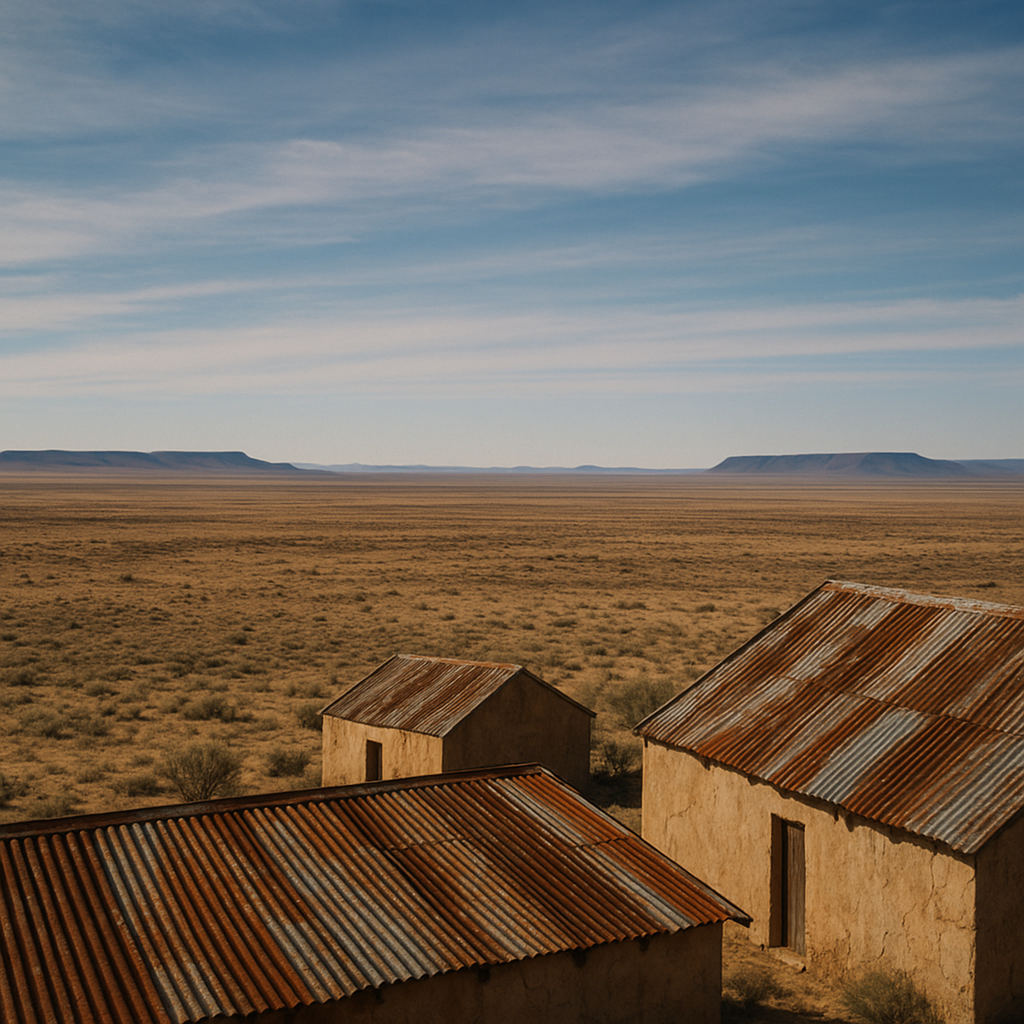
Middelpos, a historic Karoo town, goes up for auction. Discover its rich history, unique features, and future potential.
Middelpos, a tiny, historic South African hamlet, is being auctioned as a whole village, including land and buildings. This remote spot, known for its extreme cold and rich history, has sparked huge interest online due to its unique offerings. People are excited about turning it into anything from a silent retreat to a film set, seeing big potential in its quiet beauty and untouched nature. The auction is online, and despite its remoteness, experts say it could fetch millions.
What is Middelpos, and why is it being auctioned?
Middelpos is a remote South African hamlet, once a vital trading post, located in the Karoo. It's being auctioned as a complete entity, including the village footprint, surrounding land, historical buildings, and even movable items. The sale, driven by increasing interest in semi-desert properties, offers potential for various commercial and eco-tourism ventures.
Get Cape Town news in your inbox
Stay updated with the latest stories from the Mother City.
The PDF That Went Viral Before the Dust Settled
Just after sunrise on 8 May 2024 a one-page flyer began ping-ponging across Karoo chat groups, farmer co-ops and Cape espresso bars.
Headline: “Middelpos – complete hamlet on auction, 21-22 May.”
By supper-time the file had been shared 3 000-plus times, sparking voice-notes that swung between mockery (“Since when can you add a whole dorp to your cart?”) and moon-shot dreaming (“I’m launching a crowdfunded silent retreat – who wants shares?”).
Less than two days later #Middelpos was trending above Eskom’s latest schedule, and the property sector woke up to what trekboere have muttered for 164 years: this crossroads is the final refill-and-deep-breath stop before the Tankwa’s 143 000 ha of shale, stars and hush swallow you whole.
Where even Google Runs Out of Road
Pin the coordinates 32°06′ south, 20°06′ east and you’ll hover 1 260 m above sea level on the Roggeveld’s lip.
Leave Cape Town on the N7, veer east at Ceres onto the R355 and you still have 186 km of gravel unspooling through emptiness so pure the telephone poles lean for company.
When the gauge flirts with red, the road drops, a windmill groans, and five tin roofs, a church spire and a bleached red sign “Middelpos Handelshuis” shimmer through the heat.
Cartographers labelled it “Middle Point” because it sits exactly 220 km from both Sutherland’s telescopes and Calvinia’s fat-tail auctions.
Weather boffins crown it South Africa’s coldest inhabited spot: on 28 July 2020 the thermometer sank to –19,4 °C, beating Antarctica’s Esperanza Base and downtown Moscow that night.
Ledgers, Legends and the Smell of Sulphur
The auction brochure traces title to 1860, yet the yarn really begins in 1857 when wander-trader Daniel Tomlinson – Scottish barrel-maker, part-time Namaqualand smuggler – off-loaded at a brack seep the San knew as !Uri‐aibes, “water that hides itself”.
Tomlinson swapped three brass kettles, a wagon wheel and a percussion rifle for 4 000 morgen of “stinkkuil” ground, named for the rotten-egg reek rising off the spring.
He threw up a sod-wall shop, imported square-face gin, Lancashire prints and Worcester salt, then kept his tallies in Arabic numerals so illiterate patrons couldn’t quibble.
Dead of horse-sepsis in 1893, he bequeathed the concern to the Sher siblings – Lebanese Maronites who had hoofed it from Beirut to the Cape in 1889.
For 87 years the family ran the concern as trading post, post office, magistrate’s chamber, 1918-flu ward and clandestine weather station for Royal Flying Corps pilots drilling near Calvinia.
Their ledgers, rescued 2019 from beneath chicken-mesh, catalogue every sale from 1894 to 1970 – Karoo wool prices, the district’s first Model T, and the afternoon in 1955 when a Sutherland grazier traded two Angora goats for a fresh copy of Alan Paton’s “Cry, the Beloved Country”.
What Exactly Changes Hands When the Mouse Clicks “Bid”
The package covers 1 032 km² – bigger than Singapore – of which 86 % is veld let to four surrounding merino outfits at R18 per hectare each year.
The remainder is the village footprint:
- 34 surveyed homesites, average 1 400 m²
- Four business plots, among them the 1896 Sher General Dealer still displaying 1970s Mazawattee tea tins
- A 1942 corrugated-iron hostel built for Italian prisoners who dug the district’s irrigation furrows, now a twelve-key hotel
- A 200-seat sandstone church (NG Kerk, 1910) housing a Leipzig pipe organ and pew Bibles in High Dutch
- A town hall with sprung floor whose backdrop still proclaims “Welcome to Middelpos – clean air, strong wine”
- Stone post office complete with brass pigeon-holes and a 1956 hand-franker
- 4,75 ha water-righted land along the Ongers, now lucerne and winter greens under flood irrigation
- A 45 kW solar-diesel hybrid grid; Eskom waits 28 km away – quoted reconnection R3,8 million
- A graveyard with 212 headstones, including seven Commonwealth airmen whose Hudson clipped the Roggeveld in 1943
- Movable odds-and-ends: two tired tractors, 4 km of fence wire, the hotel’s 1958 Coldstream bar-fridge and, inexplicably, a 1973 tangerine Volvo 144 on blocks, odometer frozen at 38 000 km.
Price Tags, Fine Print and the 24-Hour Shot-Clock
Home & Hectare, riding shotgun with Sotheby’s International Realty Cape, will run the sale purely online.
No reserve figure has been whispered, yet title deed clauses oblige the purchaser to keep public roads open, maintain the cemetery fence and grant the NG Kerk at least one quarterly service – heritage-minded handcuffs typical of sellers who care more for legacy than leverage.
Would-be owners must park a refundable R500 000 deposit and pass a FICA sweep; offshore proxies welcome.
Bidding opens 12:00 on 21 May and shuts exactly twenty-four hours later, but any snipe in the final moments resets the clock by five minutes, eBay-style.
Market chatter puts opening offers between R18 million and R25 million – roughly what a sea-view lock-up garage trades for in Clifton.
Why Semi-Desert Dirt is Suddenly Hotter Than Bitcoin
Between 2019 and 2023 upper-Karoo farmland prices climbed 14 % annually, beating the JSE All-Share over the same stretch.
Propulsion comes from:
- Low-orbit broadband (Starlink licences pending) turning dead-zone isolation into laptop-eligible real estate
- Climate-driven relocation – semi-desert scored “minimal risk” for both bushfire and deluge
- Astro-tourism: Sutherland’s SALT telescope pulls 37 000 visitors a year; Middelpos lies 96 km south, just outside the light-pollution cordon
- Location scouts: “The Endless River”, “The Dark Tower” and two Netflix Afrikaans dramas already shot on the R354’s empty horizons
- Renewable-energy sprawl: fourteen solar farms licenced within 80 km, substations already humming
- Wildlife pivot: springbok, gemsbok and quagga-revival projects change hands at R18 000 per hectare, four times the small-stock tariff.
Eight Blueprints Already Scribbled on Napkins
-
Dark-Sky Caravan Park & Observatory
Exploit 300 clear nights and the existing hostel. Add five A-frame pods at R250 k each; rack rate R750 pp. Break-even at 42 % occupancy. -
Karoo Bio-Char Hub
Convert invasive mesquite to charcoal in mobile Adam-retorts; peddle European carbon offsets at €60 per tonne CO₂. Internal rate of return: 18 %. -
Off-Grid Torture Lab
Rent empty cottages to hardware start-ups that need cold, dust and flaky volts: Tesla vs. Victron vs. Huawei in real-world stress tests. -
Heritage Backlot
The whole town already rocks 1940s décor. Lease it to Netflix for thirty years; throw in period costumes. -
Frost-Distilled Lavender
Plant 20 ha of Lavandula angustifolia; distil at –15 °C for higher ester counts; export to perfumers in Grasse. -
Migrant Genealogy Retreat
Digitise Sher ledgers; package ancestry tours for 250 k northern-hemisphere descendants of Italian POWs and Lebanese traders. -
Gravel-Bike Mecca
Carve 120 km of single-track linking padstals; run a mid-winter race when Cape trails are ankle-deep in mud. -
Executive Silence Sabbatical
Pair with Stellenbosch Business School; charge R45 k for a ten-day digital detox under 22-magnitude skies.
The Invisible Aquifer That Keeps the Dream Alive
Middelpos endures thanks to a fracture in the Dwyka tillite: a 14 m artesian eye that delivers 18 000 litres an hour at 29 °C.
Free-State geologists carbon-dated the water at 4 200 years – older than the pyramids – and logged lithium at 0,21 mg per litre, just shy of bottling thresholds but sexy enough to market “Karoo Lithium Spring” to the wellness crowd.
The transferable licence irrigates 4,75 ha under riparian law – liquid gold in a province where new water rights are frozen solid.
Residents, Rates and the Shoebox of Bureaucracy
Permanent tally: 23 humans.
- Schalk and Beulah van Wyk, 71, pump 93-octane by hand and serve coffee in enamel mugs; they’ll stay on as managers if medical aid is bundled.
- Doreen Sher, 89, great-grand-daughter of the original traders, breeds canaries in the postmaster’s cottage and holds the only liquor licence for 60 km – her continued tenancy is protected.
- Three shearers, two shade-tree mechanics, one teacher-dominee and a communal border-collie named Klaas complete the social fabric.
Buyers must honour the 1958 Commonage Agreement letting fourteen families graze 1 200 sheep on municipal veld for a token R2 per head per month.
Municipal anchor: Hantam, administered from Calvinia 110 km west; last year’s rates for the entire town totalled R14 267 – less than a city resident pays for parking.
Spatial rules label Middelpos a “peripheral settlement”: no structure within 40 m of the R354, corrugated roofs preferred, neon banned.
SAHRA has slapped a Section 34 heritage blanket on the trading store, church and POW cemetery; expect 90-day permits for any alterations.
The hotel liquor licence runs to 2027 but needs amendment for outdoor seating once glamping pods appear.
The general dealer still owns an apartheid-era “firearms trader” certificate; SAPS advise renewal before transfer to dodge a 90-day embargo.
Epilogue That Refuses to Wrap Up Neatly
Some acquisitions are driven by potential; others by the stubborn poetry of what refuses to change.
Middelpos – 23 souls, 150 mm annual rainfall, mean chill factor –5 °C – has spent a century and a half declining to be anything except itself.
On 22 May at midday the virtual hammer will fall and the next caretaker will learn whether obstinacy can be monetised, whether silence carries a per-hectare price, and whether a wind that memorises your name will still answer when the bank labels you landlord.
What is Middelpos, and why is it being auctioned?
Middelpos is a historic, remote hamlet in South Africa's Karoo region, being auctioned as a complete entity. This includes the village footprint, surrounding land, historical buildings, and even movable items. The auction is driven by increasing interest in semi-desert properties and the potential for various commercial and eco-tourism ventures in its untouched nature and quiet beauty.
Where is Middelpos located, and how remote is it?
Middelpos is located at coordinates 32°06′ south, 20°06′ east, 1,260 meters above sea level on the Roggeveld's lip. It is considered South Africa's coldest inhabited spot. To reach it from Cape Town, one would travel on the N7, then veer east at Ceres onto the R355, followed by 186 km of gravel road. It sits 220 km from both Sutherland's telescopes and Calvinia's fat-tail auctions, making it quite remote.
What historical significance does Middelpos hold?
Middelpos, initially known as !Uri-aibes by the San people, has a rich history dating back to 1857 when wander-trader Daniel Tomlinson established a trading post. It was later run for 87 years by the Sher siblings, serving as a trading post, post office, magistrate's chamber, 1918-flu ward, and even a clandestine weather station during WWII. The village boasts a 1942 corrugated-iron hostel built by Italian prisoners of war, a 1910 sandstone church with a Leipzig pipe organ, and a graveyard with 212 headstones, including those of seven Commonwealth airmen.
What does the Middelpos auction package include?
The auction package covers a vast 1,032 km² area, of which 86% is veld leased to merino outfits. The remaining village footprint includes 34 surveyed homesites, four business plots (including the 1896 Sher General Dealer), a 12-key hotel (the former POW hostel), a 200-seat sandstone church, a town hall, a stone post office, and 4.75 ha of water-righted land. It also comes with a 45 kW solar-diesel hybrid grid, a graveyard, and various movable items like tractors, fence wire, and a 1973 Volvo 144.
How will the auction be conducted, and what are the financial details?
The auction will be held purely online by Home & Hectare, in conjunction with Sotheby’s International Realty Cape. While no reserve price has been whispered, market chatter suggests opening offers between R18 million and R25 million. Prospective buyers must place a refundable R500,000 deposit and pass a FICA sweep. Bidding opens at 12:00 on May 21st and closes 24 hours later, with a five-minute clock reset for any last-minute bids. Heritage clauses require the purchaser to keep public roads open, maintain the cemetery fence, and ensure at least one quarterly church service.
What makes semi-desert properties like Middelpos so attractive now?
The appeal of semi-desert properties like Middelpos is surging due to several factors. Low-orbit broadband (Starlink) is transforming remote areas into viable real estate, and climate-driven relocation sees semi-desert regions as minimal risk for bushfire and deluge. Astro-tourism is booming, with Middelpos being near Sutherland's SALT telescope. The area is also attractive to location scouts for film and television, and there's a rise in renewable-energy projects and wildlife conservation initiatives, all contributing to a 14% annual increase in upper-Karoo farmland prices between 2019 and 2023.

Thabo Sebata is a Cape Town-based journalist who covers the intersection of politics and daily life in South Africa's legislative capital, bringing grassroots perspectives to parliamentary reporting from his upbringing in Gugulethu. When not tracking policy shifts or community responses, he finds inspiration hiking Table Mountain's trails and documenting the city's evolving food scene in Khayelitsha and Bo-Kaap. His work has appeared in leading South African publications, where his distinctive voice captures the complexities of a nation rebuilding itself.
View all articles →