
Meet the moms making maths fun
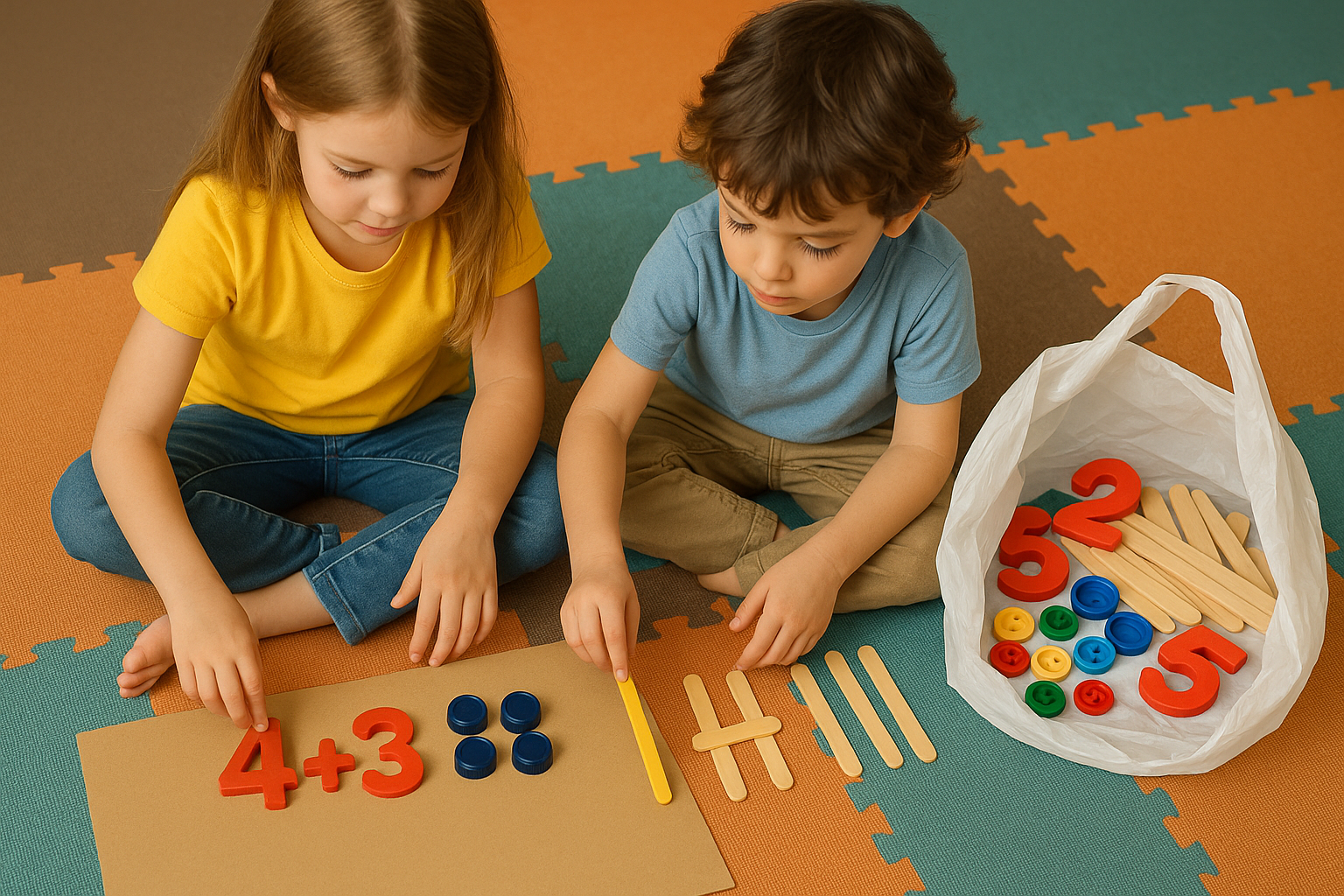
MathMoms empowers women in Cape Flats to teach early math using games, transforming communities and improving numeracy outcomes for children.
In the Cape Flats, grandmothers are becoming MathMoms, teaching early math with everyday items like dominoes and bottle caps. This smart program helps kids learn numbers and gives women jobs, fighting poverty and gang problems. By using simple games and nurturing relationships, MathMoms isn't just teaching math; it's building stronger communities and brighter futures, one child at a time.
What is MathMoms?
MathMoms is a South African initiative where grandmothers and other community women use tactile games with everyday objects like dominoes and bottle caps to teach early maths to children in the Cape Flats. This program aims to improve numeracy skills, provide economic opportunities for women, and offer a pathway out of poverty and gang influence.
Get Cape Town news in your inbox
Stay updated with the latest stories from the Mother City.
1. The Buffer Zone That Became a Trap
Cape Town’s N2 highway rushes commuters past a wind-bitten 150 km² moonscape known as the Cape Flats. In the fifties, apartheid engineers drained the wetlands, slapped up thousands of sand-coloured boxes and called the strip a “buffer” between white suburbs and Black/Coloured townships. The buffer still stands, only now it functions like fly-paper: households survive on less than R1 500 a month, youth unemployment in pockets exceeds 60 %, and no-fee primary schools post maths results 30–40 marks below the national mean. For a nine-year-old here, long division is not a school requirement; it is the most reliable exit visa from gang recruitment before fifteen.
The state offers no coherent rescue plan. Textbooks arrive late, copper thieves rip out ICT cables, and psychometric support is a distant Pretoria spreadsheet. Into this vacuum walked two pensioned teachers, Bertha Losper and Theresa October, who decided that the crisis was neither fate nor donor-fodder, but a design flaw that could be hacked with bottle tops and a second-hand deck of cards.
2. Kitchen-Table R&D: Games That Fit in a Plastic Bag
Losper and October began in 2016, re-typing the entire Grade-2 CAPS curriculum into 42 tactile games spread across a plastic shopping bag. Dominoes became bonding boards, playing cards flipped into inverse-operation drills, painted beer caps modelled place-value, and an empty Coke bottle morphed into a random-number shaker. Their pedagogical bet: fingers must fondle quantities before brains can symbolise them. Neuroscientists call it embodied cognition; the grandmothers simply call it “making maths stick.”
No tablets, no data bundles, no photocopy budgets - just objects that survive township grit. The entire archive costs less than a movie ticket and travels light enough to outrun eviction orders or gang shoot-outs. In short, the bag is a curriculum server that never crashes, a quiet act of resistance against EdTech evangelists who equate digital access with learning.
3. Moms, Aunties, Grant-Queue Veterans: The Human Infrastructure
MathMoms does not parachute in starry-eyed graduates. It harvests talent already threaded through neighbourhood crevices: the auntie who hustles loose cigarettes, the mother queuing for the SASSA grant, the gogo raising six grandchildren on a state pension. Recruitment screens for “relational intelligence,” the instinct that spots a trembling lip as maths dread, not defiance. After 60 hours of fraction chips, clothes-peg geometry and data games played with school-uniform colours, each lady inherits seven Grade-2 or Grade-3 learners, twice a week, no classroom longer than a threadbare mat.
The 1:7 ratio is deliberate: intimate enough for trust, large enough to crowd-source peer status where “clever” earns playground clout. Sessions unfold in whatever corner is safe that day - storage room, church foyer, even a converted shipping container graffitied with gang tags - because stability of relationship outweighs stability of real estate.
4. Songs, Milkshakes and Trauma-Informed Tricks
A casual visitor sees only boisterous kids and milkshake foam, yet every element doubles as stealth therapy. The opening chant - “I am learning, I am growing every day” - is a cortisol-lowering ritual after dawn raids or domestic shouting. Dominoes sport ANC green-black-yellow asymmetry to force subitising, the brain’s instant-quantity snap that underpins later algebra. Milkshakes are not bribes; they are ratio boot-camps (250 ml milk : 50 ml syrup) timed to etch procedural memory, plus a lipid gift for neurons that need fat to myelinate number pathways.
Each facilitator keeps a “regulation toolbox” within reach: lavender-scented socks, glitter-water bottles that settle in two visual minutes, koki-drawn “safe islands” on wrists. Friday debriefs upload learner errors via WhatsApp to a retired UCT professor who diagnoses misconceptions before Monday, creating a double-loop that questions the model, not just the mistake. In effect, maths anxiety is untangled from PTSD, a distinction national policy has not yet memorised.
5. Banking, Bilingualism and Boys Who Build Wire Cars
Stipends - R1 800 monthly - land in freshly opened low-cost bank accounts, nudging moms into ATM literacy, debit-order defence and interest-rate shock therapy. A micro-credential called “household maths” rehearses real threats: a R1 000 mashonisa loan at 30 %, unit-price combat between Shoprite and Spar, zero-based budgeting on grant incomes. When children watch a caregiver reconcile a bank statement, the number line walks out of the workbook and into lived reality; 14 moms have since graduated to teacher-assistant posts and two are part-time B.Ed students at UNISA.
Language toggling is equally strategic. Concepts anchor in isiXhosa or Afrikaans - “hamba, haal, vat” for subtraction - before “bridging” to English. Stellenbosch data show bilingual mediation bulks up working memory, the RAM chip children need to hold dual representations while manipulating quantities. Father-track pilots, launched with 15 rehab graduates, reveal that male facilitators turbo-charge spatial rotation: Grade-3 boys who once could not turn a T-shape now build wire cars with symmetrical axles.
6. Dense Networks, Not Wide Splash: The 94 % Attendance Secret
South African NGOs usually bloom, balloon, then collapse under donor pressure to “scale.” MathMoms grows only when a retired HOD living within a 30-minute minibus ride can still attend Friday reflective loops face-to-face. The result is density over width: 28 schools, 196 moms, 1 372 children, yet attendance hovers at 94 % and independent evaluators clock an effect size of 0.78 standard deviations in numeracy after one year - triple the national literacy catch-up score.
Gang geography itself is bending. In Lavender Hill the Globe Gang and Corner Boys enforce an informal truce: no recruitments on MathMoms afternoons. In Macassar the 26s prison faction calls participants “die nommer vroue” and permits dominoes in pockets as neutrality badges. A private girls’ school in leafy Rondebosch - where Grade-9 algebra pupils still finger-count - has requested an exchange, conceding that the shortest path out of the buffer zone may indeed travel through a 50-cent domino.
7. Nine-Year-Olds Who Prove Commutativity at Wire Fences
The organisation tracks 42 metrics, yet three trump all others: Can a Grade-2 learner subitise seven dots without counting? Can a mom explain to a neighbour why a six-month R1 000 loan at 30 % costs R180 more than lay-bye? Does a child skip break to finish a maths puzzle? When all three answers tilt yes, both hippocampus and habitus have been rewired, the dual terrains where poverty replicates.
At 12:15 the Balvenie Primary bell clangs. Fourteen boys spill out, milkshake cups in hand like Olympic torches. One stops at the wire fence to show a Metro officer his domino: six dots on one slab, three on the other. “How much together?” the officer teases. The boy flips the tile end-to-end: “Nine, meneer. And if I twist it, still nine.” Laughter erupts - currency rarely heard on the Flats - while the N2 traffic roars past, oblivious that commutative law just demonstrated the cheapest exit ramp out of the buffer zone.
[{"question": "
What is MathMoms?
", "answer": "MathMoms is a South African initiative where grandmothers and other community women in the Cape Flats teach early mathematics to children using everyday objects like dominoes and bottle caps. The program aims to improve numeracy skills, provide economic opportunities for women, and offer a pathway out of poverty and gang influence in the community."}, {"question": "How did MathMoms start and what is its core philosophy?
", "answer": "MathMoms was founded in 2016 by two retired teachers, Bertha Losper and Theresa October. They developed 42 tactile games based on the Grade-2 CAPS curriculum using simple, everyday items. Their core philosophy is 'making maths stick' through embodied cognition, meaning children learn best by physically interacting with quantities, rather than relying solely on abstract symbols or digital tools."}, {"question": "Who are the MathMoms facilitators?
", "answer": "The facilitators are community women, including grandmothers ('gogos'), mothers, and aunts, who are recruited for their 'relational intelligence' – their ability to connect with and understand children's needs. They undergo 60 hours of training in tactile maths games and then work with small groups of 7 learners, twice a week, in various safe community spaces."}, {"question": "How does MathMoms address the broader social challenges in the Cape Flats?
", "answer": "Beyond teaching maths, MathMoms acts as 'stealth therapy' by incorporating elements that reduce stress and build resilience. Activities include cortisol-lowering chants, milkshakes that provide nutritional benefits for brain development, and 'regulation toolboxes' to help children manage trauma. The program also provides economic empowerment through stipends and financial literacy training, and fosters community strength by creating safe spaces and even influencing gang dynamics."}, {"question": "What are the tangible impacts of the MathMoms program?
", "answer": "MathMoms has shown significant results, with 94% attendance and an effect size of 0.78 standard deviations in numeracy after one year, which is triple the national literacy catch-up score. The program also leads to banking literacy for the mothers, with some progressing to teacher-assistant roles or pursuing B.Ed degrees. It also indirectly contributes to community safety, with informal truces observed between gangs on MathMoms afternoons."}, {"question": "How does MathMoms ensure its effectiveness and sustainability?
", "answer": "MathMoms prioritizes 'density over width,' meaning it focuses on deep engagement within existing communities rather than rapid, widespread expansion. It maintains a close-knit network of retired educators for support and regular debriefs. The program tracks 42 metrics, focusing on key indicators like a child's ability to subitise, a mother's financial literacy, and a child's engagement with maths puzzles, ensuring both cognitive and behavioral changes are monitored for long-term impact."}]
Isabella Schmidt is a Cape Town journalist who chronicles the city’s evolving food culture, from Bo-Kaap spice merchants to Khayelitsha microbreweries. Raised hiking the trails that link Table Mountain to the Cape Flats, she brings the flavours and voices of her hometown to global readers with equal parts rigour and heart.
View all articles →