
Multiple fires kept Cape Town firefighters busy across metro
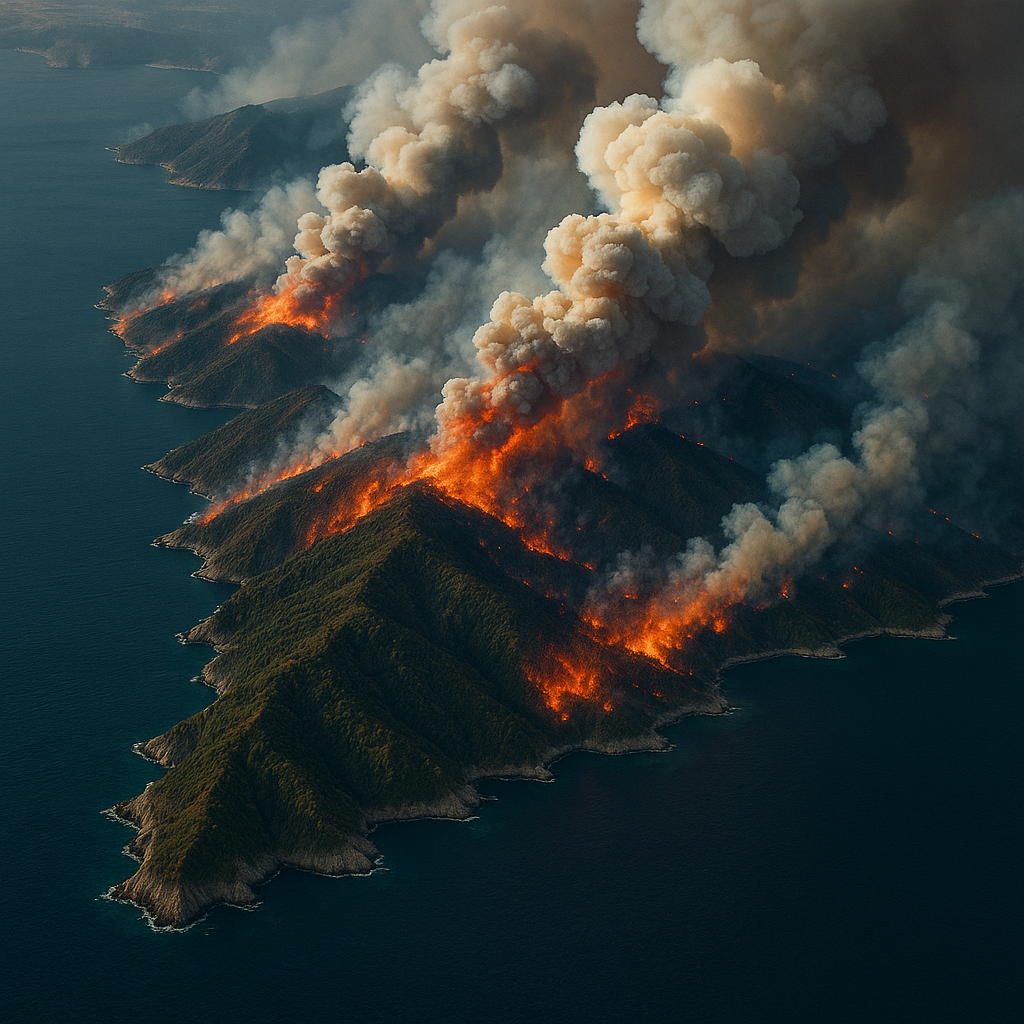
Cape Town battles three simultaneous emergencies: a veld fire in Simon's Town, a factory blaze in Bellville, & a smoldering compost heap in Philippi.
Cape Town faced a fiery disaster with three big blazes all at once. One fire, started by unknown reasons, raged in a steep valley, needing helicopters and brave firefighters. Another fire, a factory accident, turned a tissue plant into a huge inferno, forcing many to fight it to save nearby buildings. Meanwhile, a giant compost pile had been slowly burning for days due to natural heat, needing special digging and soaking to put out. These fires stretched the city's helpers thin, caused air pollution, disrupted daily life, and even affected naval operations, leaving everyone tired but still fighting as night fell. three big blazes all at once.
What caused the multiple fires in Cape Town's Cape Peninsula?
Cape Town experienced three unrelated fires simultaneously. The Dido Valley blaze was sparked by unknown causes in a steep ravine. The TwinSaver tissue plant fire in Bellville South was an industrial accident. The Philippi compost stack fire was a result of thermophilic bacteria oxidizing organic acids in brewery and winery waste, causing self-ignition.
Get Cape Town news in your inbox
Stay updated with the latest stories from the Mother City.
Dawn of a Triple-Headed Monster
Cape Town’s southern arm woke on 11 March to the smell of burning resin and the thud of rotors. Before most commuters poured coffee, the peninsula was already juggling three unrelated blazes - each hungry, each moving, each demanding its own language of suppression. Radios crackled shortly before noon when a hiker spotted a grey thread rising from Dido Valley, a steep ravine that drops from Simon’s Town’s lower peaks straight toward the naval yard. Within minutes the Navy’s own fire unit rolled, Table Mountain National Park’s hand-picked veld crews followed, and City tankers screamed down the coastal road, sirens bouncing off granite walls like rifle shots.
By 11:50 the slope was a living wall of flame. March thermals - those sneaky berg-winds that replace the famous south-easter - were sucking heat uphill, launching embers into a cocktail of invasive pines and ancient fynbos. GPS pinned the start at 240 m above sea level; ten minutes later new ignitions flared 80 m higher, textbook plume-driven spotting. Crews wrestled 1 200 m of 45 mm hose up a 35-degree scree that kept slipping under their boots; every third length had to be roped to a rock or a root. Two Navy AS-350 B3 Squirrels - call-signs Kus-31 and Kus-32 - arrived overhead, swinging 600-litre Bambi buckets on a four-minute circuit: dip in the calm harbour, climb, dump, flatten the flame tips just long enough for hand-crews to scratch mineral line. By 15:30 infrared showed a 12-hectare charcoal scar, zero structures lost. Fourteen historic cottages, an ammo depot and the naval workshops survived because a bulldozer carved a 30-metre mineral break through the pines while helicopters beat the flames into submission.
Inferno in the Northern Suburbs
The valley fire still smouldered when the next alarm rang at 13:12 - this time 35 kilometres north in Bellville South. The TwinSaver tissue plant, an 18 000 m² maze of corrugated sheds on Fabriek Street, was pushing a purple-black column hundreds of metres high. First-in crews saw fire punching through the saw-tooth roof and instantaneous rollover inside a 12-metre storage mezzanine crammed with two-ply jumbo reels. Engineers later tallied 24 tonnes of cellulose and four tonnes of plastic film - enough to spit out 1 800 megajoules of heat every single second at peak burn.
Incident Commander Riana Visser escalated fast: second alarm at 13:18, third at 13:31, fourth soon after. More than 70 firefighters, four water-tankers, two 30-metre aerials and the City’s only 54-metre Bronto Skylift converged on the complex. Veteran operator Willem October parked the Bronto on the eastern berm and opened its 1 500-litre-per-minute monitor like a horizontal waterfall while ground crews attacked from alpha and delta divisions. Roof trusses began to sag and thermal imagers hit 730 °C at the ridge, forcing a switch to surround-and-drown. The tactic saved the adjoining latex-glove warehouse - 40 million nitrile units meant for hospitals never caught a spark. Fabriek Street stayed closed for eight hours, 14 MyCiTi bus routes were rerouted, and PetroSA’s lubricant depot froze tanker loading as a precaution. PM2.5 monitors on the N1 spiked to 180 µg/m³, triple the WHO daily limit, but dropped below 35 µg/m³ once a light southerly sheared the plume seaward.
The Heap That Refuses to Die
While Bellville lit up the northern sky, a quieter enemy kept exhaling acrid haze across the Cape Flats. On Olieboom Road in Philippi, a 1.6-hectare compost stack six metres high - brewery waste, winery pomace and shredded urban greens - has been burning since Saturday. Microbiologists know the drill: thermophilic bacteria oxidise organic acids, core temps climb past 80 °C, and once the insulating mulch exceeds 1.5 m depth heat loss loses the race. By Sunday night probes recorded 510 °C at 3.8 m; cracks opened, tarry smoke jetted out, and the haze drifted as far as Rondebosch on the nightly katabatic drift.
Water alone is useless - droplets flash-steam before they reach the hot core - so crews borrowed a California trick: peel-and-drench. Articulated Volvo L220H loaders, usually seen in quarries, strip 300 mm layers every two hours while eight 38 mm ground monitors soak each fresh face. Two Huey-II helicopters, leased from a logging outfit, haul 1 000-litre buckets from the Black River and drop onto hot spots revealed by handheld FLIR. Internal thermocouples showed a 190 °C drop by Wednesday night, yet dawn visibility on the M5 still fell below 600 m. The City advised asthmatics to seal windows; agronomists warn that if the heap is not fully cooled within five days a refractory crust will form, locking in sub-surface embers for weeks and threatening neighbouring wooden-pallet stacks.
Resources, Ripples and the Long Tail
Wednesday’s choreography pulled 110 of Cape Town’s 210 on-shift firefighters into active firegrounds, shoving five structural stations onto “status yellow” where only medical calls get a 15-minute response. The Metro’s fire-danger index is stuck at “very high” after three weeks of berg-winds, 18 % humidity and temperatures 3.4 °C above average. A cold front is forecast for Sunday, but its precursor north-westerlies could turbo-charge any lingering hotspot before rain arrives.
Logistics groan under the load. Bellville alone swallowed 1.4 million litres of potable water shuttled by 12 tankers; Philippi has soaked up another 2.3 million from the Black River, raising eyebrows in a drought-sensitive city. Air Ops tallied 42 flying hours in two days - naval helicopters burned R180 000 in fuel vouchers and the City owes a contractor R14 000 per airborne hour per Huey. Behind the scenes, 120 new Nomex suits replaced tear-prone PBI Gold gear; Simon’s Town crews packed 6-litre collapsible aluminium “Mondo” pumps that let two-person teams chase spot fires where 12 kg hose-packs can’t go. A drone unit, birthed only last November, flew 22 FLIR sorties and caught a hidden ember pocket behind the naval gym before it could re-ignite.
Daily life feels the sting. Schools in Retreat and Heathfield saw 17 % absenteeism on Thursday; the air-quality call centre logged 318 complaints - double the norm - about soot on washing and the metallic taste that clings to throats near Philippi wetlands. Informal traders beside Fabriek Street lost a full trading day with no insurance safety-net; a disaster-relief desk at Bellville civic centre is now fielding claims for category-A funding. TwinSaver normally supplies 42 % of South Africa’s private-label toilet paper; analysts predict spot shortages in both Cape provinces within ten days. Naval planners rerouted two frigates scheduled for Simon’s Town maintenance because smoke dropped visibility below safe approach minima; the ships will berth in Durban, pushing anti-piracy patrols back 48 hours. Even Chapman’s Peak drive is quieter - tour operators report a 30 % drop in cyclists and motorists since the haze settled, another nick in a tourism sector still nursing 2023 bruises.
Night brings no off-switch. Thermal satellites at 22:30 show three heat signatures inside the TwinSaver ruins demanding hourly foam baths; the Simon’s Town escarpment still glows at 220 °C, ready to roll downhill if the wind pivots. Under floodlights in Philippi, loader buckets bite into steaming mulch that sparks like a blacksmith’s forge with every turn. Radios swap colour codes and hectare tallies; firefighters trade cracked jokes about who showers first when the station geysers run cold. The city drifts to sleep, windows shut against the smell, aware that somewhere on the horizon a red beacon still pulses - an eye that refuses to blink.
What caused the multiple fires in Cape Town's Cape Peninsula?
Cape Town experienced three unrelated fires simultaneously. The Dido Valley blaze was sparked by unknown causes in a steep ravine. The TwinSaver tissue plant fire in Bellville South was an industrial accident. The Philippi compost stack fire was a result of thermophilic bacteria oxidizing organic acids in brewery and winery waste, causing self-ignition.
How were the firefighters able to combat the Dido Valley blaze?
The Dido Valley fire, located in a steep ravine, required a coordinated effort. Firefighters on the ground wrestled 1,200 meters of hose up a 35-degree slope, while two Navy AS-350 B3 Squirrel helicopters, call-signs Kus-31 and Kus-32, conducted aerial water drops using 600-litre Bambi buckets. A bulldozer also carved a 30-meter mineral break to protect nearby structures.
What challenges did the TwinSaver tissue plant fire present?
The TwinSaver tissue plant fire was an intense industrial accident involving 24 tonnes of cellulose and four tonnes of plastic film, generating immense heat. It required over 70 firefighters, multiple water-tankers, two 30-meter aerials, and the city's only 54-meter Bronto Skylift. The primary challenge was containing the inferno to save adjacent buildings, which was achieved by employing a "surround-and-drown" tactic after initial attempts to fight from within were deemed too dangerous due to sagging roof trusses and extreme temperatures.
Why was the Philippi compost stack fire so difficult to extinguish?
The Philippi compost stack fire was a slow-burning event caused by thermophilic bacteria and self-ignition within a 1.6-hectare, six-meter-high pile of brewery waste, winery pomace, and shredded urban greens. Water alone was ineffective as it would flash-steam before reaching the hot core. Firefighters adopted a "peel-and-drench" method, using articulated loaders to strip 300 mm layers every two hours while ground monitors soaked each fresh face. Two Huey-II helicopters also assisted by dropping 1,000-litre buckets on hot spots.
What impact did these fires have on Cape Town's resources and daily life?
The fires severely stretched Cape Town's resources, pulling 110 of 210 on-shift firefighters into active firegrounds and pushing five structural stations to "status yellow." Logistics groaned under the load, with 1.4 million litres of potable water used in Bellville and 2.3 million litres from the Black River used in Philippi. Daily life was also disrupted: schools saw increased absenteeism, air quality complaints doubled, informal traders lost income, and naval operations were rerouted due to poor visibility. The fires also raised concerns about potential toilet paper shortages and a drop in tourism.
What measures were taken to mitigate the effects of the fires and support the responders?
To mitigate the effects, a disaster-relief desk was set up at Bellville civic centre to field claims. New Nomex suits replaced older gear for firefighters, and Simon's Town crews utilized lightweight collapsible pumps for spot fires. A newly formed drone unit conducted FLIR sorties to identify hidden ember pockets. Air quality advisories were issued, and continuous monitoring of heat signatures and internal temperatures was conducted to ensure the fires were fully extinguished, especially in the compost stack and tissue plant ruins.

Michael Jameson is a Cape Town-born journalist whose reporting on food culture traces the city’s flavours from Bo-Kaap kitchens to township braai spots. When he isn’t tracing spice routes for his weekly column, you’ll find him surfing the chilly Atlantic off Muizenberg with the same ease he navigates parliamentary press briefings.
View all articles →