
New grocery math: How South Africans are stretching food budgets in 2026
Explore how South Africans navigate rising food costs, from bulk buying & loyalty programs to urban farming & clever tech solutions.
South Africans are getting super clever to fight rising food prices! They're teaming up in WhatsApp groups for big shopping trips, using loyalty cards like secret savings accounts, and spotting when food sizes shrink. Many are also growing their own veggies in backyards and using special apps to find the best deals or even get small loans for groceries. They're even bartering food and snatching up discounted items to make every rand count – it's a real-life money-saving adventure!
How are South Africans coping with rising food costs?
South Africans are employing various strategies to combat the escalating cost of food. These include leveraging WhatsApp groups for shared bulk buying trips, maximizing loyalty card benefits, detecting 'shrink-flation' through community networks, engaging in backyard gardening, utilizing social relief grants for curated bundles, and employing apps for real-time price comparisons and credit options. Bartering and purchasing discounted perishables are also common tactics.
Get Cape Town news in your inbox
Stay updated with the latest stories from the Mother City.
1. From Sandwich to Chappies: The 25-Year Price Shock That Never Ended
In 1998 a single R5 coin handed to a primary-school tuck-shop owner bought a toasted cheese-and-tomato sandwich, a 300 ml Coo-ee and two Wilson’s toffees. The same coin also bought playground clout: you were “flush” for a day. Today that coin will not even cover one Chappies bubble-gum. The rand has slipped roughly six percent a year against the dollar since 2000, electricity tariffs have trebled in real terms, and Brent-crude swings are passed on at the shelf within weeks. Supermarket concentration - five chains control 70 % of groceries - makes price collusion easy and discounts rare. The upshot: food inflation has beaten headline CPI in 16 of the past 20 years. The Pietermaritzburg Economic Justice & Dignity Group (PMBEJD) pegs the bare-bones “nutrition basket” for four people at R5 324 a month - before soap, before paraffin, before toilet paper.
That number is intentionally spartan: 5 kg rice, 10 kg maize meal, 10 kg potatoes, 5 kg apples, 4 kg chicken portions, 2 kg pilchards, 1 litre oil and eleven other essentials. Add R400 for detergent and R250 for sanitary towels and the trolley nudges R6 000. Yet the median formally-employed worker takes home only R4 800 after tax. In other words, the minimum calories needed to keep a family upright swallow 110 % of the typical salary. Rent, transport, school fees and data must be financed through grants, side hustles or debt. The grocery aisle has become a daily maths olympiad where subtraction is survival.
2. The Township Loop 2.0 and Other Road-Maps to R203 a Week
The 1990s supermarket boom killed the old “township loop,” where a housewife walked from the butchery for bones to the Indian spaza for rice and the municipal market for bruised tomatoes. WhatsApp has resurrected the loop, faster and cheaper. A Soweto run on grant payday starts at 06:00 with four strangers sharing an Uber to Makro (R55 each) for 25 kg maize meal and 5 L oil. By 08:40 they are back home, having spent R812 in total - R203 per household - after stops at a Zimbabwean fruit stall (apples R7/kg versus R19 in-chain), a butcher selling “walk-bones” at R35/kg and a Chinese wholesaler off-loading chicken feet at R40 for 5 kg. Total time: two hours forty minutes. Participants call the ritual “ukonga iGroceries,” a phrase that roughly translates to “herding the food.”
Loyalty plastic has become a parallel bank account. Thirty-eight million cards are active - more than one for every adult - holding R4.1 billion in unspent points. Clever shoppers convert Checkers Xtra Savings to fuel vouchers, or preload R200 cash to end the month with R260 store credit, a 30 % return that beats any stokvel. Others screenshot shelf prices in airplane mode, then re-enable data only if an AI-generated coupon beats the baseline. The aisle itself is a battlefield where machine-learning end-caps change promotions every 90 minutes; consumers fight back with flight-mode guerrilla tactics.
Shrink-flation has turned shoppers into label detectives. A 500 g bacon pack quietly trimmed to 400 g while retaining the barcode is photographed, shared on Facebook mom-groups and memorised. Retailers now schedule “shrink amnesty” weeks, temporarily reverting to old pack sizes to prevent boycotts. Meanwhile, rotational co-ops - six neighbours, 25 kg beans, six global spice profiles - defeat taste fatigue and cut gas costs because the pot is pressure-cooked once and eaten cold all week.
3. Grants, Gardens and Gig-Economy Groceries: The New Pantry Pipeline
The R350 Social Relief of Distress grant is mocked as “pocket money,” yet grocers treat it like a thirteenth cheque. Shoprite assembles “R350 bundles” (maize, sugar, oil, rice, soap) priced to the coin. Spaza shops give R50 top-up vouchers - spend R300 on a card, get R50 bread-and-milk credit for the month. Rather than charity, this is micro-credit that guarantees foot traffic for the full payment cycle.
Back-yard botany is booming. Seed suppliers recorded a 400 % spike in kale, spinach and beetroot seed sales between 2020 and 2022. One square-metre wicking crate, cobbled from an old paint tin and river sand, produces 4 kg spinach in six months - R160 retail value from a R12 seed pack. In Katlehong, 14 households share a 12 m × 4 m shade-net “tunnel,” harvesting 200 cucumbers a cycle and dropping each member’s weekly veg bill from R45 to R9. Municipalities now exempt registered food gardens from water restrictions, classifying them as critical infrastructure.
Apps have slipped between the consumer and the till. Zulzi compares unit prices in real time and pings shoppers when tracked items fall 15 %. Yebo Fresh lets township customers pre-order “stokvel hampers” on credit, delivered free on grant day. Lula Lend advances R500 grocery vouchers at zero interest if repaid within 30 days - still cheaper than loan-shark rates. Users of the three platforms save on average R673 a month, enough to cover a child’s taxi fares for a school term. The grocery list has become code, and the smartphone is the most powerful coupon in the country.
4. From Yellow-Sticker Queues to Water-Footprint Labels: Tomorrow’s Checkout Chess
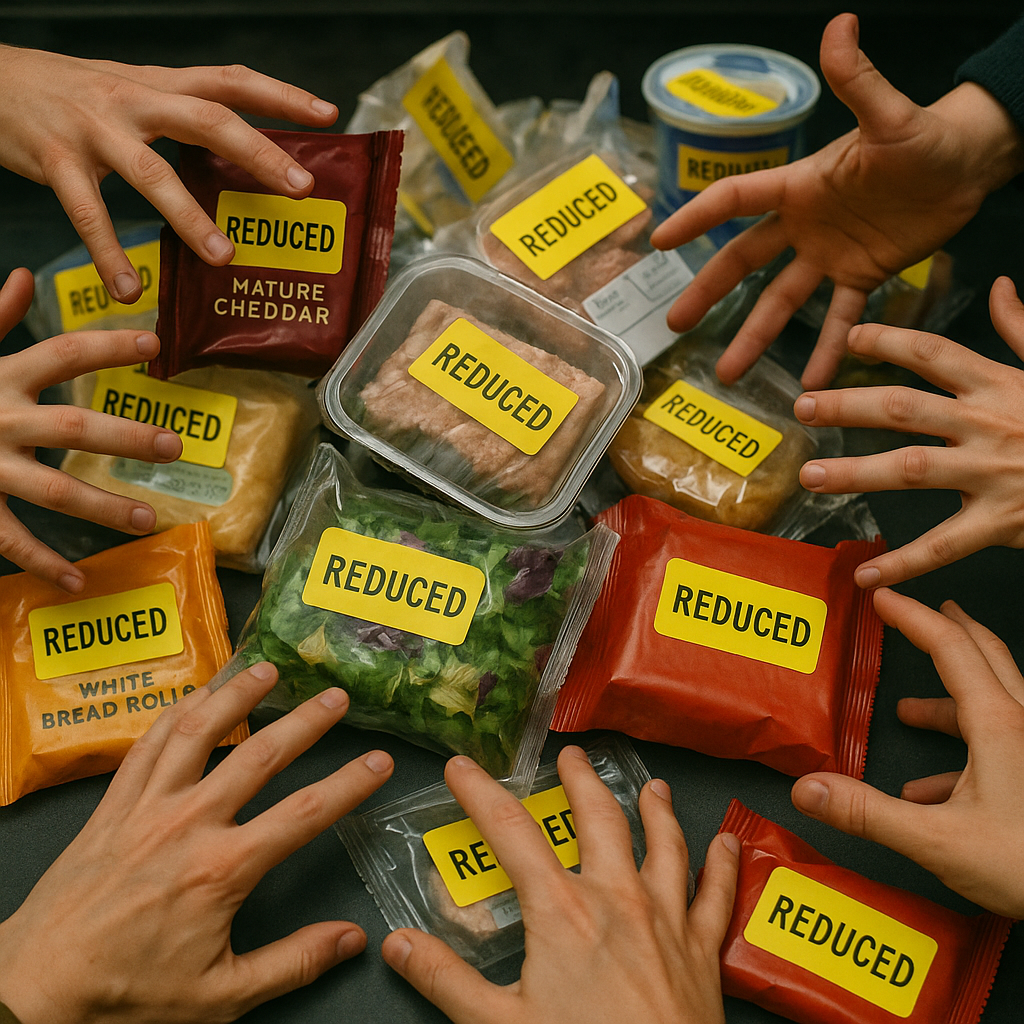
At 17:45, a quiet cult queues outside Woolworths clutching thermal bags. After 18:00, staff slap on yellow stickers discounting perishables 30–50 %. One UNISA student funds her textbooks by reselling discounted gourmet salads at half retail; she clears R1 800 a month, enough for data and taxi fares. Others arrive with battery-operated card machines, supplying inner-city restaurants with yellow-sticker fillets at a markup but still below wholesale. The after-hours aisle is a bazaar where sell-by dates equal opportunity.
Barter has gone digital. Facebook group “Barter-Barter SA” logged 18 000 successful food swaps in 2023: butternut for dish-washing liquid, home-made jam for cheddar off-cuts. In rural Eastern Cape, a 2.5 kg live chicken still trades like currency - two litres of paraffin or four cabbages. Meanwhile, single-serve 50 ml oil sachets sell for R2.50, translating to R50 per litre, triple the two-litre bottle price. They function as micro-loans: repay R3 tomorrow for today’s R2.50 sachet, a weekly interest rate of 20 % that undercuts mashonisa loan sharks. Roughly 38 % of local cooking-oil revenue now comes from sachets under 100 ml, proving that poverty-level demand can redefine product formats.
The next price shock is already in the pipeline - water. A meat-based dinner carries 1 800 L of virtual water; its plant-based twin only 450 L. Rand Water forecasts a 17 % supply deficit by 2030, prompting Spar to pilot “water-footprint” shelf labels. Early adopters are pivoting: beetroot over green beans, millet over rice, greywater from bathing tanks to spinach crates. The joke in township WhatsApp groups is that the 2025 smart shopper will carry two calculators - one for rand, one for litres. Every tomato is now a case study, every swipe of a card a chess move against macro-forces no trolley can outrun.
How are South Africans combating rising food prices?
South Africans are employing a variety of innovative strategies to counter escalating food costs. These include forming WhatsApp groups for coordinated bulk shopping, maximizing the benefits of loyalty cards, and meticulously identifying 'shrink-flation' where product sizes decrease while prices remain stable or increase. Many are also cultivating their own vegetables in backyard gardens, using specialized apps to compare prices and access small loans for groceries, bartering food items, and strategically purchasing discounted perishables to stretch every rand.
What does the 'R5-to-R5,000 Food Squeeze' refer to?
This phrase vividly illustrates the drastic decline in purchasing power in South Africa over the past 25 years. A R5 coin that once bought a substantial meal in 1998 can now barely afford a single bubblegum. The 'R5,000' refers to the estimated monthly cost of a basic 'nutrition basket' for a family of four, which significantly outstrips the median formal worker's salary, indicating a severe squeeze on household budgets.
How do South Africans use technology and community to save on groceries?
Technology and community efforts are central to saving. WhatsApp groups facilitate 'township loops' for shared bulk buying trips, enabling participants to access wholesale prices and fresh produce from various vendors. Loyalty cards are treated as 'parallel bank accounts,' with savvy shoppers converting points to fuel vouchers or preloading cash for significant returns. Apps like Zulzi provide real-time price comparisons, while Yebo Fresh allows credit-based pre-orders for 'stokvel hampers.' These tools empower consumers to make informed choices and access deals.
What impact has 'shrink-flation' had on South African shoppers?
'Shrink-flation' has transformed shoppers into vigilant 'label detectives.' Consumers actively monitor product weights and quantities, sharing instances of reduced sizes on social media platforms like Facebook mom-groups. Retailers have even resorted to 'shrink amnesty' weeks to temporarily revert to original pack sizes and prevent boycotts, highlighting the significant consumer awareness and pushback against this practice.
How are social grants and gardening contributing to food security?
Although the R350 Social Relief of Distress grant is often seen as minimal, grocers have responded by creating 'R350 bundles' of essential items, effectively treating it as a 'thirteenth cheque' for recipients. Backyard gardening has seen a boom, with seed sales for vegetables like kale and spinach soaring. Innovative methods like wicking crates and shade-net tunnels allow households to produce significant amounts of their own food, drastically reducing their weekly vegetable bills and improving food security.
What are some emerging trends in grocery shopping and food access in South Africa?
Emerging trends include the practice of 'yellow-sticker' shopping, where consumers queue after hours at supermarkets like Woolworths to purchase discounted perishables, sometimes reselling them for profit. Bartering has gone digital via Facebook groups, enabling food swaps. The sale of single-serve sachets of oil, though more expensive per litre, functions as a micro-loan system. Looking ahead, the focus on water scarcity is leading to 'water-footprint' labels and a shift towards more water-efficient food choices, indicating that future shopping decisions will likely involve both financial and environmental considerations.

Isabella Schmidt is a Cape Town journalist who chronicles the city’s evolving food culture, from Bo-Kaap spice merchants to Khayelitsha microbreweries. Raised hiking the trails that link Table Mountain to the Cape Flats, she brings the flavours and voices of her hometown to global readers with equal parts rigour and heart.
View all articles →