
New species named after CapeNature ecologist Dr Martine Jordaan
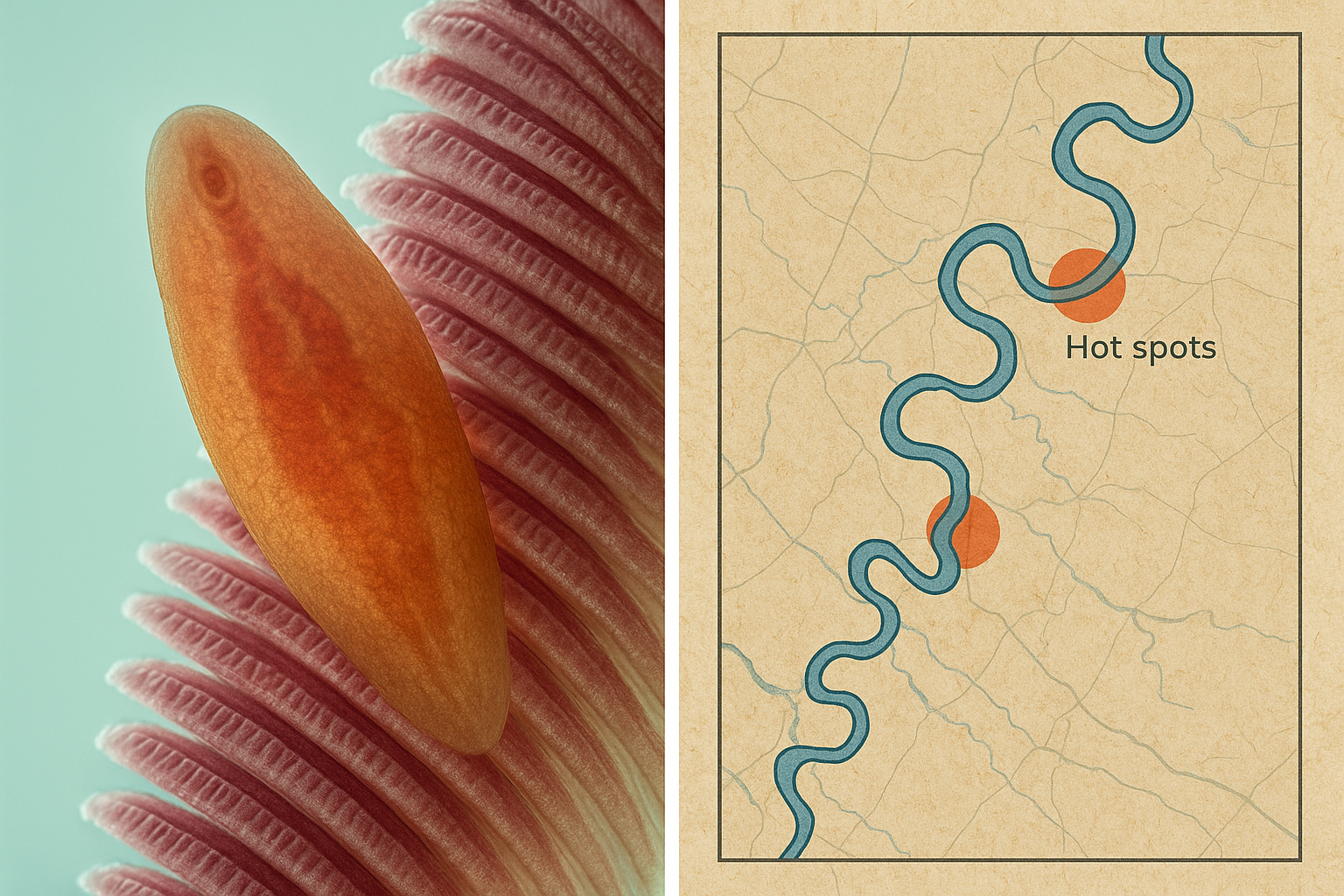
Discover Paradiplozoon jordaanae, a new monogenean species from South Africa's Cederberg rivers, revealing host-parasite evolution & conservation insights.
The Paradiplozoon jordaanae is a tiny flatworm that lives on fish in a special river in South Africa. It helps us understand how healthy the river is because changes to the fish quickly affect the flatworm. When the river gets too hot, the flatworm can hurt the fish more, making the river sicker. Scientists are using this little worm to learn how to keep the river and its fish safe, even making it a star in educational shows to teach kids about nature.
How does the Paradiplozoon jordaanae flatworm impact fish and river ecosystems?
Paradiplozoon jordaanae is a monogenean flatworm that co-evolved with native Clanwilliam redfin and sawfin in the Olifants-Doring river system. It acts as a living barometer for river health, with abrupt shifts in fish communities rapidly impacting its life cycle. Under stress, like drought-induced heat, parasite burden can increase, accelerating ecosystem collapse.
Get Cape Town news in your inbox
Stay updated with the latest stories from the Mother City.
1. A Speck on a Gill-Net: From Casual Glance to Taxonomic Spotlight
Tiny, translucent and scarcely the width of a match-head, the flatworm lay clamped to the delicate red comb of a Clanwilliam redfin for millennia before anyone bothered to notice. Its official debut did not unfold as a horror scene of dying fish or a lab-bench eureka, but in the low-key bustle of a 2017 health check. Dr Martine Jordaan had just eased a redfin into anaesthetic when pale, pitted scars on the fish’s gill arches caught her eye. She clipped a thumbnail-sized sliver of tissue, pressed it between two glass slides, and dropped the makeshift sandwich into a plastic vial. The tagged fish swam off; the slide travelled 300 km south to a diesel-powered field station, then 600 km north to North-West University’s parasitology lab whose cabinets now safeguard more than 12 000 reference slides.
The hunt for a name turned into a six-year relay race between rugged mountain streams and humming fluorescence microscopes. Researchers lugged generators, surfed genomic databases and swapped stories with rangers who know every pool by its informal nickname. The parasite’s rear attachment disc - the opisthaptor - already appeared as the tell-tale double-X shape of its genus, yet its tiny hooks measured four micrometres shorter than those of Paradiplozoon ichthyoxanthon, the only western-escarpment cousin known at the time. A 742-base snippet of the 28S ribosomal gene differed by 2.3 %, safely above the 1 % threshold that usually signals “potential new species” among monogeneans. Even so, numbers on a spreadsheet were not enough.
Complications arose because the Matjies River fish also hosted an undescribed gyrodactylid whose crowded presence warped crucial measurements. The breakthrough arrived when post-doctoral researcher Nokuthula Mabika revived a three-decade-old enzymatic bath originally cooked up for salmon lice. The tweaked protocol dissolved surrounding tissue without eroding the calcium phosphate of the tiny hooks. Under crossed polarised light, the hooks revealed a pattern of pits and ridges as distinctive as a fingerprint. That constellation finally convinced the conservative panel of the International Monogenean Working Group that a new voice had entered the choir.
2. Written in Stone and Water: Parasite, Host, and an Ancient River Basin
The flatworm’s biography is inseparable from the Clanwilliam redfin and the equally endemic Clanwilliam sawfin - two robust cyprinids whose ancestors cruised these waters long before the Cape Fold Belt began to rumple 200 million years ago. The Olifants-Doring network, nourished by the Matjies and Rondegat tributaries, stands as one of only two South African river basins listed simultaneously as a freshwater ecoregion and a global biodiversity hotspot in WWF’s “Rivers of Life” scheme. Step-deep granite seeps and bedrock kettles act as natural laboratories, isolating fish lineages - and the worms riding them - in micro-vessels of evolution.
Mitochondrial DNA surveys led by Jordaan’s crew show that redfins living in adjoining headwater streams can differ by up to 2.8 %, a divergence that translates to roughly 700 000 years of separation. The implication is elegant and sobering: the parasites have been co-evolving for at least as long, their own branching events locked to the geological calendar. For ecologists, monogeneans serve as living barometers; any abrupt shift in the fish community ricochets through the parasite’s life cycle within weeks, telling a story faster than quarterly fish counts ever could.
The cautionary tale arrived in 2014 when invasive smallmouth bass slipped past the Clanwilliam Dam tailrace. Hitch-hikers on the bass were Salsuginus flatworms - strangers to the Olifants basin. Within twenty-four months Jordaan’s snorkel crews detected Salsuginus on 42 % of native cyprinids downstream of the wall. The finding drove home an uncomfortable truth: even streams that look crystal clear to hikers can already be staging silent epidemics. In contrast, the newly named Paradiplozoon jordaanae still clings exclusively to the native redfin and sawfin, a small but cheering endorsement that intact water quality and natural flow regimes can still protect ancient alliances.
3. When Heat Becomes a Weapon: Parasites Thrive While Hosts Collapse
Between 2017 and 2023 the lower Rondegat forfeited 18 % of its base-flow to illegal blueberry farms that perforate the Table Mountain Sandstone aquifer with shallow boreholes. In 2022 the drought delivered the knockout punch: the riverbed lay bone-dry for 37 consecutive days - the longest stretch since monitoring began in 1978. Thermistors clipped to submerged rocks recorded afternoon peaks of 31 °C, a full five degrees above the lethal threshold measured for redfin in lab respirometry trials run by honours student Ashleigh Ruiters.
When water finally trickled back, fish counts dropped by half. Paradoxically, individual survivors carried a far heavier parasite burden. Pre-drought redfin averaged eleven P. jordaanae worms each; post-drought survivors lugged seventy-three. At that density the tiny flatworms stitched a living curtain across the gill lamellae, tipping overheated fish into osmotic free-fall. The episode supports a growing hypothesis: as rivers warm, faster larval development can briefly turbo-charge parasite transmission even while host numbers crash, accelerating ecosystem collapse long before fishermen notice empty pools.
These dynamics now complicate every conservation blueprint. CapeNature’s 2018 Biodiversity Management Plan lists seventeen interventions - alien-fish eradication, rock-ramp fishways, stewardship agreements - yet none mentioned parasites until 2020. An addendum, drafted jointly by Jordaan, North-West University parasitologists and SANParks aquatic scientists, proposes three concrete changes: treat monogenean diversity as a core indicator in the provincial River Health Programme, impose 14-day quarantines combined with gill screenings for any translocated fish, and compile a thermal-tolerance database for native monogeneans so that water-release models can include parasite-safe thresholds. Funding is already earmarked to insert PIT tags and fingertip-sized temperature-depth loggers into fifty redfin, generating a 90-second-interval map of where fish - and their worms - feel most at home.
4. From Microscope Slide to Storybook: Flatworms as Outreach Heroes
In 2023 CapeNature’s Conservation Caravan - an overland truck that parks at school gates and farm shows - unveiled a fold-out kiosk nicknamed “the micro-aquarium.” Through a bench-top lens children watch live P. jordaanae thrash their twin anchors in a drop of saline while interpreters explain that every sip of river water carries more ecological data than a week’s game drive in Kruger. Visitor logbooks rank the worm station second only to the raptor flight display, and post-visit quizzes show a 40 % jump in learners who can correctly define “endemic.” By personifying an otherwise invisible layer of biodiversity, the parasite has achieved what photogenic megafauna usually monopolise: turning abstraction into emotion.
The tale, however, is still being written. PhD candidate Nombuso Khumalo recently filtered 200 ml of Matjies River water and fished out 14 COI gene variants belonging to monogeneans that vanish into thin air when compared to every barcode in GenBank or BOLD. Whole-genome sequencing is on the to-do list, but logistics loom large: the study site lies four kilometres beyond the final tyre track, and liquid nitrogen must be hiked in to stop genetic decay. A drone-based cold-chain pilot, inspired by medical-supply drops in rural Malawi, could compress the journey from 36 hours to four, ensuring DNA crisp enough for long-read sequencers that can untangle the repetitive ribosomal regions vital for species boundaries.
Back on the riverbank Jordaan keeps a respectful distance from mascot status. “Parasites score low on the cute-and-cuddly index,” she jokes, waving away cigarette smoke from a passing angler while balancing a stainless-steel tray. A freshly euthanised sawfin glints gun-metal blue under the sunrise. She lifts the operculum, revealing gills freckled with sesame-seed flatworms, each one now taxonomically wedded to her surname. With tweezers calibrated to exert no more than 20 milliNewtons - just enough to pluck a worm yet spare the filament - she drops a specimen into molecular-grade ethanol. Somewhere downstream the river purrs against ledges of 600-million-year-old gneiss, oblivious to the fact that its tiniest emissary has become the newest diplomat in the ancient, three-way negotiation between rock, water and life.
What is the Paradiplozoon jordaanae?
The Paradiplozoon jordaanae is a tiny flatworm, a type of monogenean parasite, that lives on the gills of native fish, specifically the Clanwilliam redfin and sawfin, in the Olifants-Doring river system in South Africa. Despite its small size, it plays a crucial role as a "living barometer" for the health of the river ecosystem.
How was the Paradiplozoon jordaanae discovered and identified as a new species?
The flatworm was first noticed in 2017 by Dr. Martine Jordaan during a routine health check of a Clanwilliam redfin. Pale, pitted scars on the fish's gills led to further investigation. The identification as a new species was a six-year process involving detailed microscopic examination of its unique attachment disc (opisthaptor) and tiny hooks, genomic analysis of its 28S ribosomal gene, and the development of a specialized enzymatic bath to overcome measurement challenges. This meticulous work, which included comparing it to known species like Paradiplozoon ichthyoxanthon, ultimately convinced the International Monogenean Working Group.
How does this flatworm indicate the health of the river?
The Paradiplozoon jordaanae acts as a sensitive indicator of river health because its life cycle is rapidly affected by changes in the fish community and environmental conditions. For instance, if the river experiences stress, such as increased temperatures due to drought, the parasite burden on fish can significantly increase. This heightened parasite load can then accelerate the decline of the fish population and the overall ecosystem, making the flatworm a direct reflection of the river's well-being.
What happens to the flatworm and fish during periods of river stress, like drought and heat?
During periods of stress, such as droughts that lead to higher water temperatures, the P. jordaanae can become more detrimental to its host fish. For example, during a 2022 drought where temperatures reached 31 °C (5 degrees above the redfin's lethal threshold), fish populations plummeted. Paradoxically, the surviving fish carried a much heavier parasite load, with an average of 73 worms per fish compared to 11 pre-drought. This increased parasite burden can further weaken already stressed fish, leading to osmotic free-fall and accelerating ecosystem collapse. Scientists hypothesize that warmer temperatures might even briefly boost larval development and parasite transmission.
How is Paradiplozoon jordaanae being used for education and conservation?
This tiny flatworm has become an unexpected star in educational outreach. CapeNature's "Conservation Caravan" uses a "micro-aquarium" kiosk where children can observe live P. jordaanae, learning about biodiversity and endemism. By making this otherwise invisible creature tangible and relatable, it helps turn abstract ecological concepts into engaging lessons. Conservation efforts are also integrating the flatworm; an addendum to CapeNature's Biodiversity Management Plan proposes treating monogenean diversity as a core indicator for river health, implementing quarantines with gill screenings for translocated fish, and developing a thermal-tolerance database for native monogeneans to inform water-release models.
What challenges are faced in studying and conserving the Paradiplozoon jordaanae and its ecosystem?
Studying and conserving P. jordaanae involves several challenges. The remote location of the study sites, often kilometers beyond accessible roads, makes logistics difficult, especially for maintaining cold chains for genetic samples (e.g., liquid nitrogen needs to be hiked in). The presence of other undescribed parasites can also complicate measurements and identification. Furthermore, invasive species, such as the Salsuginus flatworms that arrived with invasive smallmouth bass, pose a threat by introducing new parasites to native fish. Conservation efforts must also adapt to changing environmental conditions like increased drought and illegal water abstraction, which directly impact the flatworm's host and the river's health.

Chloe de Kock is a Cape Town-born journalist who chronicles the city’s evolving food culture, from township braai joints to Constantia vineyards, for the Mail & Guardian and Eat Out. When she’s not interviewing grandmothers about secret bobotie recipes or tracking the impact of drought on winemakers, you’ll find her surfing the mellow breaks at Muizenberg—wetsuit zipped, notebook tucked into her backpack in case the next story floats by.
View all articles →