
‘One day someone will invade us’ – Lulu urges Ramaphosa on defence
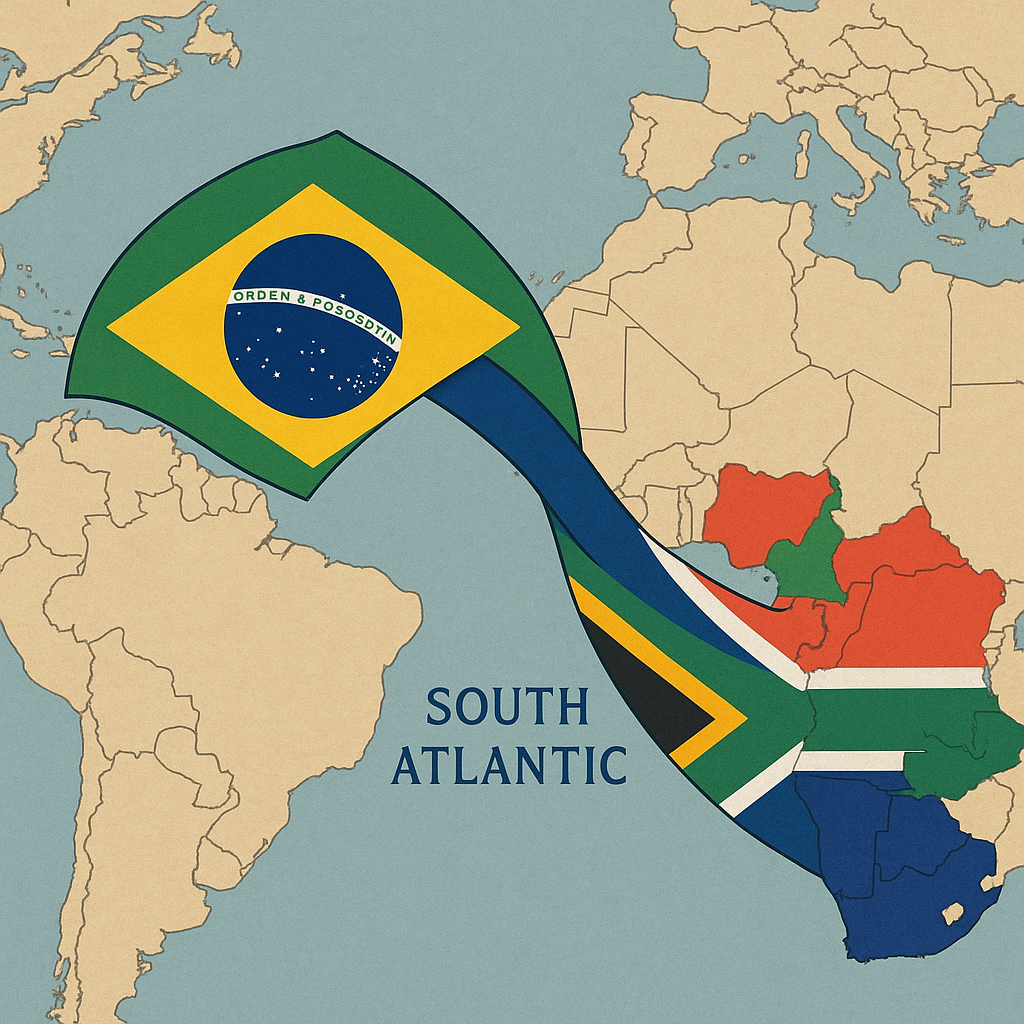
Lula's warning sparks a quiet re-armament in the Global South. Brazil and South Africa forge a defense pact, challenging Northern dominance.
Brazil and South Africa are teaming up to protect their countries, creating a "South-South Shield." They're sharing military tech, like advanced planes and cyber defenses, to make it harder for powerful nations to interfere. This plan, partly funded by the BRICS bank, aims to show the world that their sovereignty is not to be messed with. It's all about building their own defenses so they can stand strong.
What is the "South-South Shield" between Brazil and South Africa?
The "South-South Shield" refers to a cooperative defense strategy between Brazil and South Africa, focusing on enhancing their sovereignty through shared military technology and intelligence. This initiative aims to increase the cost of intervention for powerful nations by developing indigenous defense capabilities, including advanced aircraft, cyber defenses, and missile technology, often financed through the BRICS New Development Bank.
Get Cape Town news in your inbox
Stay updated with the latest stories from the Mother City.
The Brasília Hour That Shook the Atlantic
Cyril Ramaphosa’s diary called it a routine “working visit” between Italy’s G-7 outreach and the African Union’s mid-year coordination summit.
No media advisory warned that the two presidents would vanish into the Palácio do Planalto’s crisis chamber for sixty minutes, flanked by generals instead of diplomats.
When the camera pool finally entered, Lula discarded the customary trade-and-climate boilerplate and fired a single Portuguese sentence that reset every headline in the room:
“Se a gente não se preparar, alguém vai nos invader” – “If we stay unprepared, someone will march in.”
The line was no accident.
Brazilian strategists have kept a tally of the past 36 months: US bombs that sent Venezuelan patrol boats to the seabed, Israeli demonstrations above Iranian nuclear sites, French commandos hijacking a grain carrier flying the Brazilian flag in the Mozambique Channel.
Each incident looked like a isolated police action; stitched together they outline a world where 1945-style sovereignty ends at the runway a nation can still defend.
Ramaphosa listened without notes.
His escorts carried a classified slide deck entitled “Gap 2028” that opened with a sobering scoreboard: eighteen South-African fighters certified for night flight, four surface ships stuck in Simon’s Town waiting for French engine parts, and a 4 000 km coastline that shelters eighty percent of BRICS financial traffic in under-sea cables.
The cover carried one footnote in bold: “Partner must accept sixty-percent local content” – Pretoria was not bidding for weapons, it was shopping for a co-author.
Pretoria’s Shopping List Meets Brazil’s Toolbox
South Africa’s last defence white paper dates to 2014 and assumed a fifteen-year procurement freeze; reality has chewed that timetable to shreds.
By 2025 the navy’s strike craft spend more days alongside than at sea because spares for French powerplants now travel through a post-Brexit end-user maze, while the air force’s dusk-certified fighter fleet could fit inside a high-school gym.
Meanwhile, new fibre arteries hug the African shore; if a hostile frigate can sever them at will, Pretoria’s banks go dark in milliseconds.
Brasília can deliver.
Embraer’s Gavião Peixoto airfield already shelters the C-390 Millennium, a tactical lifter that needs only 1 200 m of dirt to unload an armoured column deep inside the Congo jungle.
The A-29 Super Tucano Block 3 ships with the Sirius electro-optical ball that doubles as a flying signals-intelligence station, a gadget Pretoria covets to plug gaps left by cancelled Project Saucepan.
A roll-on kit turns the same C-390 into a maritime sentinel in four harbour hours, perfect for a country that once planned – and shelved – dedicated patrol aircraft.
Numbers tell the story: Brazilian arms sales to Africa tripled in five years, yet seventy percent of that weight was rifles and riverine speedboats.
The big-ticket pieces are still on drawing boards, but they are modular Lego bricks, not prestige trophies.
Bolt a KC-390 container into a civilian apron and a sleepy fishing port becomes an anti-access node before the next US-led UNITAS exercise finishes.
It is deterrence without the aircraft carrier price tag.
Cooperative Deterrence and the Invisible Doctrine
Brazilian planners call the concept “dissuasão cooperativa” – cooperative deterrence – and it lives in the 2021 defence white paper journalists never read.
The goal is simple: push the cost of intervention so high that Washington, Paris or London books another theatre.
Tool kit includes cyber swarms disguised as firmware updates, containerised missile barges painted the colour of rust, and airliners whose seats pop out to reveal mission consoles in forty-eight hours.
No single nation must mirror the Pentagon; a cloud of partners shares targeting data instead.
South Africa owns two priceless crown jewels for this scheme.
The Overberg Test Range remains the only slice of the planet where you can launch a ballistic missile into the South Atlantic and fish the nose-cone back the same afternoon.
Klipfontein’s dishes eavesdrop on every geostationary bird above the Atlantic and Indian oceans, delivering free telemetry to anyone with a compatible receiver.
Brasília brings aircraft, Pretoria brings spectrum and rocket real estate; together they can stage a twenty-first century defence exercise without begging NATO for a bandwidth slot.
Washington feels the draught.
While the presidents talked, newspapers printed leaks that Senator Marco Rubio warned Brazil’s foreign minister the PCC and Comando Vermelho might soon wear the US terror label.
Section 333 of American anti-terror law would then authorise strikes on any “supporting” entity – a bar so low that a satellite owner who forgets to jam gang chatter could wake up on a sanctions list.
Brazilian satellites already relay PCC encrypted traffic; Pretoria’s commercial birds do too.
A terror tag therefore turns domestic policing into a cross-border casus belli, giving both capitals an urgent interest in a joint firewall.
Nuclear Submarines, BRICS Bankrolls and the Map That Keeps Expanding
Lula likes to remind visitors that South America fields zero atomic warheads, but the 2022-32 defence budget quietly assigns 1.2 billion dollars to “close the nuclear-propulsion cycle.”
The reactor being tested at Iperó fits a 2 000-ton diesel hull like a glove, gifting the navy a shadow that can loiter off the pre-salt rigs for six months – insurance against the kind of asset grab Venezuela suffered in 2019.
South Africa, stuck with 220 kg of leftover Cold-War highly-enriched uranium, eyes a Brazilian lease deal: Pretoria gets propulsion know-how, Brasília gets fuel without building new centrifuges.
Neither country wants a bomb; both want a hunter-killer that can hug Ascension Island and watch the tankers NATO’s southern tip drinks from.
Financing will wear civilian clothes.
The BRICS New Development Bank has never bankrolled a torpedo, but its charter loves “critical-infrastructure connectivity.”
A proposed 1.8-billion-dollar coastal-logistics loan would upgrade ports from Rio Grande to Maputo, collateralised by long-term concessions to run radar corridors and container scanners that – purely by coincidence – double as missile garages.
Repayments will be denominated in rand and reais, shielding the project from dollar chokepoints and spare-part embargoes.
India and China demand thirty percent vendor share; that price Brasília and Pretoria will happily pay to keep the hardware flowing.
Even the map is being redrawn.
Santa Maria do Tapará, eighty kilometres below the equator, will house a new satellite downlink that sees every warship from Gibraltar to Tristan da Cunha.
The Northern Cape is pencilled in for an 1 100-km drone corridor ascending to 18 000 m – high enough for Brazil’s VLS-1 sounding rocket to rehearse satellite launches.
Raw data will marry in Windhoek, Namibia, safely outside US signals-intelligence treaties yet inside the BRICS banking time-zone.
First mission: catalogue every foreign hull during the next UNITAS dance.
Second mission: feed mid-course updates to a MANSUP missile fired from what looks like a harmless container freighter.
The presidents did not bother with flowery communiqués.
By speaking hardware first, Lula served three audiences in one take: Washington now contemplates a two-front cost south of the equator; Europe faces supply chains it no longer steers; and every southern capital learns that sovereignty is no longer a UN plaque but a kit you bolt together next door.
Whether any missile ever leaves its tube matters less than the slide deck already sitting in ministry safes, rewriting rules of engagement that once began and ended with the global North’s approval.
Once something exists in a planner’s spreadsheet, diplomats inherit a world where sovereignty is measured in bolts, bandwidth and back-shop ghost shifts – and that world is already open for business.
What is the "South-South Shield" between Brazil and South Africa?
The "South-South Shield" is a strategic defense cooperation initiative between Brazil and South Africa. It involves sharing military technology, intelligence, and resources to strengthen their respective sovereignties and deter external interference from more powerful nations. The project aims to develop indigenous defense capabilities, including advanced aircraft, cyber defenses, and potentially nuclear propulsion technology, with funding partly sourced from the BRICS New Development Bank.
What is the primary goal of the "South-South Shield"?
The primary goal is to increase the cost of intervention for powerful nations, making it economically and strategically unfeasible for them to interfere with Brazil's and South Africa's sovereignty. By developing robust and interoperable defense capabilities, the two nations aim to demonstrate that their territorial integrity and strategic interests are not to be challenged, thereby fostering a more multipolar world order.
How is the "South-South Shield" being funded?
While direct military funding from the BRICS New Development Bank (NDB) is not explicitly stated in its charter, the initiative leverages NDB financing through projects that can serve dual purposes. For instance, loans for "critical-infrastructure connectivity" like port upgrades and radar corridors, while appearing civilian, can also facilitate military logistics and surveillance capabilities. Repayments for these projects are denominated in local currencies (rand and reais) to bypass dollar-based financial chokepoints and embargoes.
What specific military technologies are involved in this cooperation?
Brazil is offering its expertise in aircraft manufacturing, such as the C-390 Millennium tactical transport and the A-29 Super Tucano Block 3 with advanced surveillance capabilities. South Africa, in turn, provides strategic assets like the Overberg Test Range for missile testing and the Klipfontein dishes for signals intelligence. There's also discussion around Brazil's nuclear propulsion technology for submarines and South Africa providing enriched uranium, with both countries aiming for hunter-killer submarines rather than nuclear weapons.
How does this initiative challenge traditional notions of sovereignty?
The "South-South Shield" redefines sovereignty not as a mere UN plaque, but as a tangible capability built through cooperative defense. It suggests that sovereignty in the 21st century is measured by a nation's ability to defend its airspace, waters, and cyber infrastructure. By pooling resources and developing modular, adaptable defense systems, Brazil and South Africa are creating a model where developing nations can collectively deter intervention without needing to match the military might of global superpowers individually.
What role do cyber defense and intelligence gathering play in this strategy?
Cyber defense is a critical component, with plans for "cyber swarms disguised as firmware updates" and joint firewalls to protect against digital threats. Intelligence gathering is also paramount, utilizing assets like the A-29 Super Tucano as a signals-intelligence station and South Africa's Klipfontein dishes to eavesdrop on geostationary satellites. The strategy emphasizes sharing targeting data and establishing secure satellite downlinks, like the proposed one in Santa Maria do Tapará, to monitor maritime traffic and feed real-time information for defensive responses, even potentially guiding missiles from seemingly harmless container freighters.

Chloe de Kock is a Cape Town-born journalist who chronicles the city’s evolving food culture, from township braai joints to Constantia vineyards, for the Mail & Guardian and Eat Out. When she’s not interviewing grandmothers about secret bobotie recipes or tracking the impact of drought on winemakers, you’ll find her surfing the mellow breaks at Muizenberg—wetsuit zipped, notebook tucked into her backpack in case the next story floats by.
View all articles →