
Overberg rail plan signals freight shift
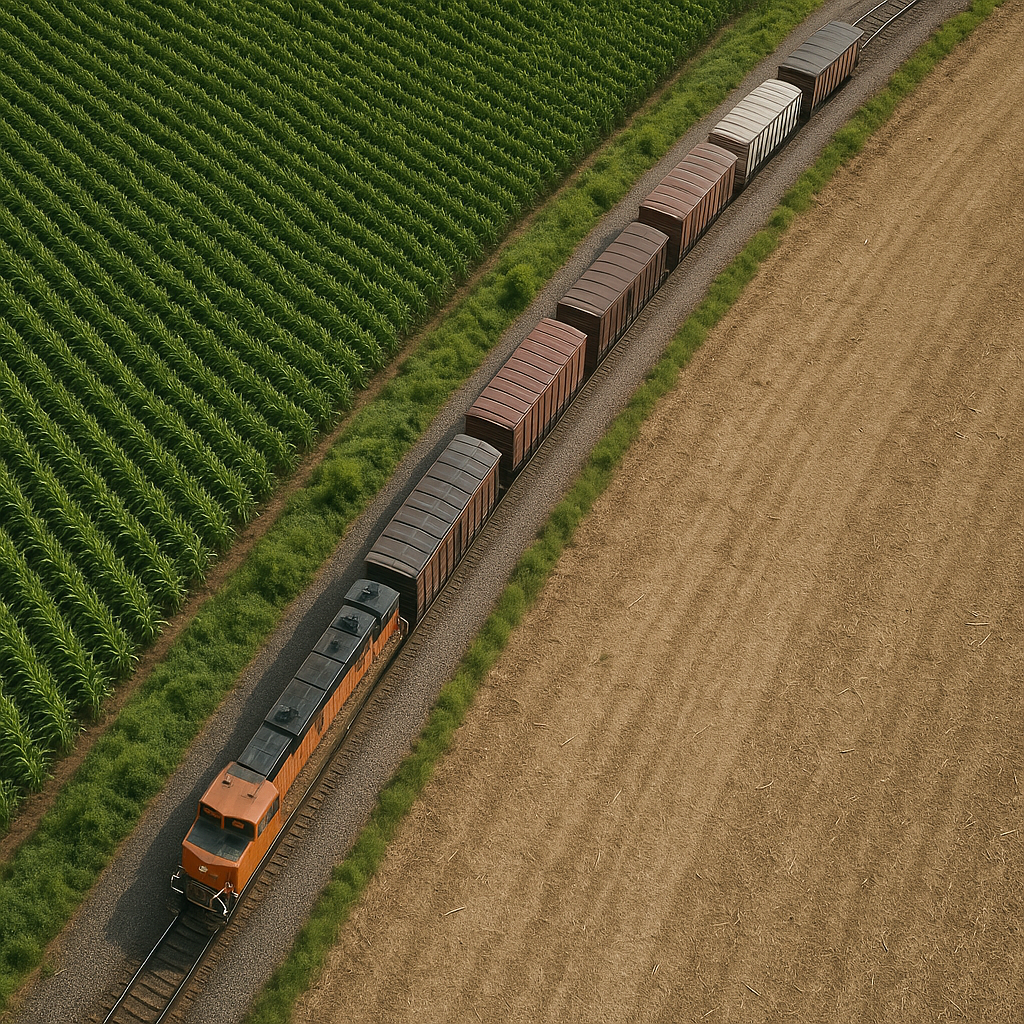
South Africa's Overberg Rail Freight Corridor is being redesigned to transform agricultural logistics, boosting exports & farmgate margins.
Imagine a dusty old railway, barely used, suddenly bursting with new life! This isn't just about fixing tracks; it's about making farms richer, roads safer, and creating tons of jobs. The plan will swap noisy trucks for quiet, efficient trains, saving money and the environment. Soon, fresh produce and grains will zoom to markets, helping the whole region thrive. It's a journey from sleepy past to a bustling, bright future!
How will the re-engineering of the Overberg rail spine benefit the region?
The re-engineered Overberg rail spine will benefit the region by significantly reducing grain transport costs, decreasing road congestion and accidents, creating employment, and enabling the export of diverse agricultural products more efficiently. It also promises substantial carbon credit income and improved product quality due to better transport conditions.
Get Cape Town news in your inbox
Stay updated with the latest stories from the Mother City.
Harvest at the Edge: Why a 130-Year-Old Line Suddenly Matters
Between 1892 and 1910 engineers pushed a slender steel ribbon through the wheat sea south-east of Cape Town so wagons loaded with wool, stone fruit and grain could reach the newly mechanised port. The rails, sleepers and ash ballast are still the same vintage: 30 kg/m steel rolled in 1976, ties drifting apart after every summer blaze. Yet the paddocks on both sides have quietly turned into one of the planet’s most dependable export breadbaskets. Winter cereals, irrigated summer barley and a 250-day canola window deliver the lowest saturated-fat oil on record.
Every 100 km a truck hauls this grain adds roughly R 67 to the landed price. With 1.2 million tonnes produced within 60 km of the track, that invisible surcharge has gnawed at farm margins for twenty years. Spread a map and the opportunity glares back: 1 050 on-farm silos, 18 feed mills, three malt houses and an oil-seed crusher all sit inside a 15 km buffer from the existing formation. No dynamite or land claim is required - only fresh metal, ballast and modern signalling.
Convoy of Costs: The Volume Already Stuck on the Highway
Right now 720 000 t of Overberg grain head for Gauteng every year and 94 % of it bounces up the N1 and N2 in trucks. Peak season funnels 2 100 rigs a week through Somerset West - one articulated monster every 48 seconds between dusk and dawn. Crash hotspots migrate eastward at roughly 9 km per year, shadowing the harvest wave.
Transnet’s 2022 waybill audit shows that 68 % of the barley reaching SAB’s Alrode maltings left the Caledon district in 34-ton interlinks. The corridor plan targets these “ghost tonnes” first; it does not try to invent mythical new traffic the way 1980s branch-line studies did. Shift the existing load to steel and everything else - canola, citrus concentrate, malt, abalone - becomes gravy.
Three Price Tags to Catch Up With Time
-
Tier 1 – “Stop the Bleeding” – R 1.4 billion*
Lay 212 km of 48 kg/m continuously-welded rail, reset 1 040 turnouts to 26 m spacing and import 400 000 pre-stressed concrete sleepers from Morocco (18 % cheaper even after rebates). Replace 76 level crossings with SIL-4 barriers; 62 % of current night-time prangs happen when harvest convoys try to outrun 40 km/h locomotives. -
Tier 2 – “Speed is Money” – R 0.9 billion*
GSM-R radio blocks piggy-back on PRASA’s commuter upgrade, slicing headways from 45 min to 12 min. Extend 60 km of passing loops to 1 800 m so 54-wagon, 3 900 t trains can meet without splitting. Build a CTC hub at Caledon; it will be the first “dark territory” conversion outside the coal line. -
Tier 3 – “Chill the Chain” – R 1.2 billion*
String 25 kV catenary only over the 42 km section that will move reef-bound reefer containers. Electric haulage chops traction cost by 32 % and frees 2 800 l of tank space for back-haul citrus concentrate. Four grid-tied PV yards will feed 12 MW of cold-storage at Belcon during off-peak, turning the inland terminal into a virtual Eskom battery that earns demand-side rebates.
Randfontein-by-the-Sea: Inventing a Dry Port in 16 Extra Kilometres
Belcon lies 1 147 rail kilometres from the coast and only 16 km farther than the truck route - an acceptable detour now that Johannesburg’s City Deep is grid-locked. The redesign gives it three super-powers. First, a 750 m aerial rope-way lifts pallets straight from wagon roof to distribution deck, erasing 38 000 forklift shuttles a year. Second, 18 000 frozen pallet slots at –25 °C can swallow an entire week of Western Cape lamb, ending peak-season harbour queues. Third, a bonded customs hall flips trade direction: Gauteng importers can clear Cape cargo inland, trimming five days from landed lead-times.
Turning Steel into Cash: Slots, Carbon Credits and Third-Party Access
National rail tariffs are still distance-based: 19 c per net-ton-km for grain, 44 c for reefers. The corridor will auction 52 north-bound and 48 south-bound slots every quarter under a “use it or lose it” rule. Modelling shows 65 % average fill already delivers an 11.4 % real IRR; add carbon-credit income from displaced trucks and the figure jumps to 15.7 %. Each 54-wagon set avoids 0.89 t of CO₂-equivalent - money that did not exist on the highway.
Because the Overberg line is one of nine routes singled out for third-party access under the 2023 Rail Economic Regulation Act, private operators can sign haulage deals while paying Transnet a track fee of seven cents per gross-ton-km. The auction price therefore stays clear of the politically charged general tariff schedule.
Wagons, Sensors and Hidden Barley Factories
South Africa has 28 000 surplus wagons rusting in sidings. The corridor snaps up 600 refurbished H-type covered hoppers for R 480 000 apiece - half the new-build price - and 180 retired citrus reefers from the Maputo run. A PPP with Toll Global fits RFID probes that ping humidity and CO₂ every 15 minutes; traders buy the data back as a quality premium, a revenue stream trucks never generated.
Road vibration and temperature swings shave 1.8 % off barley germination, forcing maltsters to top up with high-grade lots at R 285/t. A March 2023 trial train delivered 1 800 t to Alrode in 28 hours with a 0.7 °C variance; germination loss fell to 0.4 %, effectively conjuring 25 t of malting-grade barley out of thin air. Extrapolated over 240 000 t a year the saving equals R 38 million - enough to fund 7 km of new rail every season simply by keeping the crop cool and still.
Pay-cheques, Skills and the 42-Month Build
Construction will need 2 100 full-time workers for 42 months; 61 % will be hired within a 50 km radius. Operations lock in 340 permanent posts - drivers, shunters, cold-chain techs, data analysts - and another 1 100 indirect jobs in bagging and packaging. Transnet’s School of Rail already runs a simulator in Caledon High; 68 learners have passed 19-grade conductor modules, seeding a skills pipeline long before Esselenpark’s national campus catches up.
What Could Still Go Wrong?
Floods: the Klein-Brak smashed a 1-in-50-year peak in 2020 and scoured ballast from four bridges. Engineers will wrap piers in polypropylene geobags and 1.2 m rock aprons - already proven on the Olifants River bridge at Vredendal.
Wildfires: 46 % of sleeper rot starts when burn-offs jump the rail reserve. A R 12 million annual fire-patrol budget, co-financed by insurance rebates for 30 m firebreaks, will keep flame and steel apart.
Policy: third-party access could be axed after the 2024 elections. To isolate the risk, sponsors have registered the Overberg Rail Logistics Company in the Western Cape; assets can transfer to the entity even if Pretoria rewrites the rules.
Ledger of Funders: No Single Wallet Rules the R 3.5 Billion Pie
- DBSA: R 1.0 bn senior debt, 20-year, 9.1 % coupon
- IDC: R 0.7 bn convertible equity, becomes 24 % shareholding once throughput tops 1 Mt in any calendar year
- National Treasury’s Jobs Fund: R 0.4 bn grant, released against training certificates
- Old Mutual’s African Infrastructure Investment Fund: R 0.6 bn commercial-paper bridge, rolled every six months until IDC equity kicks in
- Transnet: R 0.35 bn in-kind - scrap rail, points and signals - staying beneath the public-finance borrowing ceiling
Clock That Ends in a Whistle: 180 Days to First Load
By December 2024 three pieces of paper must be signed:
1. A 15-year haulage contract with Grain SA covering 42 producer silos
2. An operating concession - whispers suggest GB Railfreight, already steering Kenya’s metre-gauge, is deep in the data room
3. NEMA approval for 25 kV electrification inside the orchid-rich Kogelberg Biosphere
If the ink dries on schedule, the first 54-wagon grain train will ease out of Caledon at 03:42 on 3 March 2025 - 117 years after the original “wool special” whistled the same route. This time a 4.5 MW Chinese-built loco, lidar scanning every sleeper, every stray sheep and every storm cloud that might wash the future into the sea, will haul the Overberg’s reborn economy toward Gauteng and the world.
[{"question": "### What is the Overberg Rail Spine re-engineering project?", "answer": "The Overberg Rail Spine re-engineering project is an initiative to revitalize an old, underutilized railway line in the Overberg region of South Africa. The project aims to modernize the infrastructure, replacing outdated rails, sleepers, and signaling systems. This transformation will shift agricultural transport from roads to rail, significantly benefiting the economy, environment, and job market in the region."}, {"question": "### How will this project benefit the Overberg region?", "answer": "The project will bring numerous benefits, including drastically reducing grain transport costs for farmers, alleviating road congestion and improving safety on major highways like the N1 and N2, and creating both direct and indirect employment opportunities during construction and operation. It will also facilitate more efficient export of diverse agricultural products, generate substantial carbon credit income, and improve product quality due to more stable rail transport conditions."}, {"question": "### What are the key stages or 'Tiers' of the project and their estimated costs?", "answer": "The project is divided into three tiers: Tier 1, 'Stop the Bleeding,' costs R 1.4 billion and focuses on foundational upgrades like new rails, sleepers, and modern level crossing barriers. Tier 2, 'Speed is Money,' at R 0.9 billion, introduces advanced signaling (GSM-R), extends passing loops for longer trains, and establishes a central traffic control hub. Tier 3, 'Chill the Chain,' costing R 1.2 billion, involves electrifying a section for refrigerated containers and building grid-tied PV yards for cold storage, reducing traction costs and offering demand-side rebates."}, {"question": "### How will the project help manage current road congestion and transport inefficiencies?", "answer": "Currently, a significant volume of Overberg grain (720,000 tonnes annually) travels to Gauteng by truck, leading to severe congestion and accidents, especially during peak season. The rail project targets shifting this existing load, particularly barley heading to maltings, to trains. By doing so, it aims to remove thousands of trucks from the roads weekly, making transport more efficient, safer, and environmentally friendly."}, {"question": "### What innovative solutions are being implemented for the 'dry port' at Belcon and cargo management?", "answer": "The Belcon facility will be transformed into a dry port with several 'super-powers.' These include a 750m aerial rope-way for efficient pallet transfer, 18,000 frozen pallet slots (-25°C) to handle significant volumes of Western Cape lamb, and a bonded customs hall that allows Gauteng importers to clear Cape cargo inland, reducing lead times by five days. Additionally, the project will repurpose existing wagons, fit them with advanced RFID probes to monitor humidity and CO2 for quality assurance, potentially creating new revenue streams from data."}, {"question": "### What are the main risks to the project and how are they being mitigated?", "answer": "Key risks include natural disasters like floods and wildfires, and policy changes regarding third-party access. Flood risks are being mitigated by reinforcing bridge piers with geobags and rock aprons. Wildfire risks will be addressed with an annual fire-patrol budget and insurance-incentivized firebreaks. To mitigate policy risks, the Overberg Rail Logistics Company is registered in the Western Cape, allowing asset transfer to this entity even if national rail regulations change after the 2024 elections."}]

Tumi Makgale is a Cape Town-based journalist whose crisp reportage on the city’s booming green-tech scene is regularly featured in the Mail & Guardian and Daily Maverick. Born and raised in Gugulethu, she still spends Saturdays bargaining for snoek at the harbour with her gogo, a ritual that keeps her rooted in the rhythms of the Cape while she tracks the continent’s next clean-energy breakthroughs.
View all articles →