
Rand dips below R16 as dollar weakens
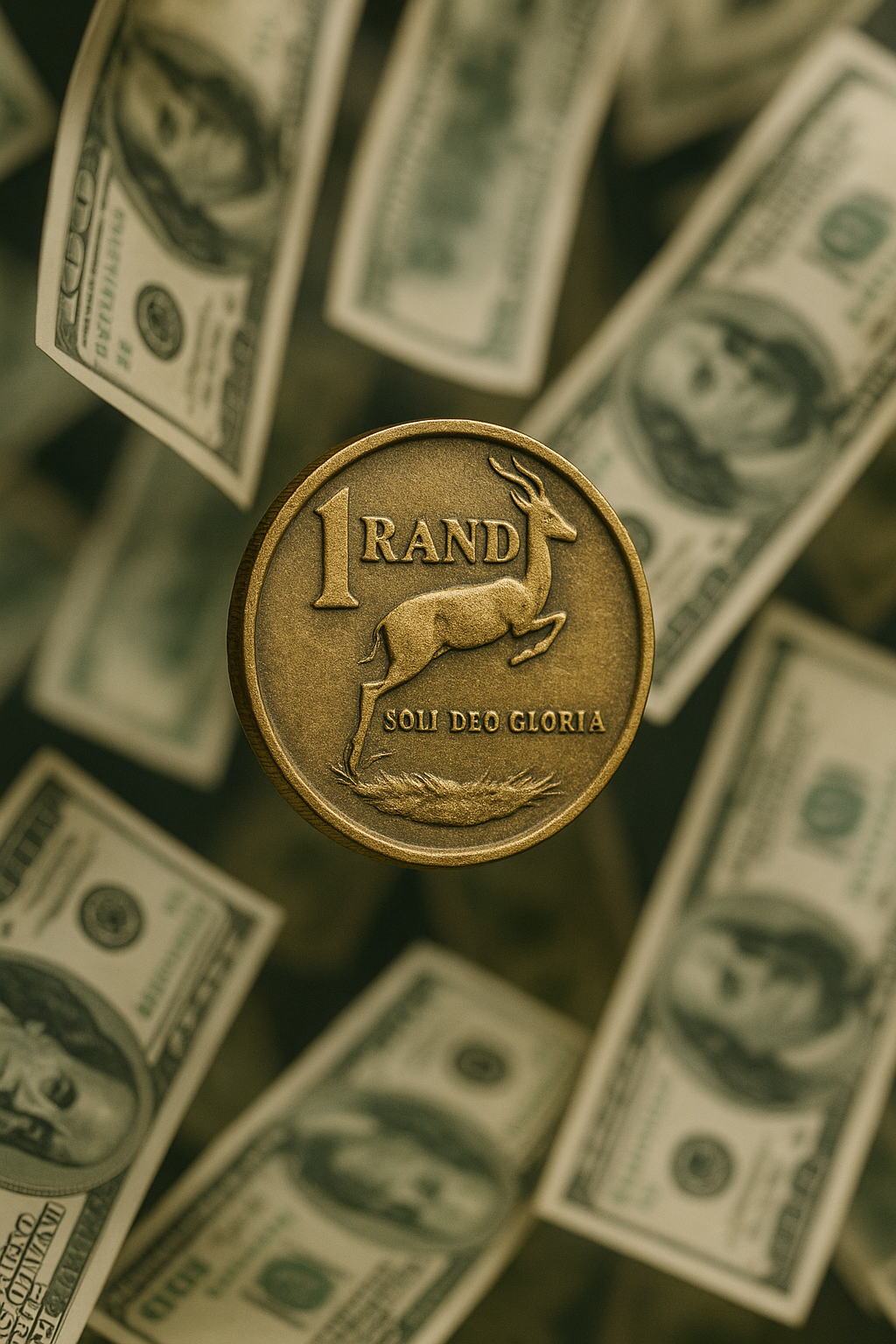
Rand breaks R16/$! Discover the 20 factors driving ZAR's strength & what could send it soaring or crashing. Is it a new era or fleeting? Read more!
The Rand just got super strong, jumping 15% from R19.30 to R15.99! This happened because the US Dollar got weaker, China let its money get stronger, and South Africa got some good news. Things like a ton of money from mining, a better credit score, and a more stable government helped a lot. Everyone's wondering if this good time will last!
What factors contributed to the Rand's recent 15% surge against the Dollar?
The Rand's 15% surge from R19.30 to R15.99 was driven by a weakening US Dollar due to fatigue and policy shifts, China's decision to allow the Yuan to strengthen, and positive domestic developments in South Africa, including a mining windfall, a credit rating upgrade, and improved political and economic stability.
Get Cape Town news in your inbox
Stay updated with the latest stories from the Mother City.
Dollar Fatigue, Beijing’s Green Light and Home-Grown Hope
Shortly after the Johannesburg Stock Exchange opened on 26 January, the rand slipped past the magic R16.00 mark, printing R15.99 before pulling back a few cents. That three-second flicker, the first sub-R16 quote since June 2022, set screens flashing from Sandton to London because it certified the 15 % rebound from the R19.30 abyss of late-2025 as the real deal rather than another “dead-cat leap”.
Behind the move sits a rare three-layer tail-wind: a US currency that is wilting on fundamental fatigue, a Chinese authorities’ decision to let the yuan rip through 7.0, and - perhaps most startling - a South African storyline that no longer opens with the word “crisis”.
Currency desks are now asking the obvious follow-up: did the rand just enter a structurally firmer corridor, or are we merely enjoying the shiniest rest-stop on an EM carry-band-wagon that can flip overnight?
When Washington Shoots the Dollar in the Foot
The greenback’s retreat began weeks before the rand’s R16 dance. Since late December the ICE dollar index has dropped 4 % as investors grow weary of ballooning US twin deficits and rising sovereign CDS spreads. President Trump’s second innings has added spice: markets now price a non-trivial chance that “weak-dollar” morphs from tweet-talk into doctrine.
Internal White House memoranda reveal three concrete signals: the Treasury’s currency report is intentionally late while staff argue over branding Vietnam, Taiwan and even Germany as manipulators; Commerce Secretary pick Howard Lutnick told senators he prefers an “appropriately valued” buck to an “exorbitant privilege” that hollows out factories; and the traditional G20 strong-dollar pledge has vanished from draft communiqués.
Net result: hedge funds are happily funding short-USD bets in yen, francs and - crucially - rand, confident that official America will not rush to break their ankles.
Mining Windfall, Rating Lift and the Carry Gift That Keeps Giving
Record bullion north of $3,100/oz and rhodium knocking on $20,000/oz have thrown a R60 billion annual gift at the current account, slicing the deficit from -2.8 % of GDP in 2024 to an annualised -0.9 % by 3Q 2025. Every extra $100 on gold pours R15 billion into exporters’ coffers, and the 30-day rand-gold correlation has jumped to 0.72, its tightest since 2011.
S&P’s one-notch upgrade to BB with stable outlook on 13 December - secured by Eskom’s energy availability factor climbing to 65 % and the prospect of a primary surplus in 2026/27 - was the first thumbs-up from any agency since 2006. Ten days later the FATF scratched South Africa off its grey list, freeing banks from the 15 bp trade-finance surcharge and forcing $2.1 billion of mechanical bond inflows to match the new, cleaner benchmarks.
Domestic inflation at 3.6 % and futures pricing 50-75 bp of SARB cuts before Christmas have steepened the short-end of the yield curve, keeping the carry party alive: three-month cash still dishes out 7.75 % against 4.25 % for dollar funding, a 350 bp pickup that looks mouth-watering when G7 volatility is spiking.
Politics, Ports and Power-Station Dashboards
Markets have quietly trimmed SA’s political risk premium. The Government of National Unity that emerged from the May 2024 poll has delivered a run of technocratic wins: 6,800 MW of private renewables green-lighted in Q4, logistics concessions at Durban and Port Elizabeth attracting DP World and PSA International, and the 2025 budget lifting the zero-tax bracket by 7 % - the biggest real rise since 2017.
Finance Minister Godongwana keeps bond investors calm while Electricity Minister Ramokgopa’s daily Twitter plant stats have turned him into an unlikely market influencer; sovereign CDS have tightened to 140 bps, 35 bps inside their five-year average and only 18 bps wide of investment-grade India.
Yet the good-news salad is sprinkled with chilli flakes: the 2025 wage season opens 11 March with unions demanding 12-14 %, AGOA expires in September unless a prickly US Congress renews it, and Eskom still has to shepherd 5,400 MW through scheduled maintenance this winter with a reserve margin thinner than an 800 MW shoelace.
Scenarios Beyond the R16.00 Crucible
Chartists insist R16.00 is more than round-number theatre - it is the 61.8 % Fibonacci retracement of the entire 2021-2025 sell-off; a weekly close below it opens the door to R15.55 and, after that, thin air down to R15.00 last sighted in early 2021. One-month implied volatility has collapsed to 12.7 %, feeding a European structured-note boom that sells upside strikes and buys spot delta, nudging the rand ever closer to the lower bound of the R15.50-R17.00 range.
Corporate supply adds another twist: Sasol, MTN and FirstRand must refinance $3.7 billion of dollar debt by May; if they switch into rand benchmarks, swap-driven demand could reach R25 billion and compress the unit toward R15.40. Conversely, an AGOA cliff-edge or a stage-8 blackout could catapult the rand beyond R17.20 in a single session, while a messy US debt-ceiling fight could drain global dollar liquidity and punish EM positioning.
In short, R16.00 is no longer a distant mirage - it is now the pivotal axis around which options strikes, parliamentary votes and power-station turbines will spin for the rest of the year.
What factors contributed to the Rand's recent 15% surge against the Dollar?
The Rand's 15% surge from R19.30 to R15.99 was primarily due to a weakening US Dollar driven by fundamental fatigue and policy shifts, China's decision to allow the Yuan to strengthen, and significant positive domestic developments in South Africa. These local factors included a substantial mining windfall, an upgrade in its credit rating, and improved political and economic stability, moving away from a 'crisis' narrative.
What caused the US Dollar to weaken, contributing to the Rand's strength?
The US Dollar's retreat began in late December, with the ICE dollar index dropping 4%. This weakening was attributed to growing investor weariness over ballooning US twin deficits and rising sovereign Credit Default Swap (CDS) spreads. Additionally, market sentiment suggests a non-trivial chance that a 'weak-dollar' policy might become a more formal doctrine under potential future administrations, further encouraging short-USD bets by hedge funds.
How did China's policies impact the Rand's performance?
China's decision to allow the Yuan to strengthen played a significant role in the Rand's surge. When China permits its currency to appreciate, it can lead to a broader strengthening of emerging market currencies, including the Rand, as it signals a more robust global economic environment and potentially increased demand for commodities.
What specific 'home-grown hopes' in South Africa supported the Rand's rebound?
South Africa experienced several positive domestic developments. A mining windfall, with record bullion and rhodium prices, injected R60 billion annually into the current account. An S&P credit rating upgrade to BB with a stable outlook, driven by improved Eskom energy availability and a projected primary surplus, and the removal from the FATF grey list, which freed banks from trade-finance surcharges and triggered bond inflows, all contributed to a more positive outlook.
Is the current strong performance of the Rand expected to last?
While the Rand has shown significant strength, the duration of this 'good time' is a key question for currency desks. The market is weighing whether the Rand has entered a structurally firmer corridor or if it's merely a beneficiary of a temporary 'EM carry-band-wagon'. Factors like potential wage demands, the renewal of AGOA, and Eskom's ongoing maintenance challenges could introduce volatility. However, the Rand breaking below R16.00 opens the door to further appreciation towards R15.55 and even R15.00 if positive momentum continues.
What are the potential risks and opportunities for the Rand moving forward?
Opportunities for further Rand appreciation include corporate refinancing of dollar debt into Rand benchmarks, which could create significant swap-driven demand. Conversely, risks such as a non-renewal of AGOA, a stage-8 blackout from Eskom, or a messy US debt-ceiling fight could cause sharp depreciation. The R16.00 mark is now considered a pivotal axis, with various economic and political factors influencing its trajectory for the remainder of the year.

Chloe de Kock is a Cape Town-born journalist who chronicles the city’s evolving food culture, from township braai joints to Constantia vineyards, for the Mail & Guardian and Eat Out. When she’s not interviewing grandmothers about secret bobotie recipes or tracking the impact of drought on winemakers, you’ll find her surfing the mellow breaks at Muizenberg—wetsuit zipped, notebook tucked into her backpack in case the next story floats by.
View all articles →