
Rangers intervene to combat Bird Flu crisis at Melkbosstrand
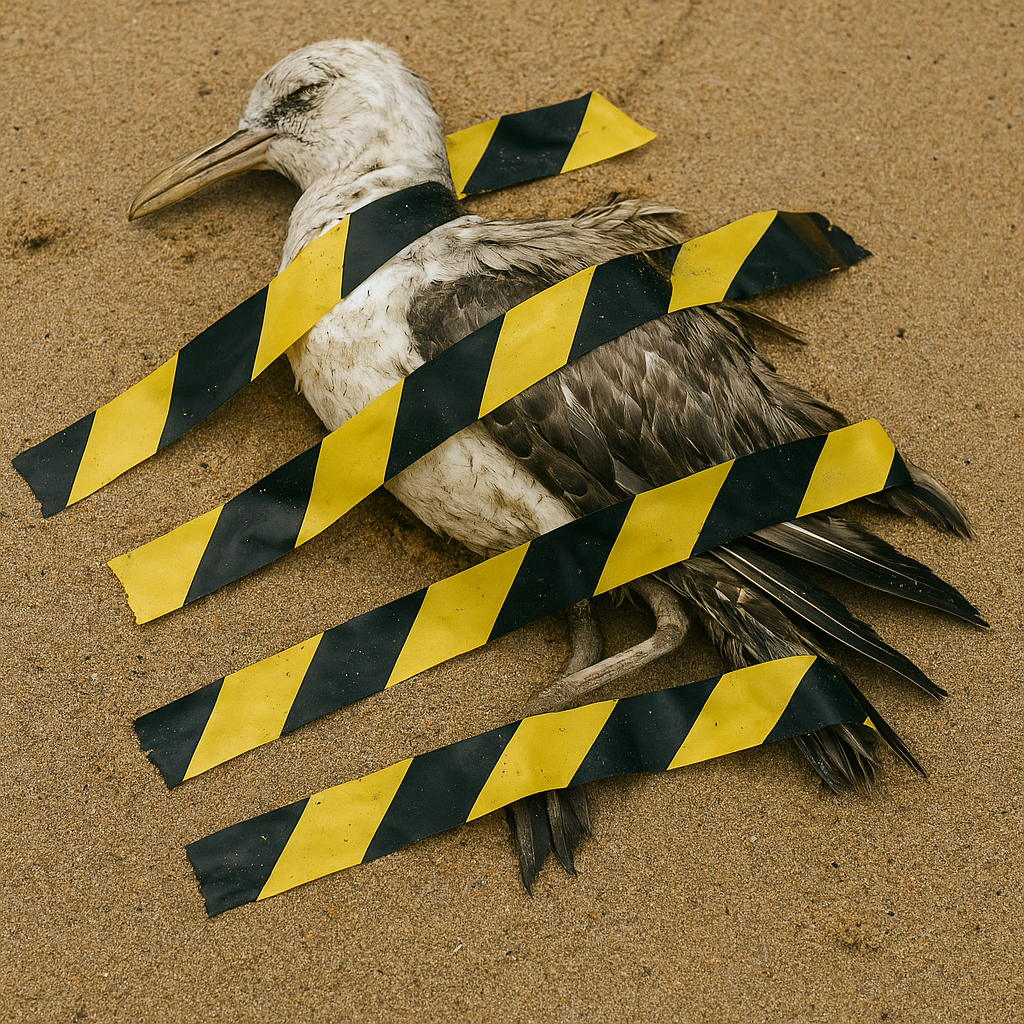
Avian influenza devastates a seabird metropolis at Soutrivier Mouth. Discover the outbreak's anatomy, from viral spread to battle efforts.
Bird flu is killing thousands of seabirds in South Africa, turning their lively nesting spots into sad, silent morgues. This super-strong virus spreads fast, helped by how close these birds live, and turns their insides into mush. People are working hard to clean up, count the dead, and even use drones to find bodies. They're also trying to save the sick birds and learn from the ones that survive, all while worrying if the virus will jump to other animals like seals, forcing everyone to rewrite the rules on how to protect these precious birds.
What is the main threat to seabirds in South Africa?
High-pathogenicity avian influenza (HPAI) H5N1 is the primary threat to South African seabirds. This virulent strain, which arrived via migratory birds, causes rapid death and spreads quickly in dense colonies, devastating populations like those at the Sout-river mouth near Cape Town.
Get Cape Town news in your inbox
Stay updated with the latest stories from the Mother City.
The First Signs: When the Nursery Became a Morgue
A thin ribbon of turquoise water curls into the Atlantic just north of Cape Town’s container cranes.
From orbit the Sout-river mouth looks harmless; on foot it is a windswept puzzle of glasswort, driftwood and dunelets that usually rocks with life between August and May.
This October the soundtrack changed: the air carried the sweet-sick stink of decay instead of tern courtship calls.
Rangers patrolling for poachers stumbled on the scene first - adults frozen mid-moult, fledglings still wearing baby-down helmets, all tangled in bladder-kelp like discarded toys.
By 3 November the daily corpse tally had sailed past 120, forcing city vets, private security guards and even vineyard-mapping drone pilots into an awkward alliance.
No one had a playbook for a seabird metropolis collapsing in real time.
The Invisible Arsonist: How H5N1 Travels Faster Than Gossip
Laboratories 1 500 km inland soon confirmed the killer: Eurasian H5N1 clade 2.3.4.4b, the same strain that sprinted across Europe in 2021 and rode the Atlantic fly-way south aboard skuas and gannets.
South Africa’s coastal checklist of doom began twelve months earlier in KwaZulu-Natal; since then the virus has hop-scotched between crowded breeding cliffs like a backpacker with an open ticket.
Its genius is stealth - gut replication does not ground a bird immediately, so carriers can dump ten-figure viral loads hundreds of kilometres before their own brains liquefy.
Early necropsies revealed organs that looked dunked in cheap red wine: pancreas that crumbled at the touch, kidneys polka-dotted with pin-prick bleeds, cerebellum swollen like a marinated grape.
PCR cycle thresholds under 18 meant every faecal fleck carried up to a billion plague particles, turning the colony into an aerosolised biohazard.
Tern Society: Built for Productivity, Vulnerable to Plague
Terns are the marathon migrants of the Charadriiformes, designed to bet everything on a single, perfectly timed surge of anchovy.
They cram nests armpit-to-wingtip, delay laying until the fish school balloons, then synchronise hatching to flood predators with surplus chicks.
Those same virtues create a perfect epidemiological storm: fish slurry passes beak-to-beak, chicks cuddle for warmth while smearing one another with viral droppings, and the south-easter launches guano dust straight into respiratory tracts.
Centuries of egg harvesting and habitat squeeze have already shaved their genetic diversity to a whisker, leaving the population immunologically naïve.
University of Cape Town modellers calculate that once H5N1 gate-crashes a mixed tern city, the basic reproduction number rockets to 5.2 - double the havoc seen inside industrial chicken barns.
Boots, Boats and Biohazard Drums: The Ranger Response
Quemic Rangers, hired to protect antelope from snares, became gravediggers overnight.
Their sunrise ritual now starts with Tyvek ghosts walking measured transects, GPS-pinging every corpse, photographing wing bars to age the victim, and uploading dots to a live QGIS map.
Neurologic birds - head cocked like stargazers, legs bicycling backwards - are netted with butterfly gear borrowed from Kirstenbosch gardens.
Live casualties go into double-walled drums chilled by phase-change packs; each container swims in 1 % Virkon before the next outing.
By lunchtime the same staff trade binoculars for pressure hoses, blasting kayaks, vehicles and boot treads with 200 litres of disinfectant a week, a choreographed decontamination ballet nobody trained for.
Tape, Text Messages and the Law That Wasn’t
Cape Town’s beach ordinances close sand for E. coli, not virus-laden gull poop.
Cornered, managers invoked the Biodiversity Act’s “emergency species protection” clause and strung 1 km of black-yellow tape usually reserved for construction pits.
Signs in English and Afrikaans warn of a “High-Risk Avian Influenza Zone – No Dogs, No Drones, No Kites,” but rangers can only ask nicely; fines remain mythical.
Surprisingly, the polite request worked: gale-force winds and a viral WhatsApp campaign featuring sneezing puffin GIFs convinced kite-surfers to relocate 800 m south, slashing visitor numbers by 70 % within days.
Even craft-beer drinkers now brag about steering clear of the “forbidden comma” on the horizon.
Trucks Tailored for Lobster, Now Ferrying the Dead
Onderstepoort’s state lab is the sole place allowed to declare an HPAI outbreak, yet it sits a day’s drive inland.
Rangers therefore courted a seafood haulier accustomed to Cape rock lobster; the lorries’ 4 °C styrofoam coffins, still smelling faintly of langoustine and iodine, keep tern carcasses chilled but not frozen on the 48-hour sprint.
While results pend, field crews operate as though every bird is radioactive, fuelling the never-ending disinfection treadmill.
Triage by Flowchart: Who Gets a Chance to Live?
SANCCOB’s pop-up clinic occupies a disused Melkbosstrand lifeguard hut where wall posters read like battlefield medicine.
Red tag: cannot stand, euthanise.
Yellow tag: wobbly but alert, isolate.
Green tag: only gooey eyes, fluids and prayer.
Oseltamivir priced at R 45 per millilitre means a 400 g tern burns R 180 daily - what it costs to rehab an oiled penguin for a week - so the charity conserves cash for Near-Threatened Little terns over globally common ones.
Once neurological signs appear, 85 % still die; the CO₂ chamber hisses in a soft, steady rhythm that volunteers refuse to call a lullaby.
Dollars, Anchovy and Instagram: The Local Economy Feels the Ripple
Melkbosstrand balances on surf tourism and west-coast rock lobster.
Terns hoover 30 tonnes of small pelagics each summer, prey purse-seiners also net for fishmeal; when the birds crash, acoustic surveys show a 40 % anchovy spike within 5 km of shore, cutting bait prices but upsetting ecosystem accountants.
Bird photographers, though fewer than surfers, pumped R 1.2 million into eateries during 2019’s breeding season.
Fearing a double loss, restaurants voluntarily tithe 10 % of November turnover to ranger fuel cards - a lifeline brokered between brewers, chefs and biodiversity guardians who once eyed each other across a picket fence.
Eyes in the Sky: Drones That See Corpses the Tide Steals
Manual counts miss lightweight chicks that vanish with the flood.
A fixed-wing eBee X now launches at dawn, snapping 1.2 cm-resolution imagery later interrogated by AI trained on 8 000 hand-labelled photos.
The algorithm scores 92 % accuracy separating tern bodies from kelp balls, and thermal layers catch freshly dead birds still warm at their core.
Drone-corrected tallies push the official kill past 1 400 in week two, a grim dataset uploaded to a national dashboard already mapping die-offs from Lambert’s Bay to Algoa Bay.
Arctic Echoes: Could African Wetlands Become Winter Vaults of Virus?
While the south roils, Norwegian researchers report 80 % Little auk chick loss at Svalbard after H5N1 hitch-hiked north with Barnacle geese.
Their sobering discovery: in near-freezing lakes the pathogen survives 250 days in water and scavenger scat, reinfecting spring returnees.
Sout-river’s seeps seldom ice over, but winter rains could flush contaminated guano into the Berg River wetland 30 km inland.
Authorities have begun coring sediment for viral RNA - the continent’s first attempt to learn whether African marshes might mimic Arctic lakes as long-term viral banks.
Survival of the Luckiest: Reading Evolution in Real Time
A scatter of Greater crested adults has shrugged off exposure and returned to courtship, behaviour that lures geneticists like moths to flame.
Stellenbosch and Dutch researchers are exome-sequencing survivors, hunting for Mx gene quirks that gum up influenza polymerase.
Early chromatograms reveal a mutation at Mx1 position 631 - the identical switch that lets farm ducks tolerate mild flu strains.
If the allele’s frequency climbs in next year’s cohort, we may watch natural selection draft a live escape plan, knowledge that could one day seed vaccines for endangered poultry.
Crossing the Species Fence: When Seals Start Coughing
Cape fur seals on nearby haul-out rocks have begun coughing like chain-smokers, some jerking with seizures.
Three carcasses returned faint H5N1 PCR signals, mirroring 2022 mass deaths in Peruvian sea lions and Argentinian fur seals.
No seal-to-seal chain has been proven, yet authorities now dish out FFP2 masks and nitrile gloves to strandings volunteers - COVID-19 gear reborn on a windy beach where off-leash dogs sniff viral corpses.
If the virus masters mammalian ACE-2 receptors, the theatre of risk widens from remote colonies to seaside suburbs.
Rewriting the Rulebook: A Policy Sprint Against the Next Wave
Pretoria’s Department of Forestry, Fisheries and the Environment is cobbling together South Africa’s first “Avian Influenza Contingency Plan for Marine Protected Areas,” a document that simply did not exist.
Draft clauses include pre-authorised beach shutdowns, emergency ring-fencing of breeding islets with decoy predators, and a carcass-disposal levy skimmed from fishing profits.
Critics dismiss it as crisis-driven patchwork; insiders shrug - ad-hoc or not, the rules forged before January’s public-comment deadline will decide how the next colony burns or breathes.
With 200 000 seabirds already lost to HPAI along these shores in just two seasons, the coastline is crying for a script before the encore begins.
[{"question": "What is the primary threat to South African seabirds?", "answer": "The primary threat is High-pathogenicity avian influenza (HPAI) H5N1. This highly virulent strain, which arrived via migratory birds, causes rapid death and spreads quickly in dense colonies, devastating populations like those at the Sout-river mouth near Cape Town. It has been identified as Eurasian H5N1 clade 2.3.4.4b."}, {"question": "How does the H5N1 virus spread so effectively among seabirds?", "answer": "The H5N1 virus spreads rapidly due to several factors. Terns, for example, nest armpit-to-wingtip, allowing for easy bird-to-bird transmission. Fish slurry passed beak-to-beak, chicks cuddling and smearing viral droppings on each other, and guano dust launched into respiratory tracts by strong winds all contribute to its swift dissemination. The virus also replicates in the gut without immediately grounding the bird, allowing infected birds to travel long distances and spread high viral loads. Early necropsies showed severe internal organ damage and PCR tests indicated that even a fleck of faeces could carry billions of viral particles."}, {"question": "What measures are being taken to combat the outbreak and protect the birds?", "answer": "A multi-faceted approach is being implemented, including rigorous clean-up operations, counting dead birds using GPS and drone technology (with AI image analysis for accuracy), and attempting to rescue sick birds. Rangers are collecting neurological birds, transporting live casualties in chilled, disinfected containers, and decontaminating equipment daily. Efforts are also focused on studying surviving birds to understand genetic resistance and developing a national 'Avian Influenza Contingency Plan for Marine Protected Areas'. Public cooperation is also being sought through warnings to avoid affected areas."}, {"question": "Are there concerns about the virus spreading to other animal species?", "answer": "Yes, there is significant concern about HPAI H5N1 jumping to other species. Cape fur seals on nearby haul-out rocks have shown symptoms like coughing and seizures, with some carcasses testing positive for H5N1. This mirrors mass deaths in Peruvian sea lions and Argentinian fur seals. While a seal-to-seal transmission chain hasn't been definitively proven, authorities are taking precautions, providing FFP2 masks and nitrile gloves to volunteers. The worry is if the virus masters mammalian ACE-2 receptors, the risk could extend from remote colonies to human-populated coastal areas."}, {"question": "How is the local economy being affected by the bird flu outbreak?", "answer": "The bird flu outbreak is impacting the local economy. Terns usually consume large quantities of small pelagic fish, and their decline has led to a 40% anchovy spike, which, while cutting bait prices, disrupts the ecosystem's balance. Bird photographers, who contributed significantly to local eateries, are now fewer. In response, some restaurants are voluntarily tithing 10% of their November turnover to support ranger fuel cards, highlighting a new alliance between businesses and conservation efforts. The closure of beaches and warnings also impact tourism-dependent activities like kite-surfing."}, {"question": "What lessons are being learned from the survivors and the environment?", "answer": "Researchers are actively studying survivors, particularly Greater crested adults that have returned to courtship behaviors, to understand potential genetic resistance. Exome-sequencing of these birds is hunting for Mx gene quirks that could inhibit influenza polymerase, with early findings of a mutation at Mx1 position 631, similar to what allows farm ducks to tolerate mild flu strains. Furthermore, authorities are investigating whether African wetlands could become long-term viral reservoirs, mimicking Arctic lakes where the pathogen can survive for extended periods in cold water and scavenger scat. Sediment coring is being done to test for viral RNA in wetlands."} ]

Kagiso Petersen is a Cape Town journalist who reports on the city’s evolving food culture—tracking everything from township braai innovators to Sea Point bistros signed up to the Ocean Wise pledge. Raised in Bo-Kaap and now cycling daily along the Atlantic Seaboard, he brings a palpable love for the city’s layered flavours and even more layered stories to every assignment.
View all articles →