
Rare fin whale washes ashore near Gansbaai in coastal stranding
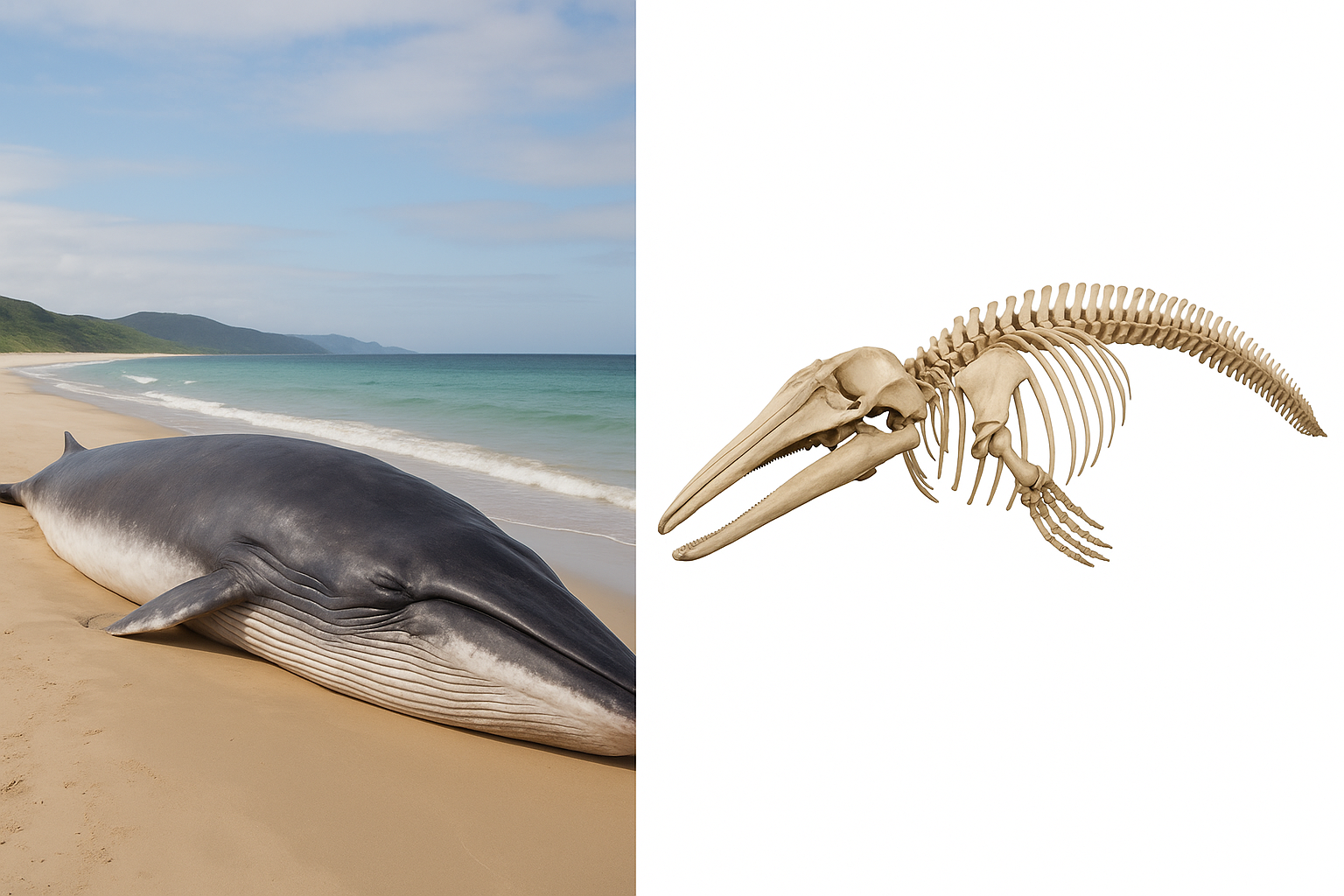
Rare fin whale strands on South African coast, sparking scientific investigation & conservation concerns about marine mammal health.
A huge fin whale, often called a "greyhound of the sea" because it's super fast, washed up on a misty morning in Gansbaai. This giant, the second-biggest whale, usually eats tiny krill and anchovies but was found dead. Her stranding brought together many people, from fishermen to scientists, to learn why she died and what it means for other whales. This rare event showed everyone how important these amazing creatures are and how much danger they still face from things like ship strikes and noise in the ocean.
What are fin whales and why are they important?
Fin whales, often called "greyhounds of the sea," are the second-largest whale species, weighing around 65 metric tonnes and capable of sprinting at 30 km/h. They are crucial to oceanic food webs, primarily feeding on krill and anchovies. Despite a rebound since the 1986 whaling moratorium, they remain vulnerable, with strandings like the Gansbaai event highlighting their ongoing threats and ecological significance.
Get Cape Town news in your inbox
Stay updated with the latest stories from the Mother City.
Dawn Alarm on the Overberg Coast
July 1 broke misty and flat over Gansbaai, the kind of morning skippers pray for when clients want shark-cage footage without green faces. Jason Stafford was ticking boxes on his pre-departure sheet when a dark blade-shaped silhouette, far too large for a whale-watcher’s splash, surfaced near Die Plaat’s thunderous breakers. Twenty-three metres of gun-metal muscle - obviously a finback - rolled once, lifted its asymmetric jaw, and went limp. Stafford’s radio call reached the Dyer Island Conservation Trust within minutes, triggering a chain reaction that would unite fishermen, geneticists, toxicologists, teachers, and drone pilots for the next four days.
Within ninety minutes, the Trust’s stranding trailer had bounced down the gravel track, packed with the same crates normally reserved for beaked dolphins or Cape fur seals. They found a female giant - tissue still warm - already attracting Kelp gulls and Black-backs. Protocols demand photos before anything is shifted, so smartphones rose like paparazzi while staff stretched survey tape between the dune pegs. Every measurement - fluke notch width, dorsal-to-snout run, blubber depth via modified ice-cream scoop - would feed a global catalogue that still holds only a few hundred Southern-Hemisphere fin-whale records.
Wilfred Chivell, whose beard has been salted by two decades of launches in these waters, admitted he had “run out of superlatives.” The Greater Dyer Island coastline keeps meticulous observer logs; until that Monday, none listed Balaenoptera physalus as anything other than a far-off spout beyond the continental shelf. A washed-up specimen therefore shattered the local “it-won’t-happen-here” mind-set and forced environmental educators to rewrite their talking-point sheets before the first school bus arrived.
Meet the Greyhound of the Ocean
Fin whales hold silver in the all-time size Olympics: second only to blues yet able to sprint at thirty kilometres per hour, earning them the mariner’s nickname “greyhounds of the sea.” The stranded cow weighed in at roughly sixty-five metric tonnes, the caloric equivalent of forty Land-Cruisers. Each sideways lunge she performed while alive could gulp seventy cubic metres of seawater, forcing krill and anchovy through 350 pairs of silky baleen plates. Unlike other rorquals, her jaw pigment is split down the middle - inky indigo on the left, brilliant ivory on the right. The asymmetry may act like counter-shaded fishing lures, confusing prey schools during the final surge.
Evolution has honed more than cosmetics. A ridge of rubbery pleats runs from the chin to the navel; these accordion folds let the throat pouch balloon, creating a parachute that fills faster than a firefighter’s rescue slide. Once prey is engulfed, the tongue - heavier than a grand piano - rams upward, expelling water through the sieve of fringe. The whole sequence lasts six seconds, proof that bulk need not equal sluggishness. Researchers measured the dead female’s ventral grooves at 1.8 m, near the upper limit recorded anywhere, suggesting she was a prime hunter at the peak of her game.
Even so, she carried scars of modernity: parallel propeller nicks along the right peduncle, cookie-cutter shark divots on the flank, and a ghost net strand embedded under the pectoral fin. Each lesion tells part of her biography - deep dives into shipping lanes, tropical detours where cigar-sized sharks nibble, and a brush with derelict gear she dragged for weeks before shedding. Such souvenirs are now photographed, 3-D scanned, and logged into a national ship-strike database that conservation managers hope will justify slower speed limits outside Cape Agulhas.
From Industrial Oil Casks to Red-List Icons
A century ago, factory ships along Africa’s southern edge rendered fin whales into nitroglycerin, margarine, and Parisian lamp oil. Shore-based whalers at Durban and Saldanha kept meticulous ledgers: 9,300 fins processed between 1912 and 1975, their tongues sold as pet food, penises dried for swagger canes. Genetic back-casting hints that Southern-Hemisphere numbers fell from 100,000 to perhaps 20,000, a slaughter that still reverberates through oceanic food webs. Since the 1986 moratorium, sightings have rebounded in the productive Agulhas Bank, yet the IUCN retains the species as Vulnerable because recovery is patchy and slow - each female produces a calf only every three years after a year-long gestation.
The Gansbaai stranding therefore removes not just one animal but an entire reproductive future: up to fifteen calves she might have nursed over the remaining decades. Scientists translate that loss into “foregone offspring” when they model population trajectories; managers translate the same data into policy briefs urging precautionary catch limits on the small-pelagic fishery that nets her main prey. Each metric tonne of sardine left in the water column equals a measurable slice of whale baby-making potential, a currency ministers can grasp when purse-seine quotas come up for review.
Modern threats add layers of complexity. Seismic arrays searching for hydrocarbons fire air-gun pulses audible across ocean basins; fin whales reply by lengthening their calls, the acoustic equivalent of shouting in a noisy bar. Chronic stress disrupts feeding efficiency and lowers birth rates, a linkage confirmed by hormone assays from free-swimming individuals. The Trust’s pathology team preserved the stranded whale’s inner ear in glutaraldehyde within minutes of necropsy; high-resolution CT scans will soon reveal whether spiral-ligament damage or air-bubble emboli - classic acoustic-trauma signatures - help explain her final erratic course toward the beach.
Science on the Sand: Protocols, Puzzles, Publics
Post-mortem work began under floodlights before the tide reclaimed the carcass. Researchers sliced blubber cores with sterilised corers, bagged each organ in Whirl-Paks, and laid them on labelled trays like a macabre sushi menu. Blood oozed into Vacutainers laced with heparin; bile was aspirated for bile-acid profiling; even gut parasites were teased into ethanol. Every sample serves dual purposes: baseline health metrics for a data-poor population, and forensic clues toward cause of death. A veterinary team hopes histopathology will flag morbillivirus, domoic acid, or micro-plastic infiltration - pathologies increasingly common in other baleen whales.
Parallel teams profiled the oceanography: sea-surface temperature had spiked two degrees above the thirty-year mean, possibly driving anchovy shoals offshore and beyond a predator’s lunging reach. Satellite chlorophyll maps showed a filament of warm, nutrient-poor water hugging the coast - the kind of setup linked to mass strandings of squid-eating beaked whales but rarely to filter feeders. Add an algal bloom that lingered the previous week, and the stage may have been set for confusion, toxin uptake, or starvation-induced navigational error.
Meanwhile, the human tide rolled in. Schoolchildren arrived with clipboards; Instagram influencers angled selfies against the backdrop of tarpaulin-draped flesh. Staff set up a rope corridor, balancing public curiosity with dignity for the animal. Evening talks at the local hall were streamed to 3,000 viewers, translating jargon - “vagrant pygmy copepod,” “persistent organic pollutant,” “effective population size” - into plain-language stories residents could retell. By the fourth afternoon, only bones remained, tagged and ready for burial above the high-water mark. Months from now, after cartilage maceration, the skeleton may tour science centres as a tangible monument to ocean vulnerability.
Outcomes will reverberate well beyond this dune field. Genetic bar-coding will tell whether the dead female hailed from Antarctic Sector IV or the migratory cohort that skims Madagascar on the way to the Benguela upwelling. Stable-isotope signatures of carbon and nitrogen will map the trophic footprint of her last meals, anchovy versus euphausiid, data invaluable for ecosystem-based fishery models. Most crucially, a final report will land on the desk of the Department of Forestry, Fisheries and the Environment just as officials debate expanding the Agulhas Bank Marine Protected Area; peer-reviewed numbers may tip the balance toward larger no-take zones, a legacy even a dead whale can still deliver.
What are fin whales and why are they important?
Fin whales, often called "greyhounds of the sea," are the second-largest whale species, weighing around 65 metric tonnes and capable of sprinting at 30 km/h. They are crucial to oceanic food webs, primarily feeding on krill and anchovies. Despite a rebound since the 1986 whaling moratorium, they remain vulnerable, with strandings like the Gansbaai event highlighting their ongoing threats and ecological significance.
What happened in Gansbaai?
On a misty July 1st morning in Gansbaai, a 23-meter female fin whale, weighing approximately 65 metric tonnes, was found stranded and deceased. This rare event brought together a diverse group of people, from local fishermen to scientists, to investigate the cause of death and gather valuable data about this magnificent creature.
What makes fin whales unique?
Fin whales are exceptional for several reasons: they are the second-largest whale species, can reach speeds of 30 km/h, and possess an asymmetrical jaw pigmentation (inky indigo on the left, ivory on the right), which may aid in confusing prey. Their unique throat pleats allow their mouth to expand significantly to engulf large volumes of water and prey, a process that takes only about six seconds.
What threats do fin whales face today?
Despite a rebound in population numbers since the 1986 whaling moratorium, fin whales continue to face significant threats. These include ship strikes, as evidenced by propeller nicks found on the stranded whale, entanglement in ghost nets, and the pervasive issue of ocean noise pollution from seismic surveys. Additionally, changes in ocean temperature and food availability due to climate change can impact their feeding patterns and overall health.
How do scientists study stranded whales?
When a whale strands, scientists follow strict protocols. They meticulously photograph and measure the carcass, collect tissue samples from various organs for genetic, toxicological, and histopathological analysis, and even preserve parts like the inner ear to check for acoustic trauma. Environmental data, such as sea-surface temperature and chlorophyll maps, are also collected to understand potential contributing factors to the stranding.
What is the broader impact of a fin whale stranding?
A fin whale stranding has far-reaching implications. Beyond the loss of an individual, it represents a loss of reproductive potential, as each female can produce multiple calves over her lifetime. The data collected from such events contributes to global catalogues, informs conservation policies, and helps justify measures like slower speed limits in shipping lanes and expanded marine protected areas. It also serves as a powerful educational tool, raising public awareness about ocean vulnerability and the importance of conservation efforts.

Oliver Daniels is a Cape Town journalist who chronicles the intersection of food, migration and identity in South Africa's kitchens—from wood-fired Gugulethu braai spots to Constantia vineyards. Born and raised on the slopes of Devil’s Peak, he still starts each week with a dawn walk across Table Mountain to catch the first Atlantic light before filing copy.
View all articles →