
Vessel Watch: Ellen Khuzwayo anchors in Simon’s Town
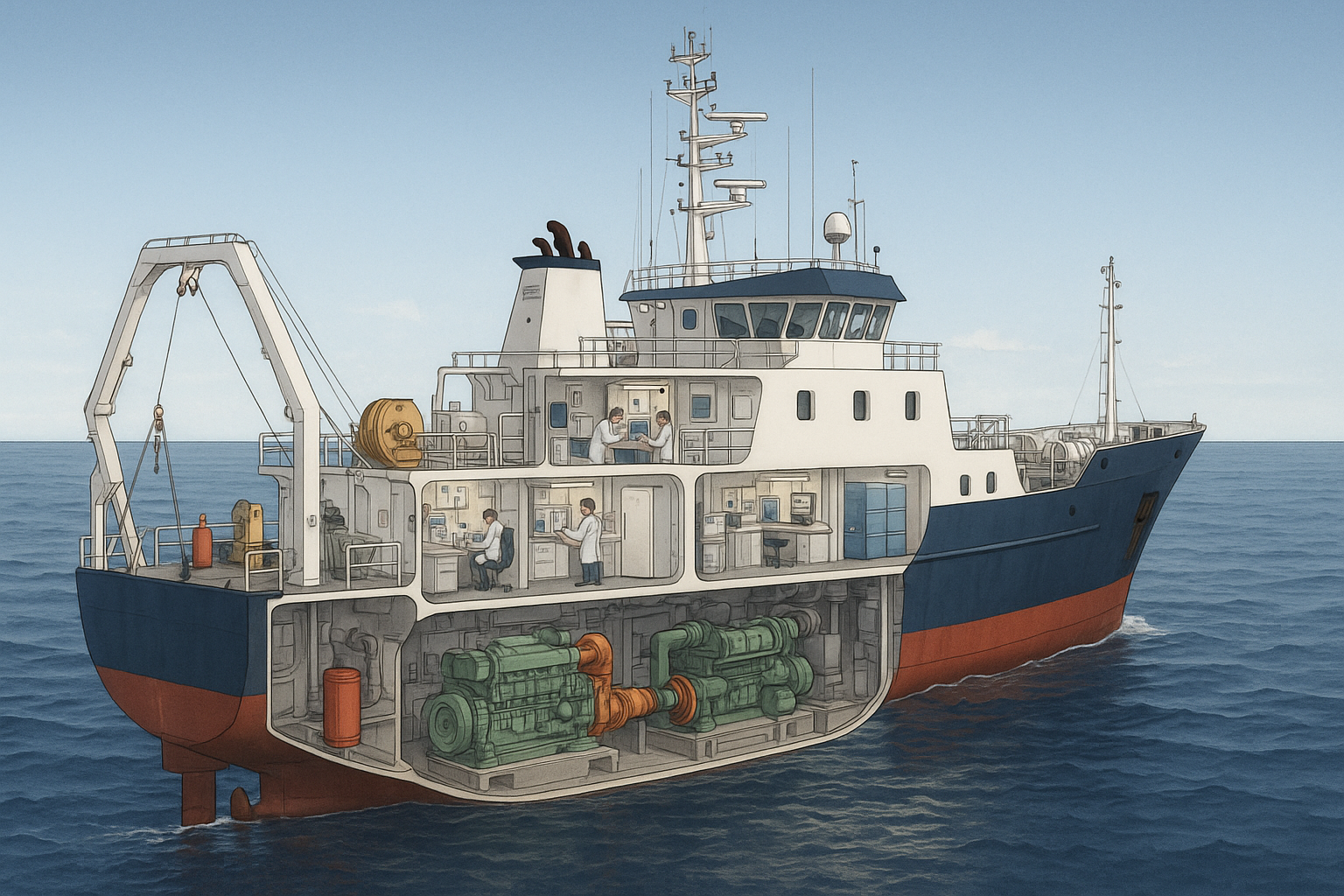
Explore the Ellen Khuzwayo, South Africa's floating lab quietly guarding its seas, conducting vital research from marine life to climate data.
The Ellen Khuzwayo is a special South African ship that helps us understand the ocean. It's like a quiet hero, gathering clues about fish, weather, and the health of the sea without disturbing anything. This helps keep our oceans healthy and our fishing strong, making sure there's enough food and good science for everyone. It's a fantastic ship that makes a big difference for our planet.
What is the purpose of the Ellen Khuzwayo research vessel?
The Ellen Khuzwayo is a South African research vessel dedicated to marine science and oceanographic studies. It collects vital data on marine ecosystems, fish populations, and climate change, contributing to sustainable ocean management, fisheries quotas, and global climate models. The ship operates silently to avoid disturbing marine life, ensuring accurate data collection.
Get Cape Town news in your inbox
Stay updated with the latest stories from the Mother City.
Dawn in the Bay – A Grey Ghost Arrives
Simon’s Town blinks awake under a peach-coloured sky. Cormorants dive, a maasbanker wriggles in a beak, and the bird pops up next to a gun-metal hull that definitely was not on the 05:30 tide. Overnight the Ellen Khuzwayo slipped past Roman Rock lighthouse, lowered 270 m of chain into 21 m of water, and shut every engine except a whispering 65 kW harbour set. From the coastal road she looks shorter than a city-block apartment block and lower than the holiday flats above the golf course, yet to anyone who makes a living from the sea her arrival feels like a mobile cardiac ward parking outside the front door.
She did not come to flirt with the postcard view. The vessel is here to do the quiet, repetitive, uncelebrated blood-work that keeps South Africa’s ocean economy alive. While the rest of the peninsula worries about traffic lights and cappuccino queues, the ship’s crew is already testing the seawater loop, firing up the CTD winch, and checking that the coffee machine can survive the first roll.
By 06:20 the deck glows with head-torches. A deckhand measures the morning fluorescence of the bay, another scribbles “secchi disk disappears at 11 m” on a whiteboard that will soon fill with wind speeds, wave periods, lobster tag numbers, and the inevitable doodle of a great white shark wearing a lab coat. The cormorant, still breakfasting, has no idea that the data cycle has already begun.
African Steel, Global Pedigree – How the Hull Was Born
Twenty-five years ago, designers in Stellenbosch coffee shops traded napkins with naval architects in Norway. The brief: build a platform that can leave Cape Town full of diesel and scientists, work for three weeks between the Orange River and Coffee Bay, and still have 27 000 litres in the tanks for the trip home. Skipsteknisk AS delivered the soft-bow “Scotia” form that once kept whale-factory ships steady in the North Atlantic; South African welders at the old Saldanha jetty cut and rolled every plate after the first 12 m, ensuring local yards could fix battle-scars without flying in foreign specialists.
Below the waterline she is quieter than a library on Sunday. Engines ride on resilient mounts, five-blade propellers are skewed seven degrees, and the bow threller can be locked so its gears stop singing. The radiated noise meets ICES rules for fisheries acoustics, meaning the echosounder will not scatter sardines before scientists log a single ping. In practice, the Ellen Khuzwayo can sidle up to a bait-ball like a whispering librarian, count the fish, and glide away without leaving a sonic footprint.
The numbers speak softly but carry weight: 110 000 litres of fuel, 21-day autonomy, 450 nautical-mile range to spare. That margin is not bravado; it is an insurance policy written in diesel, enough to reach Tristan da Cunha if a medical evacuation or a rogue storm ever demands it. South Africa once outsourced such capability; now it rides at anchor inside the breakwater flying the national flag.
Laboratories That Never Sleep – Science at 2 °C and 35 Knots
Step across the starboard A-frame and you walk into what the crew call “the factory.” The wet lab smells of brine and freshly scrubbed fibreglass. Seawater races through 200 litres-per-minute pipework that can chill to 2 °C or warm to 25 °C faster than you can finish a sandwich. Overhead, a 1.5-ton Weka crane glides like a bored ghost, shuttling crates of lobster tags, otolith trays, and the inevitable paint bucket that doubles as a bar-stool when the ship rolls. Waste fish disappear into a macerator that dices them into 5 mm crumbs and releases the slurry below the thermocline, sparing seabirds the 1990s “sushi slick” that once made front-page mockery of research ethics.
Forward of the watertight door the air warms and smells of warm circuit boards. Nineteen 52-cm monitors bloom with rainbow topographies from the WASSP multibeam, oxygen curves from the Seabird CTD, and the occasional WhatsApp emoji from a graduate student who just discovered cold-water corals on the drop-camera feed. A red IKEA tool chest, bolted to the deck, holds spare acoustic-modem boards because, as technicians say, “the ocean eats Wi-Fi and burps salt.”
When work moves outside, two 35-knot RIBs rest in Schat-Davit cradles. One deckhand with a wireless remote can launch a boat while the mother ship holds station within a two-metre circle using Dynamic Positioning. Students lean over the inflatable tubes, clipping spaghetti-sized tags onto the abdomens of protesting rock lobsters, then race back to upload GPS positions before the next swell lifts the stern. The choreography looks casual; in reality it is a ballet choreographed by 17 years of risk assessments and one unbreakable rule: no one works alone.
People of the Time-Series – Captain, Chef, and Yellow Notebook
Seven scientists occupy bunks designed for eight; the spare bed hosts a data-manager who has spent fourteen midnights digitising trawl logs written in 1987 ballpoint. Two fisheries officers from the Department of Forestry, Fisheries and the Environment, a benthic ecologist from the University of Cape Town, honours students from Nelson Mandela University, a GIS specialist on loan to Durban’s Oceanographic Research Institute, and the aforementioned night-time archivist form the floating think-tank.
Captain Thulani Mthembu swapped the 13 000-ton SA Agulhas II for this 43-metre “Ferrari.” DP-1 software lets him hover above a reef while students clip tags; if the ship drifts more than two metres an alarm chirps like a Nokia ringtone and every head on deck swivels toward the bridge. “The lobsters don’t give second chances,” he laughs, “but the computer gives me plenty, so I try not to annoy either.”
Chief Scientist Dr Nasima Laubscher is on cruise number 43. Inside the pocket of her orange flotation suit she carries a yellow field diary pressed open by a dried flower handed to her by a Grade-6 girl in Elands Bay in 2018. “Time-series are people,” she says, tapping the page. Miss one month and the story collapses into gossip; string the months together and you can watch an ecosystem breathe. She can recite 380 trawl station codes between the Orange River and the Kei, and when she speaks the wet lab falls quiet enough to hear the CTD bottles snap shut 450 m below.
Invisible Data, Visible Impact – From Night Shift to National Budget
Every evening at 20:00 the Iridium array tilts south-east and coughs up a 3 MB encrypted bundle: temperature profiles, tag positions, CO₂ readings, GoPro stills of trawl doors, and the barcode of every hake ear-bone heading for the ageing lab. By 21:00 Pretoria’s Marine Spatial Planning engine has swallowed the acoustic biomass estimate and begun calculating next year’s hake quota. By midnight the file lands in Swakopmund, where Namibian and Angolan scientists fold it into their own surveys, and by breakfast a European climate model nudges its temperature boundary 0.3 °C closer to reality.
Since 2009 the ship has supplied 18 % of all mid-shelf CO₂ measurements south of 30 °S. An equilibrator mounted in what used to be the bosun’s broom cupboard samples wake air every 45 seconds; a Picarro analyser records partial pressure to one micro-atmosphere. Those numbers feed the Global Carbon Budget and South Africa’s greenhouse-gas inventory, the ledger that decides how many carbon credits Treasury can still auction under Paris Agreement rules. The work is invisible, but the consequences ripple through grocery prices, fishing licences, and the interest rate on government bonds.
At 02:00 the galley serves boerewors rolls smothered in caramelised onion and peri-pera, a tradition inherited from the old Africana II. Under red headlamps a student photographs a sevengill cowshark that mistook a lobster line for breakfast; the image will train an algorithm to recognise the species from drop-camera footage, sparing future sharks an unnecessary ride to the surface. Far below, the hull-mounted ADCP pings once per second, mapping a filament of warmer Agulhas water sliding southward, a sneaker-wave in the global conveyor that will reach Lisbon in two months and tweak a weather forecast the captain of a sardine purse-seiner will trust with his season’s income.
False Bay’s Living Archive – Baselines, Corals, and Township Campuses
Simon’s Town is more than a pretty anchorage. The bay has been a no-trawl reference zone since 2000, so every echosounder trace adds to a 17-year portrait of an un-fished shelf. The ship’s Kongsberg EM 302 can chart the entire bay at 1 m resolution in six hours, a job that once occupied a navy launch for weeks. In 2018 the survey revealed an uncharted 4 m pinnacle 900 m from the submarine quay; the next month the mine-countermeasures unit used the grid to recover a training mine that had dragged its anchor in a storm.
Beyond the breakwater the year’s scorecard piles up: 210 acoustic receivers strung between Dassen Island and Cape Agulhas form the largest tri-national telemetry array in the southern hemisphere; 1 847 km² of untrawled reef mapped west of Cape Point hides a 3 km-long cold-water coral patch that was already ancient when da Gama rounded the Cape; 4 000 lobster shells analysed in a mass-spectrometer reveal the animals are swapping mussels for sea-urchins as the west coast warms, a menu change that explains mass walk-outs in Elands Bay. Add to that 37 Grade-11 girls from township schools who spent three days casting CTDs and plotting their own salinity graphs; two have already enrolled for BSc Oceanography next year.
Provisioning arrives at dawn: 200 kg of butternut, 36 dozen eggs, 120 litres of long-life milk, 6 kg of coffee, and a secret stash of condensed milk for the 02:00 watch. The bakery turns out fresh loaves that drift their scent past the engine-room vent and mix with diesel and brine in a perfume every scientist recognises as “home.” In the tiny library a dog-eared copy of “The Living Shores of Southern Africa” shares shelf space with a meme of the ship punching through a 6 m swell captioned: “Research is not a comfort zone – it’s a comfort time-series.”
Tomorrow, weather gods willing, the anchor will rise at 04:45. The bridge will set a course 259° true toward the 18 °E outer shelf edge to repeat a transect first occupied in 1925 by the SS Pickle, whose lead-line soundings are still archived in copperplate ink. The Ellen Khuzwayo will paint the same seabed with 12 000 soundings every minute, a handshake across a century. When she appears on AIS as a slow-moving blip south of Cape Columbine, retirees in Scarborough may wonder why a government ship is steaming in circles at 4 knots. The answer is straightforward: she is listening to the heartbeat of an ecosystem that fills supermarket freezers, keeps fishing towns alive, and nudges the planet’s climate engine one more turn. Then, mission complete, she will swing south-east again, drop anchor beneath the lion-shaped mountain, and wait - quietly, reliably - for the next item on humanity’s endless ocean to-do list.
[{"question": "
What is the primary mission of the Ellen Khuzwayo research vessel?
\nThe Ellen Khuzwayo is a South African research vessel dedicated to marine science and oceanographic studies. It collects vital data on marine ecosystems, fish populations, and climate change, contributing to sustainable ocean management, fisheries quotas, and global climate models. The ship operates silently to avoid disturbing marine life, ensuring accurate data collection."},{"question": "How does the Ellen Khuzwayo ensure minimal disturbance to marine life during its operations?
\nThe Ellen Khuzwayo is designed with advanced quiet operation features. Its engines are mounted on resilient mounts, it uses five-blade propellers skewed seven degrees, and its bow thruster can be locked to silence its gears. This design allows it to meet ICES (International Council for the Exploration of the Sea) rules for fisheries acoustics, ensuring that its echosounders do not scatter fish before data can be collected. It can approach marine life like a 'whispering librarian' to count fish without leaving a sonic footprint."},{"question": "What kind of scientific data does the Ellen Khuzwayo collect and how is it used?
\nThe vessel collects a wide array of data, including temperature profiles, tag positions, CO2 readings, acoustic biomass estimates, oxygen curves, and data on marine species like fish and lobsters. This data is crucial for calculating hake quotas, contributing to global climate models, informing marine spatial planning, and providing measurements for the Global Carbon Budget and South Africa's greenhouse-gas inventory. It also helps in understanding ecosystem changes, such as how marine animals adapt to warming waters."},{"question": "Where was the Ellen Khuzwayo built and what are its notable design features?
\nThe Ellen Khuzwayo's hull design, a soft-bow \"Scotia\" form, was a collaboration between designers in Stellenbosch and naval architects in Norway (Skipsteknisk AS). The initial 12m of the hull was built abroad, but South African welders at the old Saldanha jetty completed the rest, ensuring local expertise for future repairs. It's designed for extended autonomy, capable of operating for three weeks between the Orange River and Coffee Bay with 110,000 litres of fuel, offering a significant range and an \"insurance policy\" of 450 nautical miles to spare for emergencies."},{"question": "What are the living and working conditions like on board the Ellen Khuzwayo?
\nThe ship features specialized laboratories, including a \"wet lab\" for marine samples with adjustable temperature pipework, and a \"dry lab\" filled with monitors displaying various oceanographic data. Crew and scientists, including fisheries officers, ecologists, and students, work in shifts, often through the night. The vessel maintains a rigorous schedule of scientific work, from testing seawater loops to deploying CTDs (Conductivity, Temperature, Depth profilers) and tagging marine life. Despite the demanding work, there's a strong sense of community, with traditions like boerewors rolls served at 02:00, and fresh bread baked daily on board."},{"question": "How does the Ellen Khuzwayo contribute to local communities and education?
\nBeyond its scientific missions, the Ellen Khuzwayo plays a role in education and local community engagement. It hosts students, including Grade-11 girls from township schools, providing them with hands-on experience in oceanography. The ship's work directly impacts local fisheries, ensuring sustainable practices that support fishing towns. The data collected also contributes to the understanding of local marine environments, such as False Bay, which serves as a no-trawl reference zone, providing a long-term baseline for ecosystem health.
Lerato Mokena is a Cape Town-based journalist who covers the city’s vibrant arts and culture scene with a focus on emerging voices from Khayelitsha to the Bo-Kaap. Born and raised at the foot of Table Mountain, she brings an insider’s eye to how creativity shapes—and is shaped by—South Africa’s complex social landscape. When she’s not chasing stories, Lerato can be found surfing Muizenberg’s gentle waves or debating politics over rooibos in her grandmother’s Gugulethu kitchen.
View all articles →