
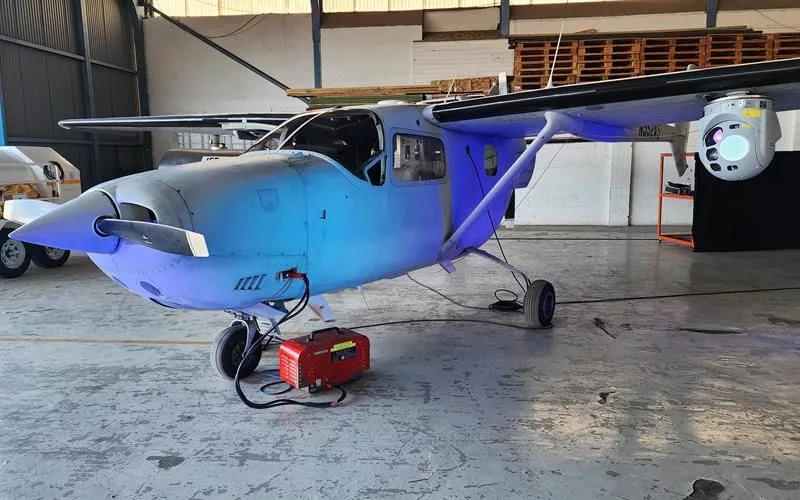
The city’s Safety and Security Directorate is revolutionizing crime prevention with the use of Information, Surveillance, and Reconnaissance (ISR) technology, also known as the “Eye in the Sky.” This two-seater fixed-wing aircraft is equipped with state-of-the-art cameras that provide situational awareness to law enforcement and has advanced detection capabilities that expand beyond law enforcement to monitor power lines, infrastructure, coastal impacts, and biodiversity. The ISR is more efficient, reliable, and adaptable than drones and sets a new standard for crime prevention with its incorporation into the city’s advanced technology in law enforcement.
Revolutionizing Crime Prevention: A Soaring Eye in the Sky
The Safety and Security Directorate of the city is incorporating Information, Surveillance, and Reconnaissance (ISR) technology into its crime prevention strategy. The ISR, also known as the “Eye in the Sky,” is a two-seater fixed-wing aircraft equipped with state-of-the-art cameras that provide situational awareness to law enforcement. Compared to drones, the ISR is more efficient, reliable, and adaptable. With its advanced detection capabilities, the ISR expands beyond law enforcement to monitor power lines, infrastructure, coastal impacts, and biodiversity. The city’s commitment to advanced technology in law enforcement sets a new standard for crime prevention.
Modernizing Surveillance and Crime Prevention Strategies
In a bid to modernize and revolutionize its crime prevention strategy, the Safety and Security Directorate of the city is taking a leap into the era of sophisticated aerial surveillance technology. One of the most recent innovations in its technological arsenal is the Information, Surveillance, and Reconnaissance (ISR) technology. This powerful tool has proven to be instrumental in countering a multitude of illicit activities. Stolen vehicle recoveries and poaching prevention are among the notable operations where its effect has been profoundly felt.
The ISR technology, informally referred to as the “Eye in the Sky,” is not a typical piece of equipment. It is a two-seater fixed wing aircraft loaded with state-of-the-art cameras, destined to transform how we approach law enforcement and safety. With its ability to provide an aerial view of the city, the ISR delivers the much-needed situational awareness that law enforcement officers need during various operational tasks.
The Superiority of ISR Technology Over Drones
Compared to drones, the ISR exhibits a higher level of efficiency and reliability. It has the ability to fly at higher elevations, cover a wider geographical span, and remain airborne for much longer durations. Additionally, it is outfitted with infrared cameras, a feature that enables it to detect body heat in cold water, trace heat from a recently discharged gun, or even sense the heat generated by the tires of a high-speed vehicle. This advanced detection capability expands the applicability of the ISR beyond just law enforcement. It can monitor high voltage power lines, detect damage to crucial infrastructures, assess coastal impacts, and address biodiversity-related issues.
Alderman JP Smith, the Mayoral Committee Member for Safety and Security, spoke highly of the aircraft’s adaptability. He stated, “The ISR technology is a multifaceted tool. The fixed-wing aircraft can cover wider geographical areas, stay airborne for longer durations during low-level reconnaissance flights, and is less susceptible to weather conditions than drones. It can also aid in enhancing the rapid response time of officers during planned operations as precise data can be relayed.”
Incorporation of ISR Technology and Staff Training
The city’s decision to incorporate this technology was a result of an extensive and intricate tender process for the fixed-wing aircraft. This isn’t the first instance of the city utilizing such an aircraft. Previously, a similar device underwent testing during crime prevention operations and was crucial in aiding fire services during the disastrous Table Mountain fire in 2021.
Subsequent to the conclusion of the contract management stage, the training of command center staff and operational personnel will begin. The objective of this training is to familiarize the staff with the technology and prepare them to fully exploit its capabilities when deployed.
The aircraft being utilized is a Cessna 337, and its operation will be managed by expert pilots provided through the tender contract. This recent inclusion enhances the impressive technological roll-out of the city, which already encompasses drones, DashCam, BodyCam, Shotspotter, CCTV, and ANPR applications, among others.
The Impact of ISR Technology on Crime Prevention
The ISR technology, through its unique abilities and potential to bolster crime prevention operations, exemplifies the city’s dedication to using advanced technologies in law enforcement. As the “Eye in the Sky” soars above the city, it heralds a new epoch of surveillance, safety, and security.
In essence, the deployment of this surveillance aircraft not only affirms the city’s commitment to ensuring the safety of its residents but also sets a new standard in crime prevention. By leveraging advanced technologies like the ISR, the city is at the forefront of modern, tech-driven law enforcement, setting an example for other cities to follow.
What is the ISR technology?
The ISR (Information, Surveillance, and Reconnaissance) technology is a two-seater fixed-wing aircraft equipped with state-of-the-art cameras that provide situational awareness to law enforcement. It has advanced detection capabilities that expand beyond law enforcement to monitor power lines, infrastructure, coastal impacts, and biodiversity.
How does the ISR technology compare to drones?
Compared to drones, the ISR is more efficient, reliable, and adaptable. It has the ability to fly at higher elevations, cover a wider geographical span, and remain airborne for much longer durations. It is also outfitted with infrared cameras, which enable it to detect body heat in cold water, trace heat from a recently discharged gun, or sense the heat generated by the tires of a high-speed vehicle.
What is the purpose of the ISR technology in crime prevention?
The ISR technology is meant to provide law enforcement with situational awareness, which helps them better execute their operational tasks. With its advanced detection capabilities, the ISR expands beyond law enforcement to monitor power lines, infrastructure, coastal impacts, and biodiversity. The technology is instrumental in countering a multitude of illicit activities, including stolen vehicle recoveries and poaching prevention.
How will staff be trained to use the ISR technology?
Subsequent to the conclusion of the contract management stage, the training of command center staff and operational personnel will begin. The objective of this training is to familiarize the staff with the technology and prepare them to fully exploit its capabilities when deployed.
What aircraft will be used for the ISR technology?
The aircraft being utilized is a Cessna 337, and its operation will be managed by expert pilots provided through the tender contract.
What impact will the ISR technology have on crime prevention?
The deployment of the ISR technology in crime prevention operations exemplifies the city’s dedication to using advanced technologies in law enforcement. The technology sets a new standard in crime prevention and safety for the city’s residents. It also sets an example for other cities to follow in modern, tech-driven law enforcement.