Robben Island, a place of somber history, now cradles a desperate hope: saving the Cape Cormorant. These seabirds face extinction as their food, sardines and anchovies, vanish from warming surface waters. Dedicated rescuers transport tiny, chirping chicks from the island to a mainland ‘orphanage.’ Here, human ‘bird mums’ tirelessly hand-feed and waterproof the young birds, preparing them for a return to an ocean that’s growing emptier. It’s a heroic, costly fight against climate change, where every saved chick is a tiny victory against a silent, looming crisis.
Why are Cape Cormorants endangered?
Cape Cormorants are endangered primarily due to a decline in their main food sources, sardines and anchovies. These fish are diving deeper as surface waters warm, making them harder for parent birds to find. This leads to increased nest abandonment and starvation of chicks.
1. From Silent Icon to Crisis Nursery
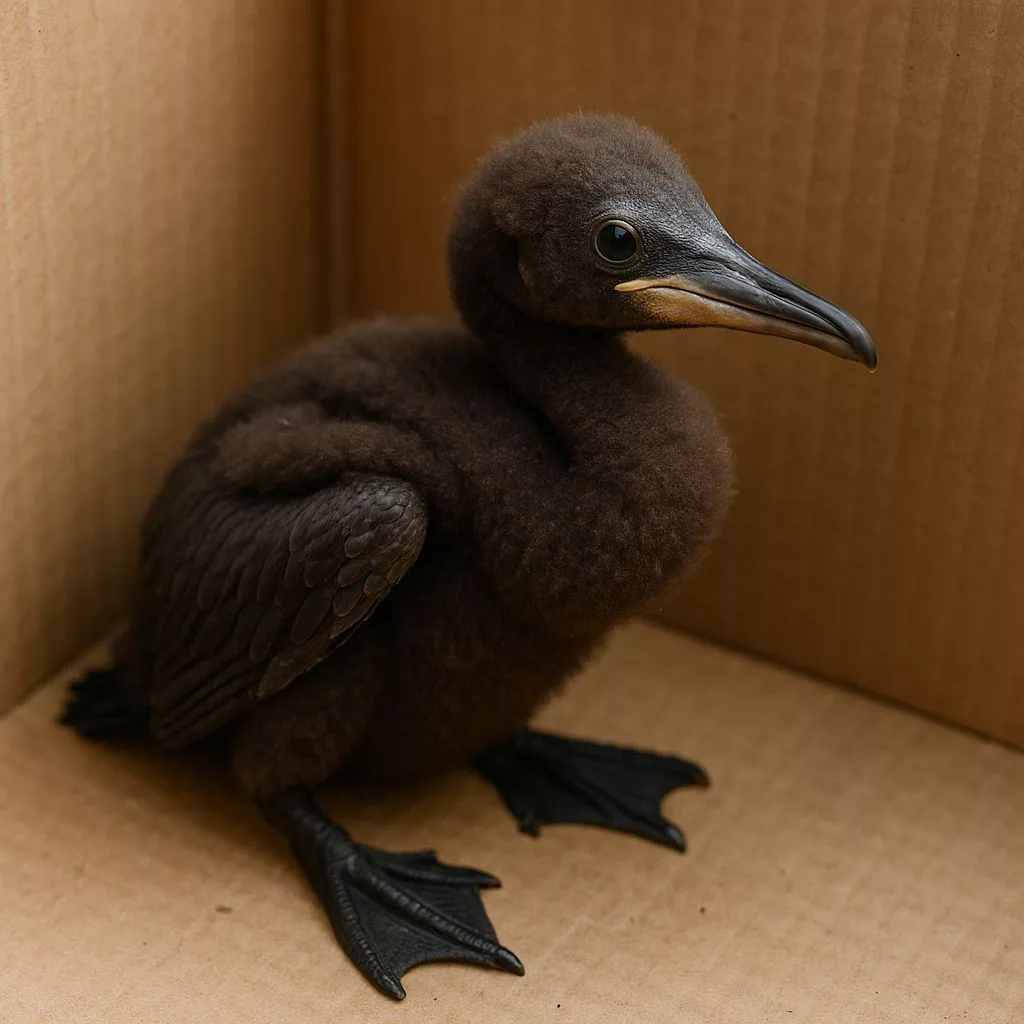
At first light, Robben Island’s limestone cliffs echo with a sound no brochure mentions: the urgent, metallic cheeping of seabird chicks packed in vented cartons. Cardboard walls perforated like machine-gun belts line the jetty where tourists normally pose for selfies; through the holes drifts the reek of diesel, seaweed and sun-baked guano. Inside each box a charcoal-grey fluff-ball teeters on oversized orange feet, throat fluttering at 200 beats a minute. These Cape Cormorant chicks should be wedged beneath a parent’s breast feathers; instead they are cargo, about to cross three kilometres of Atlantic swell to an improvised orphanage on the mainland.
Phalacrocorax capensis once darkened horizons in flocks the size of city suburbs. Today the same bird is Red-Listed as Endangered, its numbers halved since the 1990s. The collapse feels quiet – no oil-slick drama, just steadily emptier cliffs and parent birds that never come back from foraging trips. Sardine and anchovy, the cormorant’s payroll, are diving deeper as surface waters warm. When the commute between chick and fish takes longer than the energy in a belly-load of prey, evolution instructs the adult to save itself. The result: unattended nests and a growing pile of tiny skeletons dressed in soot-coloured down.
Against that backdrop, the ferry dock becomes a triage theatre. A refrigerated trailer – usually parked behind Cape Town’s fish-market – now doubles as an avian NICU. Heat-lamps, fish smoothies and a laminated “Intake Protocol” await the WhatsApp SOS from island rangers who counted 400 orphans before breakfast. The protocol ends with the line “Release when 90 % adult mass and waterproof,” yet everyone knows the unspoken footnote: only if the ocean still holds fish by then.
2. Cardboard Boxes to Salt-Water Bootcamp
Loading the 09:30 ferry is choreographed chaos. Volunteers slide chicks head-first into blue IKEA bags for weighing, snapping colour-coded cable ties around scaly ankles – blue for under 300 g, yellow for middling, red for near-fledgers. Each hue maps onto a labour schedule: blue equals ten days of syringe feeds every 120 minutes from 05:00 to 21:00; red means two afternoons in a salt-water pool before graduation. The first 48 hours are razor-edged; a chick deprived of parental fluids can tumble into renal failure before dinner. Thandiwe, a veteran “bird mum,” perfects the stealth tube-feed: 2 ml electrolyte shot while the chick is still in its box, heart-rate barely spiking.
By mid-morning the ferry deck resembles a low-budget space mission – crates strapped to the gunwales, engine idling to cancel swell, captain watching for the south-easter that could cut the operation short. Once docked, a truck emblazoned “Every Bird Counts” races the cargo to SANCCOB’s Rietvlei centre, a repurposed sewage works now ringed with artificial grebe rafts instead of gun clubs. Inside the cormorant nursery, noise-dampening crocs and whispered conversations protect developing cortisol levels. Heat lamps create 28 °C micro-climates above rubber mats that can be fire-hosed every two hours. Formula is a fish milk-shake – anchovy, sardine oil, calcium carbonate and a taurine boost because cormorants can’t make their own.
Feeding masks printed with adult gular-pouch patterns try to fool chicks into thinking their waiter is a parent, yet the birds quickly clock Elizabeth’s green gumboots as the true dinner bell. Her battered notebook logs stool texture, wing-stretch frequency and the quarter-degree beak-temperature rise that flags looming fungal infection. Outside, three seawater pools bubble like oversized spa baths. A GoPro on a weighted line audits the students: stay under 15 seconds and surface dry and you earn a GPS backpack plus a one-way ticket back to the wild. Waterproofing is everything – one soaked feather can kill in minutes, so the pools double as final exam and quality-control gate.
3. Payday for Seagulls: Economics and Ethics of Saving a Species
Rehabilitation maths is brutal and brilliant. One chick swallows 1.2 kg of imported anchovy before release – R45 at wholesale – then adds syringes, power bills and diesel. Crowdfunding turns donations into dopamine: R250 “feeds a chick for five days,” R5 000 buys naming rights that last season produced Marvel superheroes instead of case numbers. Corporates receive carbon-offset certificates arguing that 500 saved chicks remove 3.5 t of fishing pressure, translating into fewer trawler litres burned. Even so, everyone agrees triage is a finger in a dike breached by climate models predicting a 1.2 °C hotter Benguela by 2050.
Science therefore chases stop-gap miracles. Drone-deployed “bait balls” squirt anchovy oil slicks that lure predatory fish upward, cutting parental foraging time by 18 %. Temperature loggers disguised as mussels stream data to an algorithm; when the risk of nest abandonment exceeds 60 %, rescue teams pre-book ferry slots, shaving a day and boosting survival by 12 %. Most ambitious is the R1.8 million “floating crèche” – a solar-powered raft anchored west of the island, blasting adult contact calls while dispensing automatic fish snacks. Prototype data show 180 chicks using it as a motorway service station before rejoining wild aggregations. Fishermen waive licence fees to tow the raft, forging an uneasy truce between conservation and the industry often blamed for empty nets.
4. The Next clutch: Waiting for a Warmer January
January will hatch another wave of chicks, timed to the historic upwelling peak. Whether their parents will still be on payroll depends on wind mood, current temperature and food web architecture redesigned by a warming planet. Volunteers have traded IKEA bags for stackable crates – reusable, washable, a micro-adaptation in an operation that inflates each year while wild numbers deflate. Above the crates, Rachel Carson’s warning – “In nature nothing exists alone” – is annotated by a red-marker addendum: “But sometimes a species needs a lift to the next raft.” As the ferry turns city-ward, sunrise glints off cardboard flaps and the Indian Ocean’s future rolls cold and uncertain beneath the keel.
[{“question”: “
Why are Cape Cormorants endangered?
“, “answer”: “Cape Cormorants are endangered primarily because their main food sources, sardines and anchovies, are becoming scarce. These fish are moving to deeper, cooler waters due to rising surface ocean temperatures, making them harder for parent birds to find. This leads to increased nest abandonment and starvation of chicks on Robben Island and other breeding grounds. Since the 1990s, their numbers have halved, leading to their Red-Listed status as Endangered.”}, {“question”: “
How are Cape Cormorant chicks rescued from Robben Island?
“, “answer”: “Cape Cormorant chicks are transported from Robben Island to a mainland ‘orphanage’ because their parents are unable to find enough food for them. Rangers on the island identify orphaned chicks, and then they are carefully packed into vented cartons and transported across the Atlantic swell to a rehabilitation center. This operation is often timed to be efficient, with refrigerated trailers and dedicated ferry slots for transport, especially when nest abandonment rates are high.”}, {“question”: “
What happens to the chicks at the mainland ‘orphanage’?
“, “answer”: “At the mainland ‘orphanage,’ such as SANCCOB’s Rietvlei centre, human ‘bird mums’ and volunteers tirelessly care for the chicks. They are categorized by weight (e.g., blue for under 300g, yellow for middling, red for near-fledgers), which dictates their feeding schedule. Younger chicks receive syringe feeds every 120 minutes, while older ones are prepared for release. They are hand-fed a specialized fish milkshake, kept under heat lamps in controlled environments, and undergo ‘salt-water bootcamp’ in pools to ensure they become waterproof before release. This waterproofing is crucial for their survival in the wild.”}, {“question”: “
What is the cost and effort involved in rehabilitating a Cape Cormorant chick?
“, “answer”: “The rehabilitation of a single Cape Cormorant chick is a significant undertaking. One chick can consume 1.2 kg of imported anchovies before release, which costs approximately R45 just for the food. This doesn’t include the costs of syringes, power bills for heat lamps and facilities, diesel for transport, and the intensive labor of dedicated ‘bird mums’ and volunteers. Crowdfunding and corporate donations help cover these expenses, with opportunities like ‘feeding a chick for five days’ or ‘naming rights’ to encourage support.”}, {“question”: “
Are there any innovative scientific solutions being explored to help the Cape Cormorants?
“, “answer”: “Yes, scientists are actively exploring stop-gap solutions to aid the Cape Cormorants. These include drone-deployed ‘bait balls’ that squirt anchovy oil slicks to lure fish closer to the surface, reducing parental foraging time. Temperature loggers disguised as mussels provide data to an algorithm that predicts nest abandonment risk, allowing rescue teams to pre-book ferry slots and increase chick survival. Most ambitiously, a R1.8 million ‘floating crèche’ \u2013 a solar-powered raft that broadcasts adult contact calls and dispenses automatic fish snacks \u2013 is being tested to provide a ‘motorway service station’ for chicks before they rejoin wild aggregations.”}, {“question”: “
What is the long-term outlook for Cape Cormorants and the conservation efforts?
“, “answer”: “The long-term outlook for Cape Cormorants remains uncertain due to the ongoing impact of climate change. While the rescue efforts are heroic and every saved chick is a victory, they are ultimately a ‘finger in a dike’ against a larger problem. Climate models predict a 1.2 \u00b0C hotter Benguela current by 2050, which will continue to affect the availability of their food sources. The conservationists are adapting their methods, using reusable equipment and micro-adaptations, but the future of the species heavily depends on the broader changes in ocean conditions and food web architecture redesigned by a warming planet. The hope is that these interventions provide a ‘lift to the next raft’ for the species while larger environmental changes are addressed.”}]