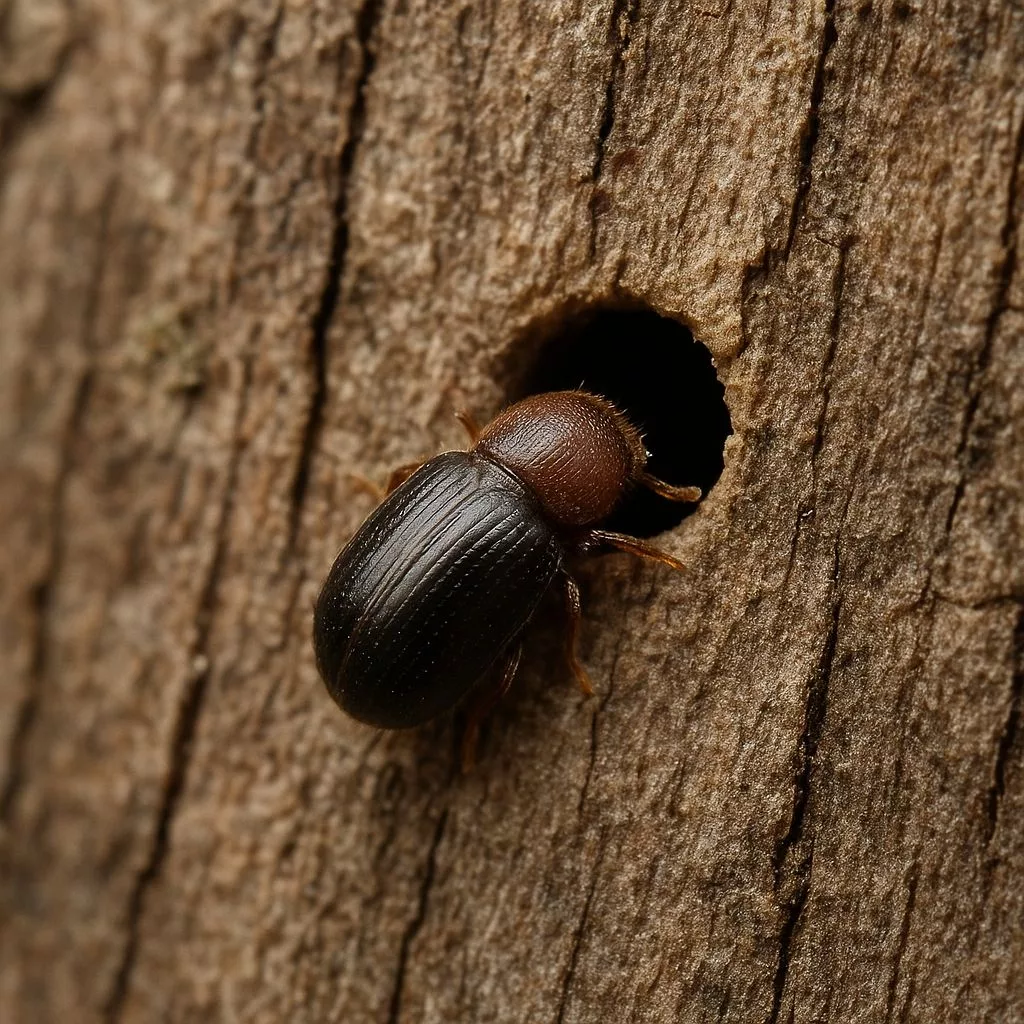
A tiny, pin-sized beetle is slowly killing Cape Town’s trees. This beetle digs into trees and introduces a deadly fungus that chokes the tree from the inside. The city is fighting back with special teams, tree injections, and even citizen help to track the beetle’s spread. They are planning to replace many trees with stronger native species, but it’s a huge, ongoing battle.
What is causing the decline of trees in Cape Town?
The decline of trees in Cape Town is primarily caused by the Polyphagous Shot Hole Borer (PSHB), a pin-sized beetle (Euwallacea fornicatus) that drills into trees, introducing a destructive fungus (Fusarium euwallaceae). This fungus clots the tree’s vascular system, effectively killing it. The beetle cultivates this fungus to feed its larvae, turning urban trees into agricultural fields.
1. The Tick Heard Around the City
On a muggy summer dawn, the only thing louder than the espresso machines on Long Street was a faint ticking from the giant London plane above the pedestrian crossing. It sounded like distant drizzle on a tin roof, yet the sky was clear. Each click is the calling card of a female beetle smaller than a sesame seed, drilling into the tree’s life-pipes and sowing spores of a hungry fungus. In the 60 seconds it takes the traffic light to cycle, she has carved a bridal chamber, seeded it with Fusarium euwallaceae, and laid the eggs that will hatch before March. One tree, one month, one hundred daughters: the beetle’s maths is brutal.
Capetonians are learning a new vocabulary overnight: brown vascular streaks, gum drool, flagging twigs, sudden snap. The insect’s Latin tag, Euwallacea fornicatus, nods to the vaulted tunnels it sculpts, but locals now translate that as “silent sabotage.” The city’s asphalt canyon streets – never designed as ecological battlefields – have become high-speed highways for a pest that can’t fly far on its own wings yet travels happily on pallets, nursery plants, or the turn-up of a visitor’s jeans. From Somerset West’s oaks to Constantia’s vineyards, the front line keeps shifting west at roughly a kilometre a week.
What actually kills the tree is not the beetle but the farm it tends. The fungus clots drinking straws in the wood, turning living tissue into damp brown biscuit. The beetle brings the seed, harvests the crop, and feeds the mycelium to its larvae. It is subsistence agriculture played out inside a single trunk, and Cape Town’s 650 000 street trees are the newest irrigated fields.
2. Boxelder: The Trojan Shade
In the 1970s city planners wanted instant canopy, so they dotted the inner city with boxelder maples from North America – soft wood, fast growth, maximum shade. Those same traits now make Acer negundo the perfect incubator. One mated female can start a metropolis without ever leaving home. Municipal counts show that 11 % of CBD street trees are boxelders; in Tamboerskloof the figure tops 18 %. Stellenbosch researchers calculate that a single infected trunk can shelter 100 000 beetles before the first dead twig is noticed.
Once the boxelder population explodes, the insect turns polyphagous. London planes, English oaks, avocadoes, and even the iconic camphors of Stellenbosch University fall to mass assault. California has already lost tens of thousands of oaks and willows; Israeli growers have abandoned entire avocado districts. South Africa’s timeline is shorter: first detected in Durban harbour in 2017, the beetle rode nursery trucks to Pietermaritzburg’s plane-lined avenues and reached Cape Town’s eastern suburbs by 2022. The city centre finding is not an isolated beachhead – it is the crest of a national tsunami moving at highway speed.
Climate change acts like an accelerator. Cape Town’s winter nights have warmed by 1.2 °C since 1960, shaving two weeks off the beetle’s hibernation and squeezing in a third generation each year. Meanwhile, the city’s drought-response irrigation – deep, infrequent soaking – boosts ethanol emissions from stressed xylem, a chemical dinner gong for gravid females. Water-wise policy, meet wood-wise pest.
3. Chainsaws, Chemistry, and Citizen Phones
Deputy Mayor Eddie Andrews has retooled 32 municipal horticulturists into “borer brigades.” Armed with cordless drills, 4 mm bits, hand lenses, and foil blankets, they extract core samples and wrap infected wood on the spot. A positive core triggers a 50 m sweep of every neighbouring property; owners receive bilingual flyers headlined “Does Your Tree Pass the Sesame-Seed Test?” If a trunk hole swallows a sesame seed, the hotline expects your call. Refuse a removal notice and you pay R5 000 daily until the chainsaw arrives.
Commercial precincts are budgeting for a new line item: annual tree injections. The V&A Waterfront has 1 200 specimens insured for R60 million; each micro-infusion of emamectin benzoate costs R850 per year – cheaper than replacement, yet an expense no balance sheet predicted. Wine estates fear not only for heritage oaks but for the barrel staves those oaks become; a 150-year-old tree at Groot Constantia underwrites wedding-photo fees of R15 000 per shoot. One beetle, one wedding industry.
Citizens have become the city’s remote-sensing network. Five hundred purple bucket traps baited with quercivorol pheromones hang in schoolyards, golf courses, and neighbourhood watch cul-de-sacs. A caught beetle is photographed, GPS-tagged, and uploaded to the iNaturalist “PSHB Cape Town” project within minutes. Negative results matter as much as positive ones: empty traps in Observatory and Camps Bay help statisticians draw the true invasion edge. Meanwhile, WhatsApp groups trade macro shots of gum lesions like wartime intelligence, and a 40-second drip-timelapse from Tamboerskloof can crash the municipal server.
4. Replacing the Canopy, Rewriting the Contract
Eradication is almost certainly off the table. Brisbane burned AU$4.7 million trying, then surrendered when the beetle hid inside a military base. Cape Town is therefore drafting a 30-year “host-free” replanting schedule: no more plane trees, no boxelders, no Japanese maples. Instead, nursery managers are propagating Cape beech, milkwood, and keurboom – species whose xylem chemistry scored lowest in beetle sniff-tests. Swapping the entire urban canopy is a generational project; the beetle can kill in a single season.
Private gardens remain the weak link. A Japanese maple in a Dunkley Square courtyard can launch a neighbourhood outbreak, so the city is piloting a “tree passport.” After a certified inspection, owners receive a QR-coded aluminium tag that links to a blockchain ledger of trunk diameter, injection dates, and inspection logs. Estate agents already report a 3 % property premium for passported trees – proof that markets can price ecological risk faster than councils can regulate it.
Night-time infrared drones are the latest gambit. A thermal camera 30 m above Company’s Garden detected 18 hot spots where fungal metabolism raised trunk temperature by 0.3 °C; coring later confirmed beetle presence in eight. Scaling city-wide would need 1 200 flight hours and R3 million, funds hustled into the next climate-resilience budget. Until then, Cape Town fights with blunt instruments: chainsaws, chippers, chemistry, and a population that has finally looked up from its coffee cups at the ticking overhead.
What is the Polyphagous Shot Hole Borer (PSHB)?
The Polyphagous Shot Hole Borer (PSHB), or Euwallacea fornicatus, is a tiny, pin-sized beetle that poses a significant threat to trees in Cape Town and other regions. It drills into trees and introduces a deadly fungus (Fusarium euwallaceae) that serves as a food source for its larvae. This fungus then chokes the tree’s vascular system, leading to its decline and eventual death. The beetle itself does not directly kill the tree; rather, it cultivates the fungus, which is the true agent of destruction.
How does the PSHB beetle kill trees?
The PSHB beetle doesn’t directly kill trees. Instead, it acts as a vector for a pathogenic fungus, Fusarium euwallaceae. When the female beetle drills into a tree, she introduces spores of this fungus. The fungus then grows within the tree’s xylem (water-conducting tissues), effectively clogging its “drinking straws” and preventing water and nutrients from reaching the rest of the tree. The beetle larvae then feed on this fungus, which it cultivates as a food source. This process of fungal growth within the tree’s vascular system is what ultimately leads to the tree’s decline and death.
What are the visible signs of a PSHB infestation?
Capetonians are learning to identify several key signs of a PSHB infestation. These include “brown vascular streaks” visible in the wood, “gum drool” or sap oozing from entry holes on the bark, “flagging twigs” (wilting or dying branches), and in later stages, “sudden snap” where branches or entire trees can break unexpectedly due to internal damage. A simple “sesame-seed test” involves checking if a trunk hole can swallow a sesame seed, indicating a potential borer entry point.
Why are Boxelder maples particularly vulnerable to PSHB?
Boxelder maples (Acer negundo) were widely planted in Cape Town in the 1970s for their rapid growth and shade provision. Unfortunately, these same characteristics – soft wood and fast growth – make them ideal incubators for the PSHB beetle. They allow the beetle to establish and reproduce quickly, with a single infected trunk potentially harboring 100,000 beetles before external signs of damage are evident. Once the boxelder populations explode, the beetles then spread to other tree species.
What measures is Cape Town taking to combat the PSHB infestation?
Cape Town is employing a multi-faceted approach to combat the PSHB. This includes:
1. Borer Brigades: Municipal horticulturists are trained to extract core samples, identify infestations, and trigger wider sweeps.
2. Tree Injections: Commercial precincts and private estates are using annual micro-injections of pesticides like emamectin benzoate to protect high-value trees.
3. Citizen Involvement: Residents are encouraged to report potential infestations via a hotline, and a network of purple bucket traps baited with pheromones helps track the beetle’s spread.
4. Long-term Replanning: The city is drafting a 30-year “host-free” replanting schedule, replacing vulnerable species with resistant native trees like Cape beech, milkwood, and keurboom.
5. Technological Solutions: Infrared drones are being piloted to detect heat signatures indicative of fungal metabolism within trees.
How is climate change influencing the PSHB spread in Cape Town?
Climate change is acting as an accelerator for the PSHB infestation in Cape Town. Warmer winter nights (a 1.2 °C increase since 1960) shorten the beetle’s hibernation period, allowing for an additional third generation of beetles each year, thus increasing their reproductive rate. Furthermore, the city’s drought-response irrigation policies, which involve deep and infrequent watering, can stress trees and cause them to emit more ethanol from their xylem. This ethanol acts as a chemical attractant, a “dinner gong,” for gravid female beetles, making stressed trees more susceptible to infestation.