
The State of the Nation Address is a significant political event in South Africa that marks the unofficial start of the parliamentary agenda. Accredited media plays a crucial role in documenting the event, and the Parliament emphasizes the importance of media participation, providing an online-based accreditation process for interested parties. The event offers insight into the government’s plans for the upcoming fiscal year, and President Cyril Ramaphosa’s SONA is set to unveil the government’s primary legislative goals and expected outcomes for the year.
The State of the Nation Address: A Mosaic of Triumphs, Challenges, and Future Steps
The State of the Nation Address (SONA) is a significant political event in South Africa that marks the unofficial inauguration of the parliamentary agenda. Accredited media plays a crucial role in documenting the event, which offers a sneak peek into the government’s plans for the upcoming fiscal year. The Parliament emphasizes the importance of media participation and provides an online-based accreditation process for interested parties. The deadline for accreditation applications is January 19, 2024, at 17:00, without any exceptions.
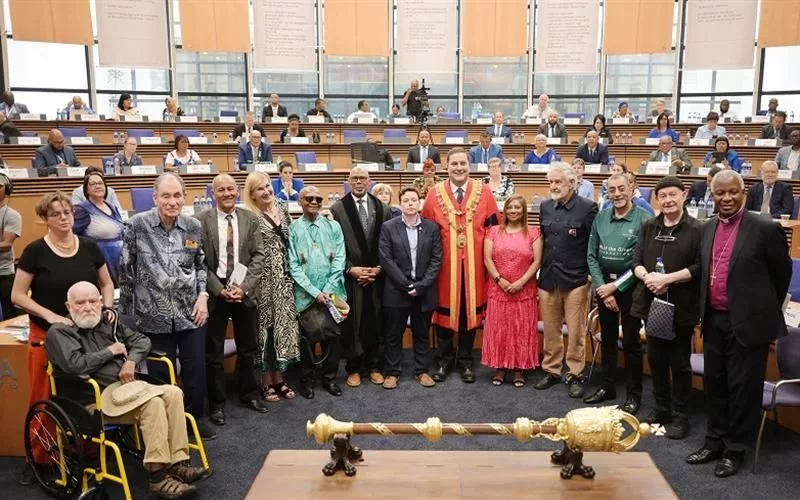
In the lush epicenter of Cape Town, a sense of expectancy vibrates within the confines of the South African parliamentary grounds. The buzz intensifies as we draw closer to an important milestone on the national agenda. On February 8, 2024, the distinguished President Cyril Ramaphosa is scheduled to deliver a speech to the nation in a joint conference of the National Assembly and the National Council of Provinces, more commonly known as the State of the Nation Address (SONA).
The merging of the two houses embodies a unified intention; a collective dream for the future of South Africa. President Ramaphosa’s SONA is set to unveil the government’s primary legislative goals and expected outcomes for the upcoming year, offering a navigational guide for the nation.
The State of the Nation Address: A Mosaic of Triumphs, Challenges, and Future Steps
SONA transcends being merely a political event; it is an intricate matrix of accomplishments, hurdles, and future actions. The speech provides a sneak peek into the government’s schemes to initiate developmental measures for the upcoming fiscal year, marking the unofficial inauguration of the parliamentary agenda.
Media holds a crucial position in the SONA, as in any significant political events. Journalists, who function as the channels of information between the government and the citizens, are invited to document both the ceremonial parade and the address. Accreditation is necessary, and the application process is entirely online-based, ensuring a seamless and efficient interaction.
Press representatives interested in covering the event can apply for accreditation through an online form on the official website of the Parliament. To maintain the credibility of the procedure, the application requires vital details such as the applicant’s name, ID number, media organization, designation, and contact information. The final deadline for these applications is January 19, 2024, at 17:00, without any exceptions.
Behind-the-scenes: Media Accreditation Process and Parliament’s Custodial Role
For those planning to broadcast live from the parliamentary grounds, supplementary details are required. These include information on vehicles, clearance certificates from service providers for temporary broadcasting infrastructures, other equipment specifics, and the proposed timetable of arrival and departure.
Behind the scenes, a team of committed professionals stand poised to assist with any queries related to the accreditation process. Masego Dlula and Malentsoe Magwagwa, available through their respective email addresses and phone numbers, are the appointed contacts for this purpose.
The Parliament of the Republic of South Africa, the body that issues these guidelines, emphasizes the significance of media participation in this pivotal event. The media’s function in conveying the details of the SONA is crucial in ensuring that the public comprehends the government’s future plans.
In a related but often disregarded fact, the South African Parliament bears a substantial responsibility beyond legislation and supervision. It is the guardian of the signed copies of Acts of Parliament, the authorized versions, which are entrusted to the Constitutional Court. This duty underscores the institution’s vital role in safeguarding the nation’s legislative history.
Key Attendees and the Blend of Tradition and Modernity in the Accreditation Process
Among the distinguished attendees of the SONA is Mr. Mbulelo Jonathan Magwala, a delegate from the Economic Freedom Fighters representing the Western Cape province. As part of the Select Committee on Land Reform, Environment, Mineral Resources, and Energy, as well as the Select Committee on Public Enterprises and Communication, his involvement illustrates the wide-ranging representation at this groundbreaking parliamentary event.
As the date of the SONA draws nearer, the online media accreditation process stands as an affirmation of the synthesis of tradition and modernity in the South African parliamentary process. As the nation eagerly awaits President Ramaphosa’s address, the media gears up to broadcast this significant policy blueprint, fostering a conversation between the government and its citizens.
1. What is the State of the Nation Address (SONA) in South Africa?
The State of the Nation Address (SONA) in South Africa marks the unofficial start of the parliamentary agenda and offers insight into the government’s plans for the upcoming fiscal year.
2. What role does accredited media play in the SONA event?
Accredited media plays a crucial role in documenting the SONA event. Journalists function as channels of information between the government and the citizens, and their participation is essential in conveying the details of the government’s future plans.
3. How can media representatives apply for accreditation to cover the SONA event?
Media representatives interested in covering the SONA event can apply for accreditation through an online form on the official website of the Parliament. The application requires vital details such as the applicant’s name, ID number, media organization, designation, and contact information. The final deadline for these applications is January 19, 2024, at 17:00, without any exceptions.
4. What additional details are required for those planning to broadcast live from the parliamentary grounds?
For those planning to broadcast live from the parliamentary grounds, supplementary details are required, such as information on vehicles, clearance certificates from service providers for temporary broadcasting infrastructures, other equipment specifics, and the proposed timetable of arrival and departure.
5. What is the Parliament of the Republic of South Africa’s role in the SONA event?
The Parliament of the Republic of South Africa issues guidelines for the SONA event and emphasizes the significance of media participation in this pivotal event. Additionally, it is responsible for safeguarding the nation’s legislative history by being the guardian of the signed copies of Acts of Parliament, the authorized versions, which are entrusted to the Constitutional Court.
6. Who are the distinguished attendees of the SONA event?
Among the distinguished attendees of the SONA event is Mr. Mbulelo Jonathan Magwala, a delegate from the Economic Freedom Fighters representing the Western Cape province. His involvement illustrates the wide-ranging representation at this groundbreaking parliamentary event.