On December 18th, the ocean turned deadly on the Western Cape coast. At Schulphoek, giant waves, formed by clashing swells, swept a fisherman away. Hours earlier at Nature’s Valley, an extra-high tide made a boulder beach a death trap, leading to a teenager’s tragic fall and drowning. These two terrible events show how powerful and dangerous the sea can be, leaving communities heartbroken and questioning why. The ocean’s wildness continues to write sad stories, reminding everyone to be careful.
How did freak ocean conditions contribute to multiple fatalities on December 18th?
On December 18th, two separate incidents on the Western Cape coast resulted in fatalities due to extreme ocean conditions. At Schulphoek, “constructive interference” created abnormally large waves, sweeping a fisherman into the sea. Simultaneously, a perigean spring tide at Nature’s Valley transformed a boulder beach into a deadly blender, leading to a teenager’s fall and subsequent drowning.
- A 900-word, three-part reconstruction of the Western Cape’s deadliest Thursday*
Section 1 – Schulphoek: the postcard that bit back
Schulphoek Cove usually ends up on fridge magnets: turquoise water, fynbos dots, whales in the background.
On 18 December it supplied the cover shot for a darker album. At 14:40 the NSRI Hermanus hot-line lit up with a German hiker’s shout that something human-shaped was floating face-down beyond the reef. Nine minutes later the station’s 8-metre RIB Leonard Smith screamed down the slip, twin 200 hp Yamahas already warm. Tucked behind it, four volunteers shoulder-carried the 4-metre JetRIB – a squat aluminium board with twin jet nozzles designed for rock-garden rodeos – and simply ran it into the surf.
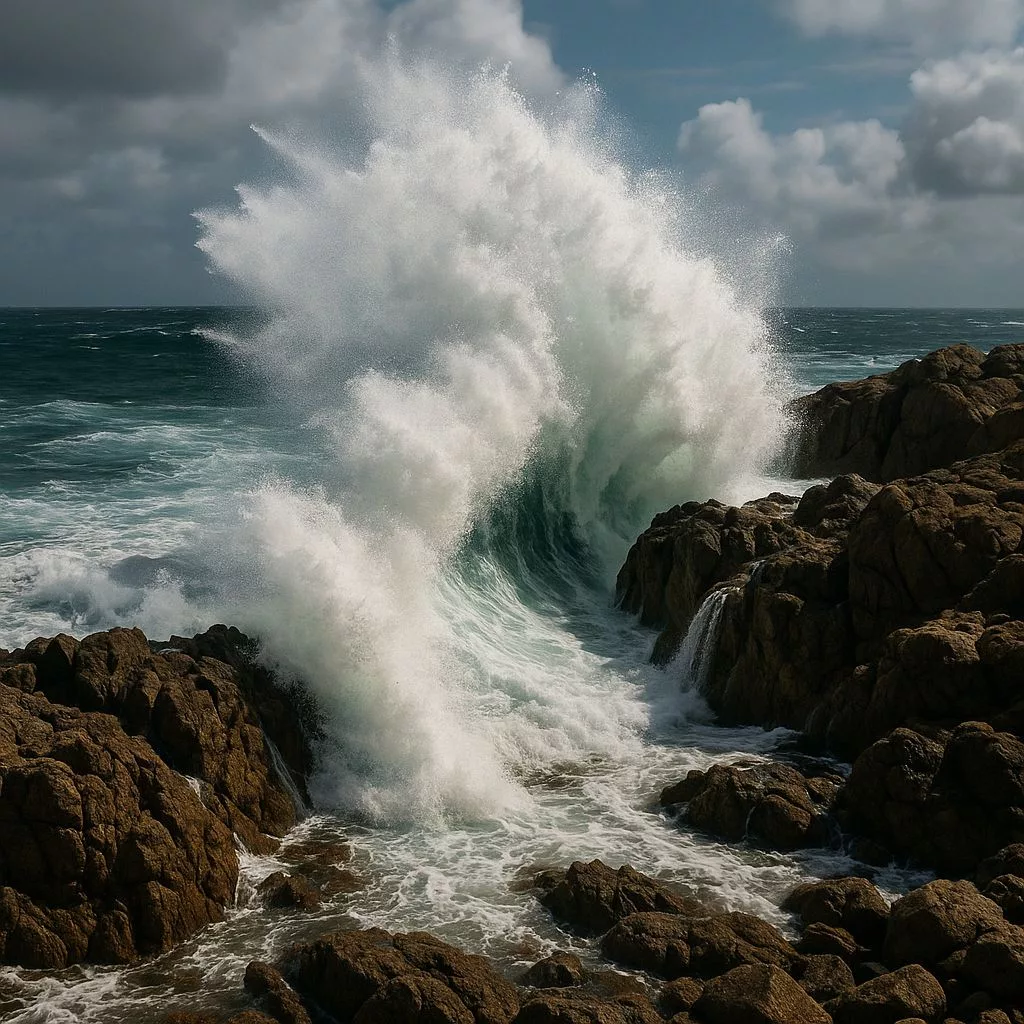
No one on the boat knew the man had been posing for the usual grip-and-grin snap, rod in one fist, phone in the other, when a freak set lurched around the harbour arm and doubled in height. Schulphoek refracts ocean energy the way a prism bends light: a 4.3 m reading on the offshore buoy can morph into a six-metre green guillotine. Witnesses say the victim tried to sprint, rubber soles skating on kelp that behaves like black ice. The sea inhaled him; his fishing rod cart-wheeled after.
Rescue swimmer Jaco van der Merwe kitted up on the bouncing deck – helmet, 5 mm vest, short fins – and rolled into the lee of a rock fin. Forty metres out he spotted the man, half-submerged, arms star-fished, a juvenile bronze whaler tracing lazy eights around the body. Van der Merwe timed the lull, closed the gap in under three minutes, and rolled the casualty supine. Foam-flecked water leaked from mouth and nostrils; carotid pulse absent. Rather than wait for a winch that might dither in the surge, he clipped the body to a half-spine board, signalled the JetRIB driver, and was towed clear. CPR began on the RIB’s deck at 15:04; the clock in the old harbour ambulance stopped at 15:27.
At dusk police divers retrieved a soaked backpack: two yellowtail lures, a chutney-smeared sandwich, and a Cape Town library card that gave the ocean its trophy’s name. Overstrand councillors slapped an emergency ban on reef fishing – good until the next committee meeting, or until boredom overrules grief.
Section 2 – Nature’s Valley: the cliff that rewrites gravity
Four hours earlier and 180 km east, the Groot River finished its mountain journey and spilled into the Indian Ocean through Nature’s Valley. The Tsitsikamma cliffs – 150 m of Cretaceous sandstone – stood jury and executioner. At 10:47 Skymed’s pilot radioed “object on boulder beach, Bull se Baai cave, human proportions.” The tide chart for the day was already inked in red: a perigean spring tide shoving an extra 20 cm of water onto rocks normally high and dry.
A Rondebosch school group had left the boardwalk at dawn to hike the Salt River gorge, aiming for the Instagram-famous twin arches locals call Oupa and Ouma. By 09:15 they were snapping dassies on a sloping ledge. One 16-year-old, keen boulderer in his spare time, went after a dropped phone. A fist-sized block popped free; he fell 40 m, ping-ponging off ledges before the cave’s mouth caught him. His friends heard the scrape of sneakers on stone, then only gull cries.
NSRI Plettenberg’s deputy commander Ross Badenhorst abandoned a budget spreadsheet, reached base in six minutes, and found the 7 m RIB Courtenay’s Rescuer already dripping on the slip. Sea state: 2.5 m south-westerly swell stacked on 1.8 m wind-chop, rebounding cliffs pitching up pyramid peaks touching 4 m. The only doorway was from the ocean side; the plateau above is a private plantation laced with black wattle and no track.
JetRIB driver threaded the rock garden by 11:20. Rescue swimmer Danielle Eedes – 24, marine-biology graduate, first fatality shout – duck-dived through the back-wash and surfaced inside a cathedral-high cave where the boy lay half-floating, left femur bent at right angles, pupils blown. She collared the cervical spine, slid him into a floating stretcher, and clipped the tether. The 200 m tow out looked like white-water rafting with a corpse: twice the stretcher slammed the cave wall before the RIB’s winch swallowed the line. Doctor Pierre van Niekerk pronounced death en route; the body reached Forensic Pathology Services at 12:15.
Section 3 – The science, the gear, the unanswered why
Oceanographers call what happened at Schulphoek “constructive interference”: a 15-second Southern Ocean ground-swell arrived just as an 8-second local wind-swell, the two wave trains stacking to 1.6 times normal height – textbook sweeper. Nature’s Valley had the opposite problem: extra water from the perigean tide turned a normally exposed boulder beach into a blender. Water temps – 14 °C on the Atlantic side, 19 °C in Tsitsikamma – can steal breath and dexterity within a quarter-hour.
Signage exists – SANParks even pictures a stick-figure plummeting – but teenagers chasing geotags carved the unofficial spur that killed. A private member’s bill on mandatory life-jackets for rock anglers has sat in committee since 2021. Meanwhile two families in Cape Town’s northern suburbs wait for DNA confirmation before Christmas-week funerals. NSRI volunteers quietly crowd-funded R35 k per burial; R10 k already arrived from a dive charter whose clients watched the Nature’s Valley winch.
The Weather Service hoists a persistent high-pressure ridge, promising 2.5–3.5 m swell for the next ten days. Fishing clubs cancelled meets; guides rerouted hikes inland. Yet the sentinels remain un-fenced, the ocean unlocked, the next dark line of swell already visible on the horizon – another sentence in a story the Cape keeps writing faster than we can read.
What caused the fatalities on December 18th?
Two separate incidents on the Western Cape coast resulted in fatalities due to extreme ocean conditions. At Schulphoek, “constructive interference” created abnormally large waves, sweeping a fisherman into the sea. Simultaneously, a perigean spring tide at Nature’s Valley transformed a boulder beach into a deadly blender, leading to a teenager’s fall and subsequent drowning.
What is “constructive interference” and how did it contribute to the Schulphoek incident?
Oceanographers define “constructive interference” as a phenomenon where two wave trains, such as a 15-second Southern Ocean ground-swell and an 8-second local wind-swell, align and stack upon each other. This can result in waves reaching 1.6 times their normal height. At Schulphoek, this led to a “freak set” of waves that doubled in height, sweeping a fisherman off the rocks.
What is a perigean spring tide and how did it impact Nature’s Valley?
A perigean spring tide occurs when the moon is closest to Earth (perigee) during a new or full moon, resulting in unusually high tides. On December 18th, this added an extra 20 cm of water to the Nature’s Valley coast. This additional water submerged normally exposed boulder beaches, turning them into dangerous, turbulent areas, which contributed to a teenager’s fatal fall.
What were the rescue efforts like for the Schulphoek incident?
Upon receiving a distress call, the NSRI Hermanus dispatched their 8-meter RIB Leonard Smith and a 4-meter JetRIB. Rescue swimmer Jaco van der Merwe located the victim approximately 40 meters out, with a juvenile bronze whaler shark circling the body. He secured the casualty to a half-spine board, and CPR was initiated on the RIB, but unfortunately, the individual was pronounced dead shortly after.
What happened to the teenager at Nature’s Valley?
A 16-year-old from a Rondebosch school group, who was an experienced boulderer, fell approximately 40 meters after a rock block dislodged while he was attempting to retrieve a dropped phone. He fell into a cave mouth on the boulder beach. NSRI Plettenberg Bay responded, with rescue swimmer Danielle Eedes locating the boy inside the cave. Despite efforts to recover him, he was pronounced dead en route to forensic services.
What safety measures are being considered or are in place following these events?
While signage exists in areas like Nature’s Valley, unofficial paths created by visitors, often for social media photos, remain a danger. There’s also a private member’s bill on mandatory life-jackets for rock anglers that has been in committee since 2021. Fishing clubs have cancelled meets and guides have rerouted hikes inland due to persistent high-pressure ridges forecasting significant swell for the coming days, highlighting ongoing awareness and caution.