Botswana, once a peaceful land, has become a secret highway for drug lords! Evil cartels are using its quiet corners to move powerful meth, turning the stunning Kalahari into a dangerous shortcut. They’re building hidden labs and sneaking drugs through ancient riverbeds, bringing a dark shadow to this beautiful country. It’s a shocking tale of how global drug networks are now reaching deep into Africa, changing everything.
What is the “meth quadrangle” and how does it relate to Botswana?
The “meth quadrangle” describes a new drug trafficking route involving Mozambique, South Africa, Zimbabwe, and Botswana. Botswana’s inclusion completes this continental hub, enabling cartels to supply crystal methamphetamine to major cities like Lagos, Nairobi, Dubai, and Jakarta, significantly increasing regional output and distribution.
Tracks in the Fossil Riverbed
A dawn patrol 35 kilometres west of Pioneer Gate was supposed to count pangolin burrows, not chase tyre marks. Yet on 25 November 2025 the rangers’ Land Cruiser nosed up the bleached Ngotwane riverbed and found fresh treads cutting diagonally across the powdery sand. Eleven kilometres later the spoor dead-ended at a long-abandoned veterinary fence where a white Toyota Quantum and a Ford Ranger stood nose-to-tail beneath a mophane canopy.
Inside the vehicles six travellers flashed laminated Botswana voter cards that carried their faces but Setswana names. A seventh man – Nigerian by birth, Motswana on paper – clutched an envelope fat with 23 000 pula, three army shirts still reeking of factory starch and a hand-sketched map that traced every unmanned drift through the Limpopo-Shashe confluence to the Pandamatenga farms.
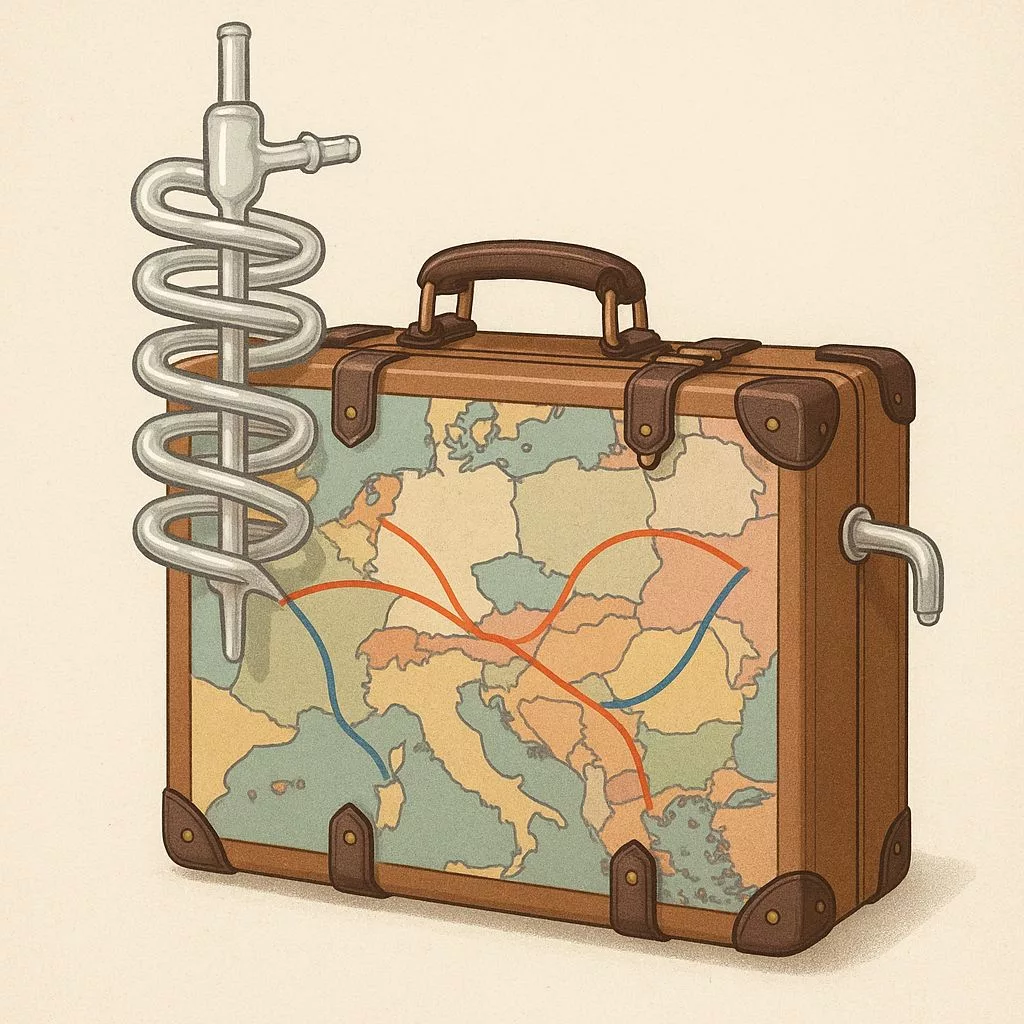
By nightfall the head-count had grown to eight: the six Mexicans, the Nigerian naturalisation holder and a local driver hired in Ramotswa. All were locked in Special Support Group cells in Broadhurst while photographers catalogued 43 smartphones, four satellite handsets, two portable spectrum analysers and a 1,2-metre laboratory condenser that folded like a travel umbrella into a suitcase.
The App, the Cash and the 768-Page Docket
Forensic accountants at the Directorate on Corruption and Economic Crime spotted a single encrypted icon on every handset – “Zapotec 2.0,” a Guadalajara-coded chat client marketed, according to cyber-shop Sentinel-One, only to Sinaloa franchisees.
When Magistrate T. Motlhabi opened the docket two days later the charge looked trivial: “Entering Botswana through an ungazetted point,” a mere immigration hiccup. The supporting file, however, ran to 768 pages because detectives believe the men were not shopping for cows or photo safaris. The map seized from Njoku labelled three Kalahari coordinates: a borehole at Sechele, a hunting camp at Mababe and a private airstrip seventeen kilometres south of Maun whose retired South African owner perished in an April 2025 cockpit fire investigators still call “convenient.”
Until that moment southern Africa’s meth narrative had been written from the South African vantage point: the R2-billion Groblersdal lab busted in July 2024; Pretoria’s R100-million Rietfontein kitchen four months later; the R350-million conversion plant at Volksrust rolled up in September 2025. Each file repeated the recipe: Mexican “chemists” on thirty-day stamps, indebted Afrikaner plot holders, Mozambican ephedrine barrels through Komatipoort and township runners who funnel 94 % pure crystal to Cape Town’s flats – double the 2021 street strength and the highest purity recorded outside Sinaloa’s Pacific corridors.
A New Chemical Spine Is Drawn
Botswana was supposed to be the exception. The country imports no industrial ephedrine, hosts no container port and, until March 2025, had never logged a meth-overload autopsy. That month a nineteen-year-old BIUST student died after smoking “tik” so pure the state pathologist first typed the death as “cocaine intoxication.”
Four weeks later customs in Selebi-Phikwe cracked open a consignment of Mexican ceramic tiles and found six kilograms of glass worth US$480 000 addressed to a shell company directed by a Zimbabwean already on bail in Polokwane for an identical stunt.
Intelligence officers now talk of a “chemical backbone” stretching from Maputo’s wharves through eSwatini’s cane, Gauteng’s highveld, Botswana’s eastern savanna and on to the Namibian Atlantic. The goal is not to flood a nation of 2,4 million but to milk four porous frontiers, daily flights to Dubai and Addis, and the fact that Sir Serse Khama International still lacks an ion-scan cargo hall. Once product reaches Maun or Kasane it is shrink-wrapped as “curios” and loaded onto charter hops to Livingstone, Victoria Falls or Wilson Airport where customs desks are staffed by a single officer and a stamp.
The Franchise Players and Their Classroom in the Bush
Julian Rademeyer’s template fits the six detainees like a caliper. Gumecindo Contreras Enriquez, 61, owns a 2011 patent for an industrial filtration unit identical to condensers seized in Groblersdal. José Alfredo Madera Peña, 48, spent 2018-22 in Wuhan advising a pharma-equipment maker later sanctioned by the U.S. Treasury for shipping pill presses to cartel fronts.
Francisco Alejandro and David Hernández Terán, 33 and 26, trained at Culiacán’s shuttered Monterrey tech campus deep in Los Chapitos territory. José Ángel Corrales, 39, was briefly held in Quito after a 400 kg cocaine load in 2023 and flew to Johannesburg on the same Emirates seat row as two Groblersdal chemists.
Carlos Alberto Torres Aguilar, 32, the baby of the group, carried a USB stuffed with 3-D blueprints for WWII-era P2P reactors that trade ephedrine for phenyl-2-propanone, doubling both volume and purity.
Their presence signals more than a toll road; it marks the birth of a regional training hub. A leaked SADC Organised Crime slide deck dated October 2025 warns that “franchise packs now include clandestine academies.” Three campuses are flagged: an abandoned asbestos mine at Pomfret, North West; a disused tea estate near Thyolo, Malawi; and – 700 metres from where the rangers smelt diesel – a safari lodge on Botswana’s Tuli Block.
Company registry lists the lodge, trading as Sefalana Safaris, as bought in August 2024 by a Seychelles entity whose beneficial owner shares initials with the youngest Mexican. C4ADS satellites show four shipping containers dropped behind the chalets between September and November, encircled by freshly dug drainage trenches typical of meth-waste control. An army helicopter overfly on 20 November logged 24-hour generator heat, yet no raid followed – the property sits just inside a veterinary fence that still answers to the 1950s Animal Diseases Act and requires a warrant that magistrates rarely grant at night.
From Lab Leak to Diplomatic Lag
Should the laboratory thesis hold, Botswana will complete the “meth quadrangle” already anchored by Mozambique, South Africa and Zimbabwe, creating a continental hub able to supply Lagos, Nairobi, Dubai and Jakarta alike. UNODC numbers put southern Africa’s annual crystal output at 140 tons – three times the 2021 figure – worth US$11 billion on European pavements. Because cartels pay regional helpers in product, local use has ballooned; South Africa alone seized 11,9 tons in the first ten months of 2025, eclipsing the previous decade combined.
Gaborone’s problem is scale and speed. Botswana spends 0,6 % of GDP on policing versus South Africa’s 2,9 %, and the 300 field agents at the Directorate of Intelligence and Security must ship chemical samples to Pretoria, gifting defence lawyers a two-week evidential lag.
President Masisi’s answer is the Chemical Precursors Control Bill tabled on 15 November 2025, criminalising possession of more than 100 g of red phosphorus or iodine without paperwork, but the draft is still stuck in committee. Meanwhile Gaborone pharmacists watch “construction foremen” sweep ephedrine cough syrup off the shelves with cash bricks – the same over-the-counter pattern that preceded lab blasts in Middelburg and Witbank.
Interpol has slipped orange notices to Botswana, Namibia and Zambia, warning that chemists may soon harvest Maerua edulis or Sceletium tortuosum if maritime precursor loads dry up. Traditional healers in Bobonong already whisper of strangers offering 5 000 pula a kilogram for “special morula root,” echoing the cartel’s earlier U.S. pivot from pseudoephedrine to nail-polish-derived phenylacetic acid.
Mexico’s ambassador to South Africa, Carmen Moreno, wants consular access, yet Gaborone hosts no resident Mexican mission, forcing all comms through Pretoria – a procedural swamp that cartel clock-watchers relish. Prosecutors plan to wield the 2019 Proceeds of Serious Crime Amendment, which lets the state freeze assets before conviction; preliminary filings target two Johannesburg houses, a Mauritius account and 31,7 Bitcoin traced via chain-hopping analytics.
Along the Limpopo, engineers are raising a 40 km “smart fence” whose Starlink-linked thermal eyes will feed Gaborone’s control room thanks to routers donated by the U.S. embassy. Old rangers shrug; every kilometre of steel simply nudges foot traffic deeper into the elephant trails where fossil rivers carve natural gates and, on full-moon nights, you can hear generators purring like distant lions – proof that where demand survives, supply finds a path.
What is the “meth quadrangle” and how does it relate to Botswana?
The “meth quadrangle” describes a new drug trafficking route involving Mozambique, South Africa, Zimbabwe, and now Botswana. Botswana’s inclusion completes this continental hub, enabling cartels to supply crystal methamphetamine to major cities like Lagos, Nairobi, Dubai, and Jakarta, significantly increasing regional output and distribution.
How did authorities discover the cartel’s activities in Botswana?
Authorities discovered the cartel’s presence in Botswana through a seemingly routine patrol. On November 25, 2025, rangers counting pangolin burrows 35 kilometers west of Pioneer Gate found fresh tire tracks in the Ngotwane riverbed. Following these tracks led them to abandoned veterinary fence where two vehicles and eight individuals (six Mexicans, one Nigerian, and a local driver) were found with suspicious items, including a laboratory condenser and a hand-sketched map of unmanned river crossings.
What evidence linked the arrested individuals to major drug cartels?
Evidence linking the arrested individuals to major drug cartels included the discovery of a single encrypted icon, “Zapotec 2.0,” on every handset seized. This chat client is reportedly marketed exclusively to Sinaloa franchisees. Furthermore, the seized map labeled three Kalahari coordinates, suggesting locations for drug operations, not typical tourist activities. Profiles of the arrested individuals also revealed connections to known cartel activities and expertise in chemical production.
Why is Botswana an attractive location for drug traffickers, despite its peaceful reputation?
Botswana, despite its peaceful reputation, has become attractive to drug traffickers due to several factors. It imports no industrial ephedrine and lacks a container port, which previously made it seem unlikely for drug production. However, its porous frontiers, daily flights to international hubs like Dubai and Addis Ababa, and the lack of an ion-scan cargo hall at Sir Seretse Khama International Airport make it an ideal transit point. Cartels are not aiming to flood Botswana itself but to exploit its location for regional and international distribution.
What measures are Botswana and international agencies taking to combat this new threat?
Botswana and international agencies are taking several measures. President Masisi tabled the Chemical Precursors Control Bill on November 15, 2025, to criminalize the possession of significant amounts of red phosphorus or iodine without proper documentation. Interpol has issued orange notices to Botswana, Namibia, and Zambia, warning about chemists potentially harvesting local plants like Maerua edulis or Sceletium tortuosum if maritime precursor loads dry up. Additionally, a 40 km “smart fence” equipped with Starlink-linked thermal eyes is being raised along the Limpopo to feed real-time data to Gaborone’s control room.
What is the broader impact of this new trafficking route on southern Africa?
The broader impact of this new trafficking route on southern Africa is significant. If the laboratory thesis holds, Botswana completes the “meth quadrangle,” making southern Africa a continental hub for supplying crystal meth to major cities globally. UNODC estimates southern Africa’s annual crystal output at 140 tons, worth US$11 billion on European markets, a threefold increase since 2021. This influx of drugs, often paid to regional helpers in product, has led to a boom in local use, with South Africa seizing 11.9 tons in the first ten months of 2025, more than the previous decade combined.