Major changes are coming to the M3 route in Newlands, Cape Town, to ease traffic congestion and improve urban mobility. The enhancements will involve closing certain intersections and establishing median terminations, alongside new right-turn and free-flow lanes. These changes are set to begin in early 2026, and are expected to improve daily commutes and make them safer for commuters. The City of Cape Town is committed to enhancing urban mobility, and these changes signal a new era of streamlined commuting in the city.
What are the M3 route revisions in Newlands?
The M3 route in Newlands is undergoing significant changes to alleviate traffic snarls and improve urban mobility. The revisions include the closure of certain intersections and the establishment of median terminations, along with additional right-turn and free-flow lanes. The enhancements are slated to begin in the first half of 2026 and are expected to revolutionize daily commutes while ensuring greater safety for commuters.
Unveiling the New M3 Plan
At the core of Cape Town, the city Council has recently greenlighted a significant adjustment to crossroads along the M3 in Newlands. The objective of these transformations is to alleviate traffic snarls between Upper Hillwood Road atop Wynberg Hill and Newlands Avenue. This high-traffic avenue serves as the critical artery for the Southern Peninsula’s suburbs, linking commuters to Cape Town’s thriving commercial hub.
The Urban Mobility Directorate of the City arranged two instances for public involvement in 2022 and either November or December 2023. Residents were given the opportunity to express their views on the prospective enhancements to the M3’s vehicular movement. Proposed modifications varied from the eradication of two signaled intersections to the establishment of three median terminations, a road closure, and the reinstatement of a signalized pedestrian crossing at Upper Hillwood Road in Bishopscourt.
Councillor Rob Quintas, who leads the City’s Mayoral Committee for Urban Mobility, recognized the tremendous public turnout during these sessions. The initial round of public involvement in 2022 saw almost 400 comments, which contributed to the further refinement of the proposed plans. These polished plans were then made available in November 2023 for additional public examination and discussion.
The Green Light for Changes
The ratification by the Council marks an exciting beginning for the Urban Mobility Directorate. Quintas stated that the directorate will now “get underway with the planning to commence the implementation of the changes, while also adding capacity where feasible, to optimize traffic movement so that commuters spend less time commuting.” The commencement of these enhancements is slated for the first half of 2026, with the Council pledging to keep the public abreast of its progress.
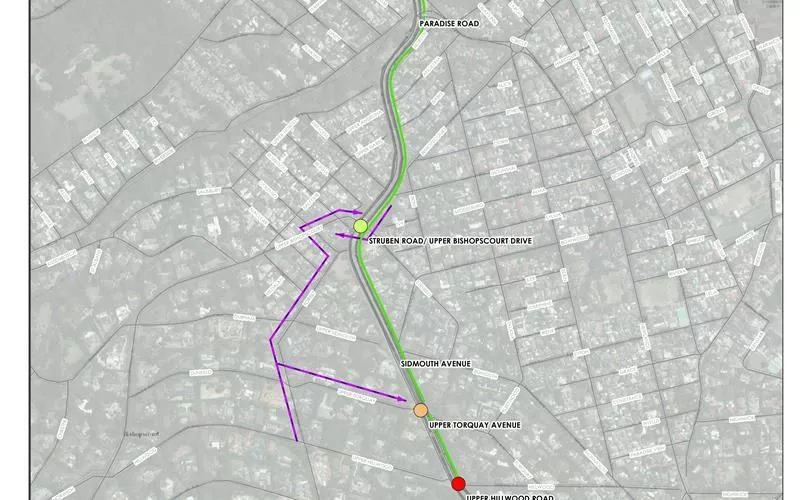
Several fundamental changes are poised to be implemented along the M3 stretch in Newlands. Among them, the junction of Fernwood Avenue is set to undergo a closure of the median and the removal of the traffic signal. This adjustment will improve the M3’s smooth functioning in this segment, alleviating traffic bottlenecks at the Paradise Road intersection and guaranteeing the necessary spacing for signalized intersections along high-traffic arteries.
Under the new regulations, only left turns into Fernwood Avenue from the M3 will be permitted for northbound traffic. As a result, vehicles will be able to exit the M3 onto Fernwood Avenue, but not vice versa. The pedestrian crossing at Fernwood Avenue will be eliminated, with pedestrians able to cross the M3 at the Paradise Road intersection and/or Newlands Avenue.
Upper Torquay Avenue is also due for substantial adjustments to augment traffic flow and roadway safety. Vehicles traveling southbound on the M3 will be disallowed from turning right into Upper Torquay, thus avoiding backups instigated by right-turning vehicles. Northbound vehicles will have the option to exit the M3 by turning left into Upper Torquay Avenue, with the opposite being true for traffic on Upper Torquay Avenue.
Upper Hillwood Road at the crest of Wynberg Hill will also be subject to closure, effecting a median termination and removing the traffic signal at this junction. This modification will allow traffic to flow more seamlessly along this segment and throughout the hill. This road will transform into a cul-de-sac, no longer intersecting with the M3, while still maintaining existing access to the corner property. A signalized pedestrian crossing will be reestablished to facilitate pedestrians and cyclists traversing the M3.
To soften the impact of the closures, several junction enhancements will also be instituted. These will encompass an extra right-turn lane and a free-flow left-turn slip lane at the M3/Rhodes Avenue intersection for eastbound traffic along Rhodes Avenue. This will significantly boost capacity at this junction during the morning rush hour for those commuting towards the city.
Proactive Measures for Future Traffic Needs
Two dedicated east-bound right-turn lanes will also be integrated on the Rhodes Drive approach. This adjustment will alleviate traffic redistribution arising from the partial Fernwood Road closure for those desiring to travel south-bound on the M3 to Claremont and beyond. The Upper Bishopscourt Road intersection will also be expanded to include two dedicated right-turn lanes for those commuting south-bound on the M3 to Claremont, Wynberg, and beyond.
To cater to traffic traveling from the city towards the Southern suburbs, the Urban Mobility Directorate will introduce a third southbound lane between Rhodes Avenue and Upper Hillwood Road. The funds for this significant improvement, which also includes upgrades to side roads, have been sanctioned by the Council.
These alterations are expected to revolutionize the daily commute for many Capetonians, ensuring that their journeys are not just smoother, but safer as well. The City’s dedication to enhancing urban mobility is evident, and the anticipation of these changes signals a new era of streamlined commuting in Cape Town.
When will the M3 route revisions in Newlands begin?
The revisions to the M3 route in Newlands are expected to begin in the first half of 2026.
What changes will be made to the M3 route in Newlands?
The changes to the M3 route in Newlands will include the closure of certain intersections, establishment of median terminations, and the addition of right-turn and free-flow lanes to alleviate traffic snarls and improve urban mobility.
What was the public involvement process for the M3 route revisions in Newlands?
The Urban Mobility Directorate of the City arranged two instances for public involvement in 2022 and either November or December 2023. Residents were given the opportunity to express their views on the prospective enhancements to the M3’s vehicular movement. These comments contributed to the further refinement of the proposed plans.
What are the major changes coming to the M3 route in Newlands?
The major changes coming to the M3 route in Newlands include the closure of certain intersections, establishment of median terminations, and new right-turn and free-flow lanes to optimize traffic movement and improve daily commutes.
What measures will be taken to ease traffic congestion in Newlands?
To ease traffic congestion in Newlands, several junction enhancements will be instituted, including an extra right-turn lane and a free-flow left-turn slip lane at the M3/Rhodes Avenue intersection for eastbound traffic along Rhodes Avenue.
How will the changes to the M3 route in Newlands impact commuters?
The changes to the M3 route in Newlands are expected to revolutionize the daily commute for many Capetonians, ensuring that their journeys are not just smoother, but safer as well.