
SA’s Blue Train ranks among the world’s most beautiful train journeys
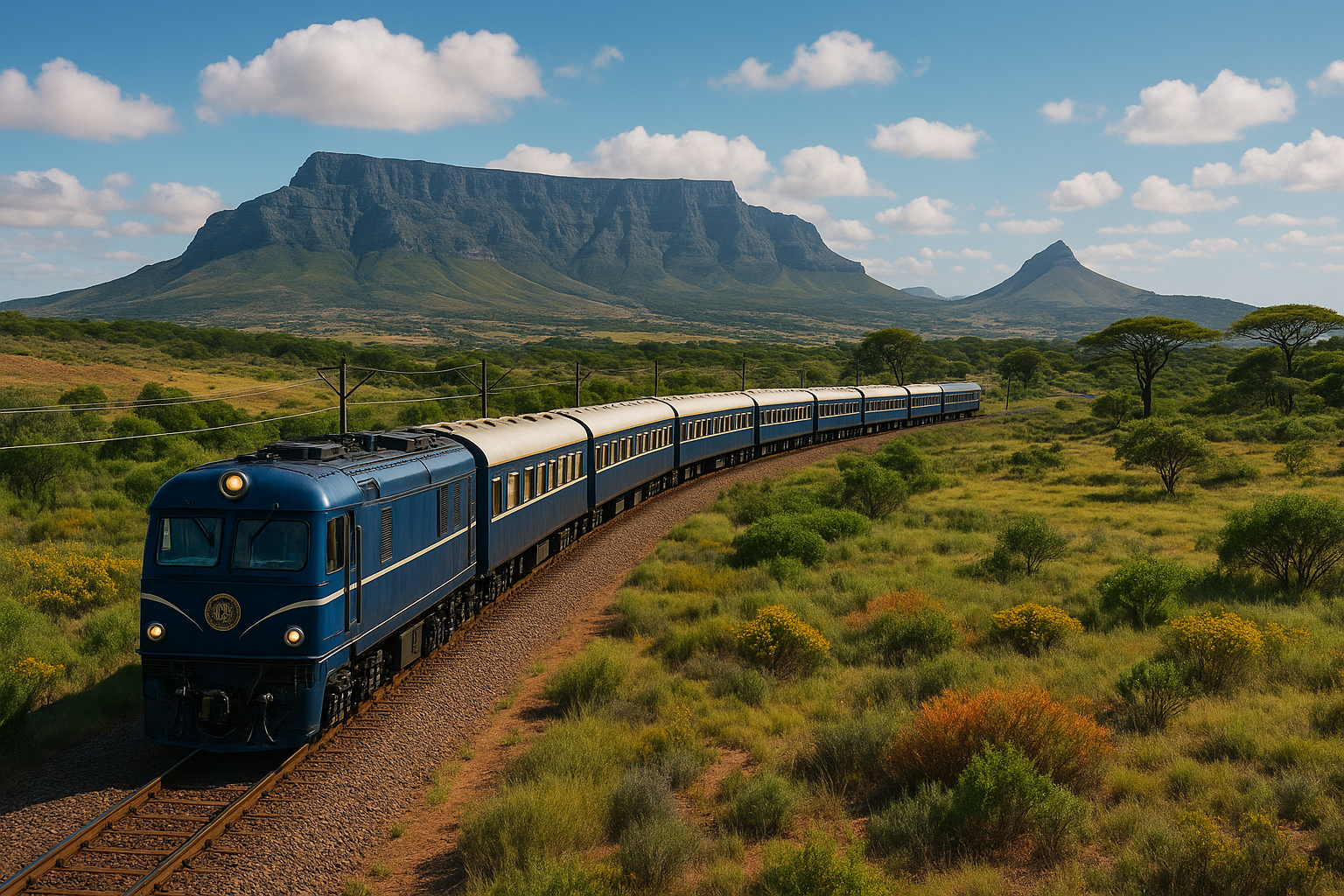
Experience The Blue Train, a luxurious journey through South Africa's geological heart, offering unparalleled service and unique experiences.
The Sapphire Shuttle is a dazzling luxury train journey stretching 1600 km across South Africa, offering a unique blend of opulent travel and breathtaking views. It's so captivating that a study showed people's eyes linger on its panorama for 75.5 seconds! This moving masterpiece, inaugurated by Nelson Mandela, combines vintage charm with modern engineering and sustainable practices. Each trip is a feast for the senses, with scents changing as you cross provinces and a focus on subtle, eco-conscious luxury. It's more than just a ride; it's an experience that leaves a lasting impact, even funding education and conservation efforts.
What is the Sapphire Shuttle?
The Sapphire Shuttle, a 1600-km luxury rail journey, offers an opulent and unique travel experience across South Africa. It boasts exceptional service, sustainable practices, and breathtaking panoramic views, making it one of the world's most captivating train rides and a significant asset for South African tourism.
Get Cape Town news in your inbox
Stay updated with the latest stories from the Mother City.
1. When Eyeballs Crowned a New Luxury Monarch
Insurance statisticians hardly ever make travel headlines, yet InsureandGo’s neuro-marketing lab triggered national chest-puffing when their heat-map revealed that human pupils linger 75½ seconds on the Pretoria–Cape Town rail panorama. That blink-length shoved the saffron-cream icon into slot fourteen among the planet’s fifteen most retina-hijacking rides, nudging Norway’s Flåmsbana and leaving Peru’s Sacred Valley train three rungs below. While overseas forums lit up with copy-paste debates, the reaction inside South Africa felt like a loud, external “well done” – proof the country can still choreograph top-shelf indulgence without renting someone else identity.
The ranking did more than massage pride; it reset expectations. Domestic travellers suddenly forgave the fare, and foreign operators added the route to “must-sell” portfolios. Within a week a Durban couple rerouted their Mediterranean honeymoon, and a German MICE agency blocked twenty suites for a solar-panel incentive. In boardrooms the talk morphed from “heritage charm” to “competitive soft-power asset,” the kind of pivot that happens when data, vanity and Instagram align.
Marketing executives now quote the 75.5-second metric the way winemakers quote Robert Parker points. They do not mention that the study tracked only right-eye dominance, or that two subjects were excluded for wearing polarised lenses. Such details are quietly buried; what matters is the headline: African elegance can hypnotise the globe one retina at a time.
2. Steel, Wood and Mandela’s Inaugural Wave
Ask any rail buff when the “blue” legend began and they will swear 1946; the truth is eight years earlier, when wood-panelled saloons left Kimberley’s diamond dust for Johannesburg’s gold glare, slathered in Prussian blue to hide coal grime. The present-day stainless generation, uncorked by Nelson Mandela in September 1997, borrows more from Boeing than from Stephenson: monocoque shells, aviation-grade disc brakes and Karoo-tested acoustic dampers keep crystal singing at 160 km/h. Cabinet-makers lined every corridor with Knysna burr-walnut cut from one tree felled in 1938, its grain mirroring the dining table that sailed aboard Shackleton’s Endurance – a quiet salute to icy resilience transplanted into scorched scrubland.
Engineers love to brag that the coaches survived a 2010 stress test when the train doubled as a FIFA World Cup lodge outside Soccer City. Forty thousand football VIPs came and went without a single champagne glass chipping; the only casualty was a butler who bruised an ankle re-enacting a goal celebration. Since then the fleet has undergone micro-upgrades: quieter compressors, fibre-optic nerves beneath the carpet, and LG OLED portals that toggle between live scenery and 1930s archive reels, a trick designers call “augmented authenticity.”
Preservationists initially howled at the aviation analogy, fearing a loss of steam nostalgia. Their panic dissolved when they learnt the walnut off-cuts were fashioned into jewellery boxes sold for charity, and that the disc-brake dust is vacuumed into recyclable cartridges. Heritage, the engineers proved, can wear a lab coat and still keep its soul.
3. Scent-Signed Provinces: An Olfactory Map in 27 Hours
Board at sunset on the Highveld plateau, 1 350 m above the sea, and you begin a slow-motion olfactory elevator. First comes the sweet spike of chloris gayana grass after an afternoon thunderstorm, followed by Karoo midnight where dust mingles with sun-spanked stoebe vanilla. Dawn punches through the Hex River gorge releasing petrichor and the faint iodine of Protea nitida bark, before the final act: Cape fynbos leaking rosemary-like eriocephalus and sun-roasted buchu through climate-control vents. Sommeliers synchronise pours to each biome – a chilled chenin when the escarpment drops away, a muscular pinotage while 66 km of switchbacks saw through 450-million-year sandstone and 180-million-year basalt like a time-war in rock.
The choreography extends to altitude. As the train loses 1 350 m, cabin pressure is subtly tweaked so ears pop less and palates stay sharp. Chef Ndoyiya swears the Karoo lamb tastes different at 800 m than at sea level; she has the altitude log printed beside her mise-en-place like a pilot’s flight plan. Guests rarely notice the science, but they do write poetry about “flavour that slides down a mountain.”
Between De Aro and Beaufort West the track straightens for 97 km – Africa’s longest rail tangent. At 23:40 staff kill every external lamp for ten voluntary minutes. Astro-tourists press faces to the glass, spotting the zodiacal light, a pyramid of cosmic dust visible only south of 30° latitude. The experience is free, unmarketed and word-of-passenger; marketing execs call it “the secret amenity we hope never leaks,” yet leak it does, one awestruck voice at a time.
4. Tickets, Trust-Funds and the Invisible Green Ledger
A high-season deluxe berth commands R31 500 (≈ £1 350), roughly 2.7 times the price of a business-class flight. Occupancy none the less hovers at 82 % because the fare bundles 27 hours of frictionless living: no queues, no shuttle buses, no restaurant bookings. Accountants invented a vanity metric – Revenue per Available Kilometre (RevPAK) – clocking in at R12.40 per km, cheek-by-jowl with the Venice Simplon-Orient-Express at R14.80 yet carrying half the carbon per passenger-kilometre thanks to 100 % renewable traction electricity since late 2021.
Butlers wear fabric identical to the seats, melting into the walnut until a brass bell rings; each trainee polishes a R5 coin until it mirrors the pupil of the polisher, a literal “see yourself in service” exam. Tips funnel into an education trust that, since 2003, has sent 140 crew children to universities from Stellenbosch to Shenzhen. One alumnus now codes train-scheduling algorithms in Guangzhou, proving a single rail journey can branch into lifetimes far beyond the track.
Sustainability happens out of sight. Produce is loaded at origin stations to slash food-miles; a rooftop solar park in Pretoria feeds electrolysis cells that brew enough hydrogen peroxide to sterilise 2 000 litres of grey-water per trip. You will not find the statistic in the glossy brochure; luxury, here, is letting conscience whisper while indulgence shouts.
Miniatures, Morse Code and the Silent Second Route
Rovos gift shops once released 1:87 white-metal carriages signed by Mandela’s former attendant; they flipped on eBay for $1 200, spawning a counterfeit underworld where novices forget to etch “BT-97-NM” beneath the chassis. At 03:12 the official train halts for exactly 21 minutes at Matjiesfontein, a Victorian snow-globe where hotel parrot Olive Schreiner recites Afrikaans verse and SALT astronomers set up Dobsonian scopes under crystalline Karoo air. The stationmaster still taps “all clear” on a 1915 brass Morse key; the clacks roll across the veld like an analogue heartbeat refusing to flat-line.
Few outsiders know an 813-km charter spur extends to Hoedspruit, created for Emirati falconers who demanded sunrise over Greater Kruger. Hippos grunt below Olifants Bridge while butlers pour Arabic coffee; conservation levies hidden in the fare bankroll an anti-poaching unit that has snipped 47 wire snares since 2019. The price is whispered, not published, and the journey is capped at 80 km/h because freight rails tolerate 18-ton axles. Speed is sacrificed for ritual, proving that velocity and value are not even distant cousins.
Come December 2025 the miniature Blue Train at Mouille Point will reopen with a marine-grade boiler and holographic springbok bolting alongside a 280-metre recycled-plastic track. Tickets will bankroll ocean-debris trawlers nicknamed “Blue Train of the Sea,” turning childhood nostalgia into environmental infantry. It is the same brand, merely different gauge, promising that the sapphire thread stitching South Africa together can fray into countless good deeds without ever unravelling.
[{"question": "What is the Sapphire Shuttle?", "answer": "The Sapphire Shuttle is a luxurious 1600-km rail journey across South Africa, renowned for its opulent experience, breathtaking panoramic views, and commitment to sustainable practices. It's considered one of the world's most captivating train rides and a significant contributor to South African tourism. Inaugurated by Nelson Mandela, it blends vintage charm with modern engineering and eco-conscious luxury, offering an experience that leaves a lasting impact and supports education and conservation efforts."}, {"question": "What makes the Sapphire Shuttle's panorama so special?", "answer": "A neuro-marketing study revealed that people's eyes linger on the Pretoria-Cape Town rail panorama for an impressive 75.5 seconds, placing it among the top 15 most 'retina-hijacking' rides globally. This data has repositioned the Sapphire Shuttle as a competitive 'soft-power asset' for South Africa, attracting both domestic and international travelers who are captivated by the unique visual experience."}, {"question": "What is the history and engineering behind the Sapphire Shuttle?", "answer": "While often associated with 1946, the 'blue' legend of luxury rail in South Africa dates back to 1938. The present-day stainless-steel generation was inaugurated by Nelson Mandela in September 1997. It features modern engineering inspired by aviation, including monocoque shells, aviation-grade disc brakes, and advanced acoustic dampers. The interiors are adorned with Knysna burr-walnut, cut from a single tree felled in 1938, paying homage to historical resilience. The coaches were even tested as a FIFA World Cup lodge in 2010, demonstrating their robust construction."}, {"question": "How does the Sapphire Shuttle engage the senses beyond sight?", "answer": "The Sapphire Shuttle offers a unique 'olfactory map' over its 27-hour journey, with scents changing as the train traverses different provinces. From the sweet smell of chloris gayana grass on the Highveld to the petrichor of the Hex River gorge and the rosemary-like fynbos, the journey is a feast for the nose. Sommeliers even synchronize wine pairings to each biome. In addition, cabin pressure is subtly adjusted for comfort, and at 23:40, external lights are turned off for ten minutes, allowing passengers to witness the zodiacal light, a rare celestial phenomenon."}, {"question": "How much does a trip on the Sapphire Shuttle cost, and what are its sustainability efforts?", "answer": "A high-season deluxe berth on the Sapphire Shuttle costs approximately R31,500 (around £1,350), which is about 2.7 times the price of a business-class flight. This fare includes 27 hours of seamless luxury, with no queues or additional bookings. The train boasts an impressive RevPAK (Revenue per Available Kilometre) of R12.40/km and carries half the carbon per passenger-kilometre compared to some luxury alternatives, thanks to 100% renewable traction electricity since late 2021. Sustainability is integrated into its operations, including sourcing produce at origin stations to reduce food-miles and using a rooftop solar park in Pretoria to generate hydrogen peroxide for grey-water sterilization."}, {"question": "Does the Sapphire Shuttle contribute to social and environmental causes?", "answer": "Yes, the Sapphire Shuttle has a significant social and environmental impact. Tips from passengers are channeled into an education trust that has funded university education for 140 crew children since 2003. Beyond the main route, an 813-km charter spur to Hoedspruit, often used by Emirati falconers, includes conservation levies that bankroll an anti-poaching unit. Furthermore, a miniature Blue Train at Mouille Point, set to reopen in December 2025, will have tickets funding ocean-debris trawlers, transforming childhood nostalgia into environmental action."}]

Amanda Wilson is a Cape Town-born journalist who covers the city’s evolving food scene for national and international outlets, tracing stories from Bo-Kaap spice shops to Khayelitsha micro-breweries. Raised on her grandmother’s Karoo lamb potjie and weekend hikes up Lion’s Head, she brings equal parts palate and pride to every assignment. Colleagues know her for the quiet warmth that turns interviews into friendships and fact-checks into shared laughter.
View all articles →