
Step by step: Walking may be your healthiest habit
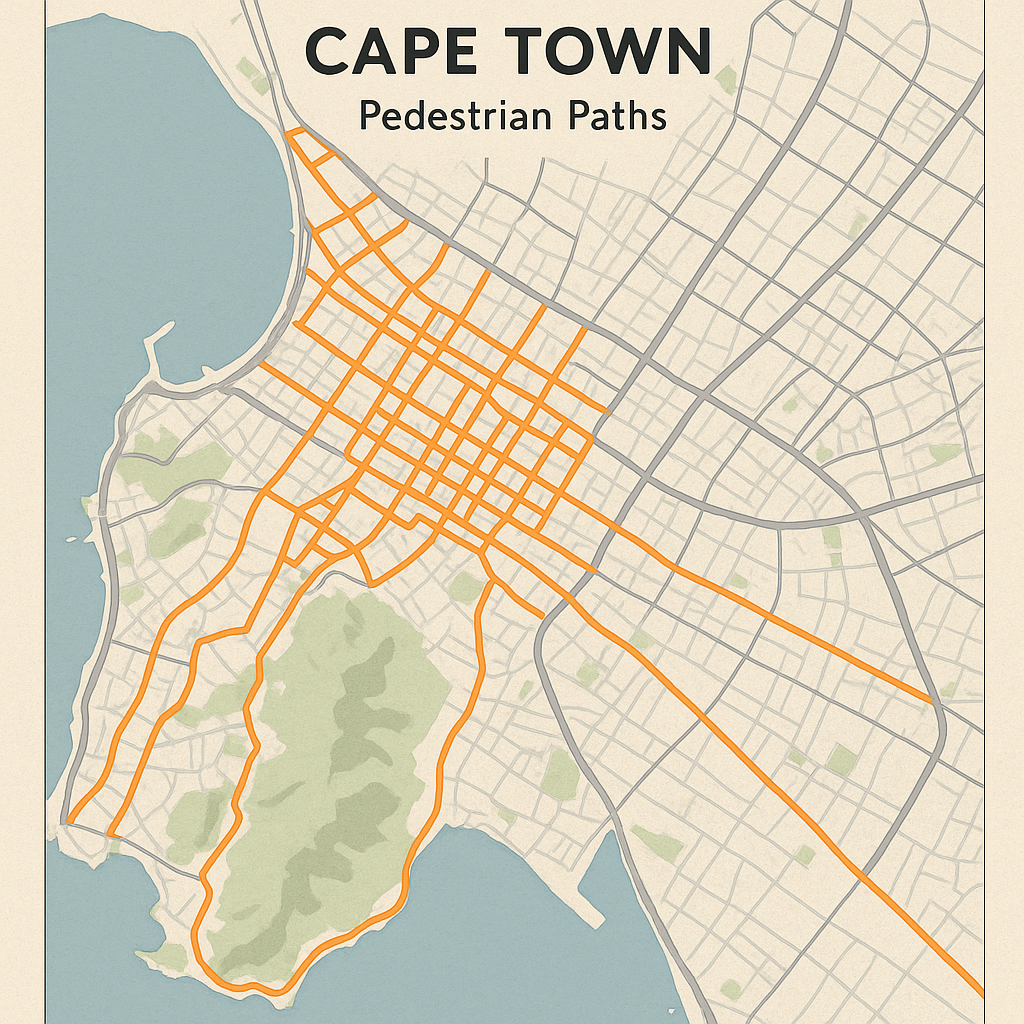
Cape Town re-engineers its streets for pedestrians, transforming urban spaces through science, stories, and innovative walking infrastructure.
Cape Town is making its sidewalks awesome for everyone, from little kids to people who can't see well. They're fixing bumpy paths and adding special sounds at crosswalks to make walking super easy and safe. This 'ankle-height urbanism' is making people happier and healthier, even helping them relax! They're also adding pretty plants and cool tech that makes power when you walk. It's all about small changes with a big impact, showing that even tiny steps can lead to a better city for all.
What is "ankle-height urbanism" in Cape Town?
"Ankle-height urbanism" refers to Cape Town's initiative to improve pedestrian infrastructure by making small, detailed changes. This includes relaying granite setts for easier walking, installing tactile ribbons for the visually impaired, and using distinct traffic signal sounds. These upgrades prioritize the human body's rightful place on the roadway, enhancing safety and accessibility.
Get Cape Town news in your inbox
Stay updated with the latest stories from the Mother City.
1. A Sidewalk Renaissance: How the City Learnt to Greet the Sole
Cape Town’s street grid began life as a wagon trail carved into Table Mountain sandstone; planners never imagined citizens would later want to cross it in soft shoes. Decade after decade, engineers widened lanes for cars and simply painted thin white lines where people were expected to squeeze. The result was predictable: ankles twisted on granite lips, blind commuters stranded in mid-block islands, stilettos wedged between historic cobbles.
Change arrived millimetre by millimetre. Granite setts in the Bo-Kaap were relaid so that the gaps match the rubber tread of school shoes, not high heels. Tactile ribbons now guide visually-impaired travellers from the station concourse to the golden mile of Adderley Street. At busy crossings the traffic signal chirps like a hadeda ibis, a sound chosen because elderly residents can pick it out above engine roar. None of these upgrades made newspaper splashes, yet together they form a manifesto: the human body still owns a rightful slice of the roadway.
City Hall calls the programme “ankle-height urbanism.” Critics scoff at the price - half a million rand per rebuilt corner - until they notice what disappears from the monthly ledger: fewer paramedic call-outs for falls, lower absenteeism among metered-taxi marshals, and a measurable bump in nighttime restaurant spend because women no longer feel the need to Uber three blocks. Confidence, it turns out, is cheaper than marketing campaigns.
2. Slow Steps, Big Pay-offs: The Laboratory We Call the Promenade
Sea Point’s oceanfront boardwalk stretches 3.2 km between lighthouse and swimming pools, but University of Cape Town scientists treat it as an open-air physiology lab. Over two years they filmed thousands of strollers, joggers and lovers at 240 frames per second, then matched gait to saliva samples collected minutes later. The headline finding overturns gym culture dogma: the slowest walkers gained the largest stress dividend.
Participants who kept a leisurely 2.9 km/h - barely 92 steps a minute - recorded a 26 % drop in cortisol compared with brisk pacers. Lead researcher Dr Nadia Ismail says the secret hides in the “ground-contact phase,” the fraction of a second the foot spreads and senses terrain. Extended contact fires Meissner corpuscles, ultra-sensitive nerve endings in the sole, which in turn tickle the parasympathetic nervous system. Translation: dawdling is a cheat-code for tranquillity.
Municipal managers did not need another white paper to act. They widened the promenade’s concrete lip by 40 cm, installed free phone-charging benches every 250 m and painted discreet way-markers so retirees can log distance without downloading an app. Within a season, lunchtime footfall rose 38 % and nearby cafés reported a run on decaf. Science turned the city’s most ordinary strip of concrete into a public mental-health clinic - no prescription required.
3. Leafy Short-cuts and the Smell of Money: Green Islands That Pull Pedestrians Off the Direct Route
A traffic circle is nobody’s destination, yet Green Point’s former concrete saucer has become a pilgrimage. In 2021 landscapers plugged 120 Cape Flats sand-fynbos plants into a 20-metre radius once notable only for bumper-to-bumper frustration. Eighteen months later thermal loggers registered a 4 °C drop at midday and pedestrian sensors clicked 38 % more crossings. Commuters now volunteer a detour of up to 180 m just to inhale honey-scented syncarpha and wild buchu.
Urban ecologists have baptised the behaviour “aromatic diversion,” a painless way to nudge citizens toward 1,500 bonus steps without lecturing them about obesity statistics. Property agents speak a different language: rental yields along the circle’s perimeter jumped 11 %, outperforming the neighbourhood average. A patch of vegetation smaller than a tennis court rewrote both waistlines and balance sheets.
The model is spreading. Three more micro-forests - one inside a former taxi rank, another on a hospital forecourt - have been planted, each budgeted at less than the annual salary of a traffic cop. Their success metric is elegantly simple: if the plants thrive and people choose to weave through them, both carbon and cholesterol counts fall. City Hall now requires every new major intersection to earmark 8 % of its surface for indigenous shrubs, codifying what began as a horticultural whim.
4. From Aroma to Electrons: The Next Frontier Under Your Feet
Tech start-ups love a seaside demo. On a 20-metre strip of Green Point promenade, rubber pavers hide piezoelectric crystals that squeeze out 2 W each time a sole lands. Critics dismiss the output as gadget fodder - barely enough to keep an LED handrail glowing - but optimists run a different spreadsheet. Ten thousand strollers equal 20 kWh per evening, sufficient for a free Wi-Fi node or a phone-charging bench.
Still, the true value may be narrative. Every footstep becomes a micropayment toward the city’s energy budget, turning routine motion into civic virtue. Children now compete to make the light-meter needle jump, unaware they are internalising the idea that citizenship can be kinetic. Whether or not the technology scales, the story has already scaled: local radio hosts talk about “people-powered streets,” and engineering applications at UCT have spiked among female students citing the glow-paver project as inspiration.
Meanwhile, trials for warmer “pedestrian amber” LEDs have tripled night footfall among women on Observatory’s lower main road, and the repeal of an archaic loitering by-law has forced developers to install 3-metre seat walls every fifty metres, replacing hostile architecture with an invitation to pause. From coral-coloured fynbos to glow-in-the-dark pavers, Cape Town keeps proving that the smallest interventions - measured in millimetres, milliwatts and micro-volts - can outrun grand masterplans. The revolution, quite literally, is afoot.
1. What is "ankle-height urbanism" in Cape Town?
"Ankle-height urbanism" is Cape Town's innovative approach to improving its pedestrian infrastructure by focusing on small, ground-level changes. This includes relaying granite setts to be more flush with the ground, installing tactile ribbons for visually impaired individuals, and using distinct auditory cues at crosswalks. The goal is to enhance safety, accessibility, and overall pedestrian experience, prioritizing the human body's rightful place on the roadway.
2. How has Cape Town's promenade contributed to public health?
The Sea Point promenade, treated as an open-air physiology lab by University of Cape Town scientists, has revealed that even slow walking speeds (around 2.9 km/h) can significantly reduce cortisol levels (a 26% drop). This is attributed to extended 'ground-contact phase' stimulating nerve endings in the foot, which in turn activates the parasympathetic nervous system, promoting tranquility. The city has supported this by widening the promenade, adding phone-charging benches, and discreet way-markers, leading to increased footfall and a positive impact on mental well-being.
3. What is "aromatic diversion" and how is it used in Cape Town?
"Aromatic diversion" refers to strategically planting fragrant vegetation in urban spaces to encourage pedestrians to take slightly longer, more pleasant detours. For example, a former concrete traffic circle in Green Point was transformed with indigenous Cape Flats sand-fynbos plants. Commuters now voluntarily walk an extra 180 meters to experience the honey-scented air. This not only adds bonus steps to their daily routine but also cools the surrounding area and has even led to increased property values nearby, demonstrating how small green interventions can have significant health and economic benefits.
4. How is technology being integrated into Cape Town's sidewalks?
Cape Town is experimenting with advanced technologies such as piezoelectric crystals embedded in rubber pavers on the Green Point promenade. These crystals generate electricity (2 W per footfall), which, while seemingly small, can accumulate to power city amenities like Wi-Fi nodes or phone-charging benches. This initiative aims to make every footstep a micro-payment towards the city's energy budget, fostering a sense of kinetic citizenship. Other tech integrations include warmer "pedestrian amber" LEDs to increase night-time safety for women and the installation of seat walls to encourage pausing and social interaction.
5. What specific improvements have been made for the visually impaired and elderly?
For the visually impaired, tactile ribbons have been installed to guide them from the station concourse to Adderley Street. For the elderly, traffic signals at busy crossings now emit a distinct chirping sound, chosen because its frequency makes it easily discernible above ambient engine noise, making crossings safer and less stressful. These thoughtful details are part of the broader "ankle-height urbanism" strategy.
6. What are the economic benefits of Cape Town's sidewalk improvements?
Although some criticize the cost of rebuilding corners (half a million rand), the city has observed significant economic benefits. These include a reduction in paramedic call-outs for falls, lower absenteeism among metered-taxi marshals, and a measurable increase in nighttime restaurant spending, particularly from women who now feel safer walking instead of relying on ride-sharing services for short distances. Additionally, areas with 'aromatic diversion' projects have seen rental yields increase, outperforming neighbourhood averages, indicating that these small urban interventions lead to tangible economic returns.

A Russian-Spanish journalist and Cape Town native, channels his lifelong passion for South Africa into captivating stories for his local blog. With a diverse background and 50 years of rich experiences, Serjio's unique voice resonates with readers seeking to explore Cape Town's vibrant culture. His love for the city shines through in every piece, making Serjio the go-to source for the latest in South African adventures.
View all articles →