
The 2026 grade 8 ‘entry fee’ breakdown
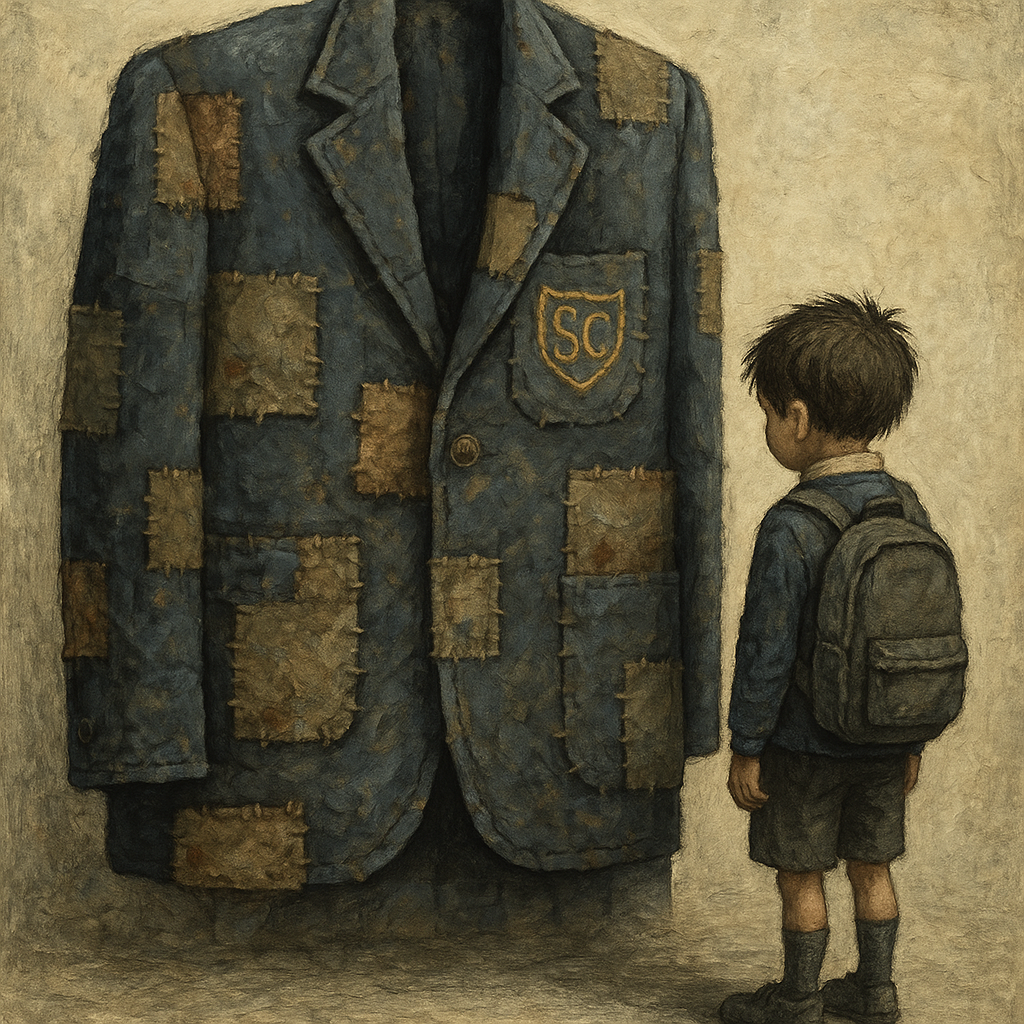
Unpacking the high cost of school uniforms in South Africa, revealing how a blazer can represent 166 hours of minimum wage labor.
166 Hours of Polyester and Pride – When a Jacket Turns Into a Turnstile
School uniforms in South Africa are incredibly expensive, costing over R5,000. That's like working for a whole month just to buy the right clothes for school! If a child doesn't have every specific item, they can be sent home, missing out on learning. This system often means schools get money from uniform sales, and it even makes clothes for girls more expensive. It's a tough situation that makes it hard for many kids to even get into the classroom.
How much do school uniforms cost in South Africa?
School uniforms in South Africa can cost approximately R5,015.78, which translates to about 166 hours of labor at the national minimum wage. This cost covers mandatory items like crested jackets, specific shirts, trousers, belts, ties, socks, and approved stationery, and does not include extra expenses like transport or tuition.
Get Cape Town news in your inbox
Stay updated with the latest stories from the Mother City.
Section 1 – The Price at the Gate
When the first siren of the 2026 school year blares at 07:00 on 15 January, pupils from Musina to Cape Agulhas have roughly four minutes to transform themselves into walking rule-books. By the time the echo fades they must be buttoned into a regulation coat carrying the school’s crest, snow-white shirt long enough to pass the “fingertip rule”, grey trousers in the exact tone on the governor’s chart, a belt narrower than three centimetres, the official diagonally-striped tie, black socks that cover the ankle, polishable lace-ups with a heel of mandated height, a 200-page exam pad printed by the sole-contract stationer, the specific calculator on last week’s approved list, and a see-through pencil case that lets invigilators inspect pen brands.
None of that is optional; absence of any item buys an immediate trip back through the gate. The cash register for the full silhouette stops at R5 015.78.
Translate that into sweat and it becomes 166 hours 14 minutes at the national statutory minimum of R30.23 an hour – four standard 40-hour weeks evaporating before the child writes a single stroke in the class register. Taxi fare, sandwiches and tuition are extra; the levy is only for the right to look like a learner instead of an intruder.
Section 2 – Who Really Owns the Crest
South Africa’s uniform game is not an open bazaar; it is a string of tiny kingdoms sewn together by governing bodies. Each SGB inks an exclusive three- to five-year supply contract with one manufacturer, spelling out Pantone colours, stitch density per square centimetre and even the origin of blazer buttons. In exchange the firm pays the school a royalty of 7–12 % of turnover. That royalty bankrolls sports tours, security upgrades and, in one KwaZulu-Natal scandal, the principal’s credit-card instalments exposed by the Public Protector.
Because the emblem is trademarked, a mother who sews her own jacket can be threatened with infringement. Governors claim the monopoly “protects institutional identity”; retailers insist short production runs inflate unit prices. The Competition Commission has launched nineteen probes since 2018; none has reached a hearing. Over the past three years school-only garments have climbed 8 % annually, 2.28 × faster than headline inflation. A blazer that cost R899 in January 2023 now retails at R1 399 – a jump that would be unlawful if applied to bread or petrol.
Section 3 – One-Day Tsunami and the Pink Tax
Until 2023 inland and coastal clusters opened a fortnight apart, giving factories time to restock and parents room to bargain. That cushion has vanished. Thirteen million basic-education learners now begin on the same morning, creating a demand wave that makes Black Friday look timid. Container ships must berth in Durban, clear customs, rail to City Deep, truck to townships and reach store shelves within fourteen days. Any hiccup cascades through the chain. Algorithms respond like airline yield-management: PEP data show a size-34 tunic for girls climbs 11 % between 26 December and 2 January. Makro mails “early-bird” vouchers on Christmas Day, confident that panic buying at full mark-up will follow. In rural Eastern Cape parents queue from 02:00; by dawn the branded tracksuit pants are gone and only the R220 “combo” remains – two sizes too large, but the receipt proves compliance.
Girls carry an extra tariff: a generic boys’ short-sleeve shirt retails at R89 while the girls’ fitted blouse, compulsory in 71 % of schools, costs R119 – a 34 % surcharge nicknamed “pink VAT” by NGOs. The extra darts add just 7 % fabric, yet the margin subsidises boys’ rugby jerseys sold at cost. Over five years the pink VAT costs a two-daughter household an additional R1 260, equal to forty-one extra minimum-wage hours.
Section 4 – The Mirage of Escape and the Lessons Learnt
Teneo Online sells itself as a loophole: ditch the blazer, the daily cab ride and the 600-page paper text, and households recover 20 % of disposable income. The arithmetic glitters – R5 015 uniform cash becomes 67 GB night-time data plus a refurbished 4G Chromebook at R2 499, leaving R1 500 for a solar panel to ride out load-shedding. But the virtual route imposes its own levies. Telkom’s 2026 uncapped 4G plan throttles speed after 150 GB, turning Zoom into a slideshow. A refurbished Chromebook carries a ninety-day warranty; when the battery collapses in month four the family finds another R899. In Mthatha only 38 % of households enjoy more than eight hours of mains power; the cheapest UPS adds R1 699. The “saved” R5 015 balloons to R7 214, pushing the barrier from 166 hours to 239.
Beyond cash, the hidden curriculum is starker. A pupil sent home for a washed-out collar learns that knowledge is collateralised by cloth. Stellenbosch research (2025) shows learners who suffered two uniform-related exclusions in Grade 8 are 27 % more likely to exit before Grade 11, even when academics are constant. Psychologists call it “enclothed cognition”: the blazer stops being fabric and mutates into a keeper of dignity. In extreme cases schools run “blazer checks” at the gate on rainy mornings; parents therefore keep two coats – one for daily wear, one for inspection – doubling the price. Meanwhile counterfeit crests arrive from Guangdong via WhatsApp stokvels, and confiscations leave teenagers barred from the June exam hall, forcing households to pay twice: first for the fake, then for the original, adding another sixty-six labour hours to the tab.
Second-hand markets skew out of reach for those who need them most; transport costs eclipse clothing outlays; protein is sacrificed to keep the crest spotless. Yet hope flickers in Beaufort West where women-owned micro-factories knit entire blazers from recycled plastic in forty-two minutes, slashing the cost by 80 %. If the model spreads nationally, the 166-hour wall could shrink to thirty-three – still painful, but inside a single week’s wage.
[{"question": "How much do school uniforms cost in South Africa?", "answer": "School uniforms in South Africa can cost over R5,000. This is equivalent to approximately 166 hours of labor at the national minimum wage. This cost covers essential items like crested jackets, specific shirts, trousers, belts, ties, socks, and approved stationery, and does not include other expenses such as transport or tuition fees."}, {"question": "What happens if a child doesn't have all the required uniform items?", "answer": "If a child does not have every specific uniform item, they can be sent home from school. This means they miss out on valuable learning time. The rules are very strict; even the absence of a single item, such as a regulation coat or specific calculator, can lead to immediate exclusion from school premises."}, {"question": "How do schools benefit from uniform sales?", "answer": "Schools often have exclusive contracts with single uniform manufacturers for a period of three to five years. In exchange for this monopoly, the manufacturer pays the school a royalty, typically between 7% and 12% of their turnover. This royalty can then be used by the school for various purposes, including funding sports tours, security upgrades, or other school-related expenses."}, {"question": "Why are girls' uniforms often more expensive than boys'?", "answer": "Girls' uniforms often carry an additional cost, sometimes referred to as a 'pink VAT'. For example, a girls' fitted blouse, compulsory in many schools, can cost 34% more than a generic boys' short-sleeve shirt, even though it uses only 7% more fabric. This extra margin often subsidizes other items, like boys' rugby jerseys, which may be sold at cost."}, {"question": "What challenges do parents face when purchasing uniforms?", "answer": "Parents face several challenges, including the high cost of uniforms, which can be a significant financial burden. The simultaneous start of the school year for millions of students creates a demand surge, driving up prices. Exclusive supply contracts limit competition, and trademarked emblems prevent parents from sewing their own uniforms. Additionally, schools may require specific items, leading to panic buying and situations where only oversized or bundled items are available."}, {"question": "Are there any potential solutions to make uniforms more affordable?", "answer": "One promising solution is the emergence of women-owned micro-factories that knit entire blazers from recycled plastic. This method can significantly reduce the cost of a blazer by 80%, potentially shrinking the 166-hour labor equivalent wall to just thirty-three hours. If this model spreads nationally, it could make uniforms much more accessible and affordable for families."}]

Sizwe Dlamini is a Cape Town-based journalist who chronicles the city’s evolving food scene, from boeka picnics in the Bo-Kaap to seafood braais in Khayelitsha. Raised on the slopes of Table Mountain, he still starts every morning with a walk to the kramat in Constantia before heading out to discover whose grandmother is dishing up the best smoorsnoek that day.
View all articles →