
Eyes on the sky: Partial solar eclipse to grace South African skies
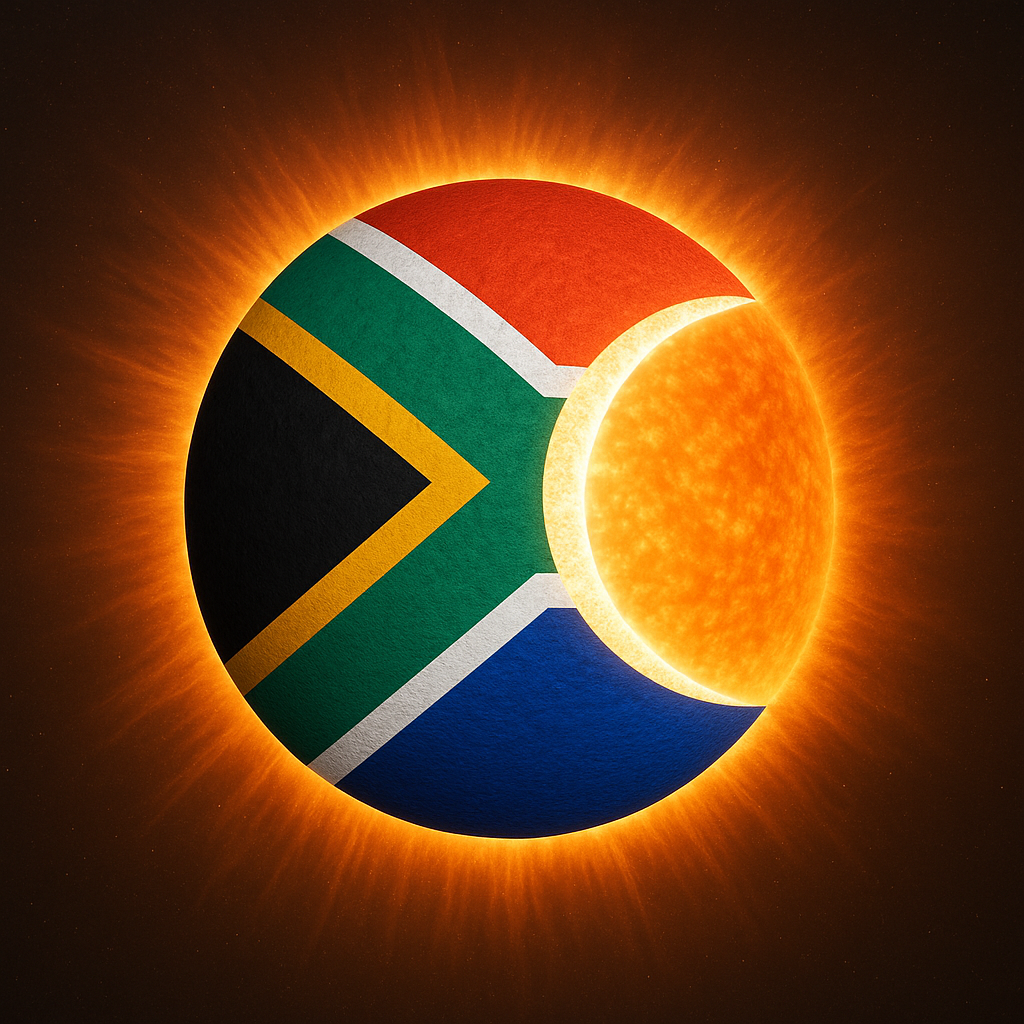
South Africa prepares for a partial solar eclipse on 17 Feb 2026. Witness a "celestial nibble" as the moon obscures the sun.
Get ready, South Africa! On February 17, 2026, the moon will take a tiny bite out of the sun, making a partial solar eclipse that's super cool. It won't be a huge bite, but even a 5% scoop of the sun is a neat sight. Remember to use special glasses to keep your eyes safe. You can even make a pinhole projector to watch it! This little show reminds us how amazing our universe is, so don't miss this chance to look up!
What is the partial solar eclipse in South Africa on February 17, 2026?
On February 17, 2026, South Africa will experience a partial solar eclipse where the moon will partially obscure the sun. This event, lasting about 83 minutes, will see the moon 'nick' the sun's upper-left rim, with the obscuration percentage varying from north to south, reaching up to 5.1% in Cape Town.
Get Cape Town news in your inbox
Stay updated with the latest stories from the Mother City.
1. Sky Geometry in Motion
Tuesday, 17 February 2026, will feel like an ordinary summer afternoon until 14:01 SAST, when the moon’s disk begins to nick the sun’s upper-left rim. The alignment is not perfect - our planet slips into the moon’s pale outer shadow, the penumbra, rather than its inky core. Think of standing beneath a giant bamboo screen instead of a lamp-post: the light dims, but no crisp outline appears. From Cape Town to Musina the same sequence unfolds, yet the depth of the scoop shrinks as one drives north. The entire passage lasts barely 83 minutes, shorter than a varsity lecture, but long enough to remind every onlooker that gravity still writes the script for our daylight.
2. How Low Can the “Bite” Go?
Because the sun rides high in mid-February - about 62° above the northern horizon at maximum - the eclipse will appear overhead, not tucked against the horizon. This high altitude reduces atmospheric distortion, so even a 5 % scoop looks crisp through safe filters. The moon’s silhouette will slide downward and slightly right, exiting the solar bottom-right edge. No corona will flash, no diamond ring will gleam; instead, the sun becomes a waning cookie, then slowly re-fattens. The subtlety is the spectacle: a live demonstration of celestial mechanics that you can watch without leaving your office parking lot.
3. City-by-City Scorecard
Below are the key numbers for nine hubs. All times are in South African Standard Time (SAST); obscuration refers to the percentage of the solar area that vanishes, not the diameter.
- Cape Town – first nibble 14:01, biggest scoop 5.1 % at 14:23, final bite 15:24
- *George * – 4.9 % peak at 14:22
- Gqeberha (Port Elizabeth) – 4.6 % at 14:21
- East London – 4.1 % at 14:20
- *Durban * – 3.2 % at 14:18
- *Bloemfontein * – 3.5 % at 14:19
- *Johannesburg * – 2.4 % at 14:17
- *Pretoria * – 2.1 % at 14:16
- *Upington * – 3.9 % at 14:20
Memorise your minute, set a phone alarm, and step outside - this is a nationwide synchronised coffee break.
2. Science in the Shadows
1. SANSA Turns a Workhorse into a Show-pony
The South African National Space Agency usually keeps its new 90 mm H-alpha telescope busy counting solar flares that menace our satellites. On eclipse day the instrument will moonlight as a public broadcaster. From 13:45 to 15:45 SAST a 4K camera will stream live on SANSA’s YouTube channel in four languages, revealing not only the dark scoop but also ruby-red prominences dancing beyond the lunar edge. Researchers will simultaneously log the dip in extreme-ultraviolet flux to calibrate the radiometers aboard EO-Sat-1, South Africa’s freshly minted environmental micro-satellite. Citizen and scientist therefore share the same photons, just for different reasons.
2. A Thermometer Becomes a Telescope
The Royal Society of South Africa is handing out 1 000 alcohol thermometers to schools. Pupils will record air temperature every 60 seconds from 13:30 to 15:30 SAST, then upload the curve to an open spreadsheet. During a 5 % eclipse the mercury typically sinks 0.8–1.2 °C if skies are clear - enough to mimic a fast sunset and sunrise. The data set will serve as a dry run for the deeper 30 % partial eclipse of 6 January 2028, when the same schools can test whether urban heat islands respond more sluggishly than rural campuses.
3. Health Department Dress Rehearsal
Provincial health offices will treat 2026 as a practice drill for safety messaging. Nurses will stock poster tubes that explain retinal photochemistry in isiZulu and Afrikaans, while environmental-health officers audit street vendors for fake eclipse glasses. The goal is to perfect the logistics chain so that by 2028 every clinic can hand out certified viewers faster than it distributes flu vaccines.
3. Watch, Shoot, Celebrate - Safely
1. The Eye-Safety Mantra Worth Repeating
A partial eclipse never outshines its own danger. Invisible infrared light can pasteurise your retina in eight seconds, faster than you can blink. Only use filters stamped ISO 12312-2:2015; hold them at arm’s length against a LED torch first - any pinhole of white disqualifies the pair. Kids get glasses secured with elastic straps; toddlers watch via wall projection instead.
2. DIY Projection Hacks That Actually Work
- Cereal-box cinema: lengthen the box to 50 cm and line it with black paper; the solar image grows to a useful 1 cm.
- Spaghetti strainer symphony: a kitchen colander throws dozens of crescents onto white cardboard - perfect for TikTok.
- Binocular projector: tape one barrel, aim the other at white card mounted behind the eyepiece; focus until the sun’s limb looks razor-sharp. Do not touch the optics - they heat within seconds.
3. Smartphone & DSLR Playbook
Slap a certified filter sheet over the lens with painter’s tape. Lock focus on the sun’s edge, drop ISO to 50, and bracket 1/1000 s to 1/250 s. Disable flash and HDR. Mirrorless owners can run 300 mm at f/8; remember to cap the finder scope so it doesn’t become a miniature death ray for your shirt.
4. Culture, Clouds and the Next Bite
1. When the Moon Was a Mischief-Maker
Khoikhoi elders once called the partial sun //Khab, briefly swallowed by the truant moon spirit //Hau. Communities banged sticks and shouted until daylight returned - an early example of participatory astronomy. Planetaria in Cape Town and Johannesburg now weave this story into pre-eclipse laser shows, inviting audiences to recreate the clatter at 14:23 SAST while seismographs in the basement wiggle from the vibration - a bridge between myth and data.
2. Cloud-Climate Roulette
February leans toward late-summer stability: Hermanus logs 68 % possible sunshine at 14:00, Durban only 45 % as thunderheads bubble inland. A slim cirrus veil still transmits 80 % of the light, so don’t abandon hope if the sky looks milky. Have a 30-minute mobility radius: sea breezes often scour coastal cloud by early afternoon, turning an overcast morning into a blue-window afternoon.
3. The Long Waitlist for Totality
After 2026, South Africa’s next home-grown partials arrive on 6 January 2028 (30 %) and 12 November 2086 (66 %). The country must wait until 3 December 2117 for a total eclipse, when the moon’s umbra finally slashes from the Kalahari to Richard’s Bay. February’s modest scoop may be the only eclipse most living South Africans ever see - proof that even a 5 % reminder of our cosmic address is worth stepping outside for.
What is the partial solar eclipse happening in South Africa on February 17, 2026?
On February 17, 2026, South Africa will experience a partial solar eclipse. This means the Moon will pass in front of the Sun, but only partially block its light, making it appear as if a small 'bite' has been taken out of the Sun. The eclipse will last for about 83 minutes, with the Moon obscuring the Sun's upper-left rim. The percentage of the Sun's area covered will vary across the country, reaching up to 5.1% in Cape Town.
How will the partial solar eclipse appear from different parts of South Africa?
The appearance of the eclipse will vary slightly depending on your location. The event will begin around 14:01 SAST, with the Moon gradually 'nicking' the Sun's upper-left rim. While the sequence of events will be similar across the country, the depth of the obscuration (the 'bite' out of the Sun) will be greatest in the south and decrease as you move north. For example, Cape Town will experience a 5.1% peak obscuration, while Pretoria will see about 2.1%. The Sun will be high in the sky (approximately 62° above the northern horizon at its maximum), which will minimize atmospheric distortion and allow for a crisp view through safe filters.
What are the key times and obscuration percentages for major South African cities?
Here are the key details for several major cities in South Africa, all times are in South African Standard Time (SAST), and obscuration refers to the percentage of the solar area that will be covered:
* Cape Town: First nibble at 14:01, biggest scoop of 5.1% at 14:23, final bite at 15:24.
* George: Peak obscuration of 4.9% at 14:22.
* Gqeberha (Port Elizabeth): Peak obscuration of 4.6% at 14:21.
* East London: Peak obscuration of 4.1% at 14:20.
* Durban: Peak obscuration of 3.2% at 14:18.
* Bloemfontein: Peak obscuration of 3.5% at 14:19.
* Johannesburg: Peak obscuration of 2.4% at 14:17.
* Pretoria: Peak obscuration of 2.1% at 14:16.
* Upington: Peak obscuration of 3.9% at 14:20.
How can I safely observe the partial solar eclipse?
It is crucial to protect your eyes when viewing any solar eclipse, even a partial one. Never look directly at the Sun without proper eye protection. The invisible infrared light can cause permanent retinal damage in seconds. Only use filters that are stamped with the ISO 12312-2:2015 international safety standard. Before use, hold them up to an LED torch; if you see any pinholes of white light, discard them. For children, ensure glasses are secured with elastic straps. Alternatively, you can use indirect viewing methods like a pinhole projector (made from a cereal box, spaghetti strainer, or binoculars) to project an image of the Sun onto a surface.
Will there be any live streams or scientific activities associated with this eclipse?
Yes, the South African National Space Agency (SANSA) will be live-streaming the eclipse. Their 90 mm H-alpha telescope, typically used for monitoring solar flares, will stream the event in 4K resolution on SANSA's YouTube channel from 13:45 to 15:45 SAST, with commentary in four languages. This stream will not only show the partial obscuration but also potential ruby-red prominences. Additionally, the Royal Society of South Africa is engaging schools in a citizen science project, providing thermometers to record temperature changes during the eclipse, which typically sees a drop of 0.8–1.2 °C during a 5% eclipse.
When is the next significant solar eclipse visible from South Africa?
After the February 2026 partial eclipse, South Africa will experience other partial eclipses. A deeper partial eclipse (30% obscuration) is expected on January 6, 2028, and a 66% partial eclipse on November 12, 2086. For those hoping to witness a total solar eclipse from South African soil, the wait is much longer. The next total solar eclipse will occur on December 3, 2117, with the Moon's full shadow (umbra) sweeping across the country from the Kalahari to Richard's Bay. Therefore, the modest 2026 partial eclipse is a significant event for many living South Africans.

Sarah Kendricks is a Cape Town journalist who covers the city’s vibrant food scene, from township kitchens reinventing heritage dishes to sustainable fine-dining at the foot of Table Mountain. Raised between Bo-Kaap spice stalls and her grandmother’s kitchen in Khayelitsha, she brings a lived intimacy to every story, tracing how a plate of food carries the politics, migrations and memories of the Cape.
View all articles →