
Cape Town fires surge as heat and winds stretch emergency crews
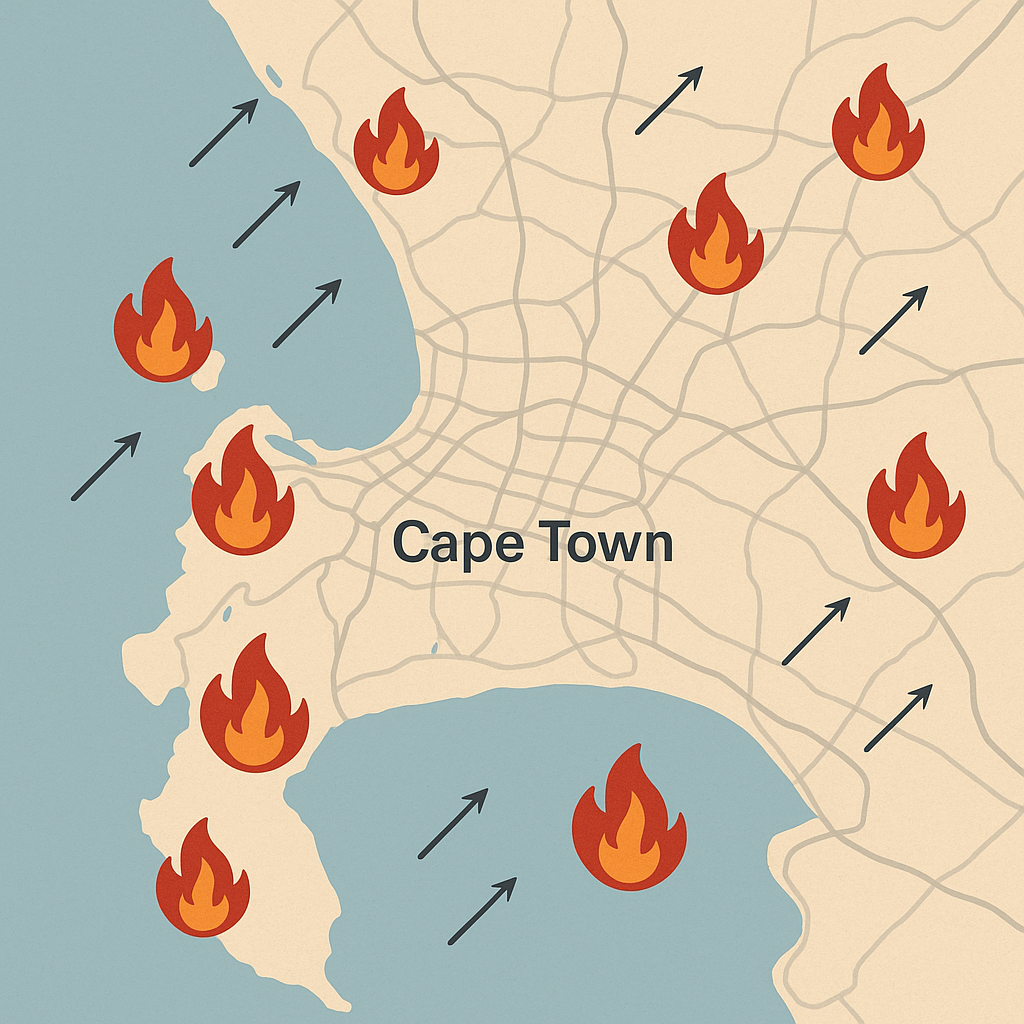
Cape Town's fire season intensifies with wind, heat, and human risk creating a perfect storm. Fires surge, resources strain, and new tech emerges.
Cape Town is facing a fiery crisis! Strong winds, lots of dry plants, and even everyday house stuff are making fires spread like crazy. Houses, shacks, and wild areas are burning more than ever, forcing lots of people to leave their homes. Firefighters are working super hard, but the fires are getting bigger and more dangerous, making it a huge challenge for the whole city.
What factors contribute to the increased fire risk in Cape Town?
Cape Town's heightened fire risk stems from several factors: increased dry fuel from generous winter rains, the destructive force of the South-Easter wind, and the flammability of urban materials. Informal settlements also face rapid and toxic fires due to construction materials like refrigerator panels, exacerbating the challenges for emergency services.
Get Cape Town news in your inbox
Stay updated with the latest stories from the Mother City.
1. The Summer the Counters Never Slept
From the first day of December to mid-January the emergency switchboard never stopped flashing. Crews raced to 5 608 shouts, almost 300 above last year’s pace. Most of the extra heat came from the mountains and veld - 3 492 grass, bush and pine strikes versus 3 213 the season before. Yet the steepest jump, percentage-wise, happened behind garden walls: 210 formal houses went up twelve months ago, this year 244 did, a 16 % spike. Informal settlements added their own grim increment, 332 homes erased compared with 315. Stretch the timeline to October and the city’s disaster managers have already drawn up humanitarian paperwork for 6 999 people - more residents than the whole of Franschhoek - an unmistakable sign that the current fire year is sprinting ahead of the five-year average.
Behind every digit stands a kitchen that will never again serve supper, a child who has lost a school jersey, a wage earner who watched the tools of trade melt. The statistics are not cold; they are still warm to the touch.
2. When the South-Easter Becomes an Arsonist
Cape Town’s famous south-easter is more than a photographer’s nuisance; it is a mesoscale cannon that can fire 70 km/h gusts through the saddles of the Peninsula. Laboratory torches show that on a slope steeper than 15° each extra 10 km/h of breeze can double the speed of the flame front. On 12 January a veld flare ignited at the foot of Chapman’s Peak at 13:42; within 42 minutes it had marched 2,3 km, hopped two firebreaks and shut the toll road.
Alderman JP Smith notes an added cruelty: the same wind hauls a smoke curtain across the northern suburbs, confusing the 107-cell optical fire-sensor grid installed after the 2015 Table Mountain scare. In effect, the gale feeds the blaze and then blinds the digital bloodhounds sent to track it.
3. Fuel, Chemistry and the Physics of Loss
SAEON field teams calculate that generous 2024 winter rains left an 18 % thicker blanket of fine fuel - dry grass, restio blades, match-stick twigs - across public open space. Fynbos is born to burn; the bonus biomass simply lifts the potential heat yield from 3 500 kJ per kilogram to just under 5 000 kJ, enough to fracture window glass 30 m away.
At the urban margin the menu turns sinister: dry timber decks, untreated pine fascias, and the black polypropylene geotextile wrapped around new road cuttings all ignite at temperatures lower than the flame of a standard domestic gas bottle, so radiant heat alone can spark secondary fires inside a yard before an ember ever kisses the roof.
4. Shack Fires: Faster, Hotter, More Toxic
Informal settlements posted only a 5 % rise, yet the tempo of tragedy has quickened. “Safer Homes” volunteers clocked the arrival of the first hose at 14 minutes this season, three minutes slower than last year, chiefly because appliances are busy on mountain runs. A single burning shack hits flashover in 90 seconds, but the real accelerator is architectural fashion: residents have swapped cardboard liners for salvaged refrigerator panels - steel foil sandwiching isocyanate foam. Once the skin peels, each cubic metre of foam belches 1,3 kg of hydrogen cyanide, a gas that kills long before the flames arrive.
5. Engines, Spares and the Return of ’89
The municipality owns 32 primary pumpers, eight hydraulic platforms and four 4×4 “bakkie-bombers” built for mountain work. Textbook maths says the fleet can tackle six large incidents at once; reality bites when spare parts are rationed by northern-hemisphere suppliers. January delivered 42 red-flag hours when fewer than two reserve vehicles sat ready. Mechanics have dragged two 1989 Mercedes-Benz 1320 rigs from the auction queue; crews joke that the analogue radios still mumble taxi coordinates, yet the old pumps still shove 2 400 litres a minute.
6. Evacuation: Alerts, Inertia and the Psychology of Flight
Cape Town’s disaster map is sliced into 173 evacuation polygons keyed to sports fields and arterial routes. When the Gordon’s Bay fire hurdled the N2 on 7 January, 1 400 households received SMS warnings inside 11 minutes through the city’s load-shedding portal. Only 62 % budged - a reluctance echoed worldwide: no orange glow on the horizon, no urgency in the gut.
Planners have switched tactics, handing out clear-plastic “go-bags” at libraries. Each pack contains a Mylar blanket, a neon buff and a waterproof 1:50 000 topo map. Behavioural science says the minute a bag hangs on a door handle the mental price of leaving drops sharply.
7. Thirsty Flames, Thirsty City
Day Zero discipline still governs the pipes: 56 pressure-management zones throttle flow to keep reservoirs afloat. Fire demand can suck 12 000 litres per minute from one hydrant, so engineers have revived the “grey-water cannon” pilot. Two ex-sewer suction tankers, now scrubbed and fitted with 40-micron filters, slurp from canals and pools. During the Marina da Gama reed fire they provided 22 % of knock-down water without touching the potable reserve.
8. Insurance Deserts and the Rebuild Queue
Of 244 formal homes lost, 38 carried no cover. The average wait for a rebuild has stretched to 19 months, up from 14, hammered by a 32 % jump in SA pine prices and a dearth of certified electricians. Renters fare worse - only 7 % of Cape Town leases include contents insurance. The state’s Emergency Housing Programme hands adults a flat R5 500, equal to three weeks of formal-sector median wage, a sum that buys little more than a fridge and hope.
9. Algorithms, Drones and the Four-Hour Future
A machine-learning test-bed now ingests 14 live feeds - wind, humidity, satellite NDVI, Twitter heat slang, even the vibrato of buzzing transformers - to spit out a four-hour fire-risk score for every 250 m pixel. Early runs score 0,73 on the Heidke scale, comfortably ahead of the 1991-vintage McArthur Mk5.
CSIR has bolted long-wave infrared eyes onto two Vulcan drones; the birds spot 0,5 m hotspots through 2 000 m of smoke and ping GPS pins to a WhatsApp bot, trimming four minutes off first-strike times.
10. Neighbours in Nomex: Community Units Fight Back
Across the metro 67 Community Fire Units guard 22 000 households, yet only 14 hold national accreditation that unlocks fuel stipends and surplus suits. To keep volunteers on the line the City swaps patrol hours for prepaid water - one hour equals 50 litres loaded onto a municipal card. Since the swap, night patrol frequency is up 28 % and the bucket-brigade clock has dropped nine minutes.
11. Three Things You Can Do Before You Sleep
Fire crews distil survival into skin, structure, source.
- Skin: hang a long-sleeved cotton shirt and a damp bandanna by the door - most flash burns happen in the first 30 seconds.
- Structure: sweep a 3 m “ember shadow” around buildings; toss scrap wood, bin refuse bags and prune dead thornwood that ignites at 220 °C.
- Source: watch the big three - candles (37 % of shack fires), illegal wires (29 %), alfresco gas rings (18 %). A R120 flame-proof lantern lasts 1 000 hours and cuts a shack’s annual fire odds by 0,8 %; multiplied across 5 000 shacks the math starts to save lives.
12. Looking West for Cheap Armor
California’s 2023 “Firesafe” rule insists on Class A roofs and 1 mm vent mesh - simple metal that blocks 70 % of ember intrusion. Cape Town mulls a similar by-law for houses within 100 m of veld, but a 150 × 150 mm stainless grille costs R89, adding R1 200 to an RDP house. The question is political: bulk-buy subsidy or criminalised poverty?
13. Your Phone is a Fire Lookout
The Public Emergency Communication Centre (021 480 7700) now takes geotagged WhatsApp voice notes in Afrikaans, isiXhosa or English; open-source software transcribes in real time, cutting dispatcher workload 15 %. Residents along the urban edge can upload smoke pics to #CapeFireSpotter; algorithms triangulate the ignition within 50 m, often fast enough for a bike squad to arrive while the blaze is still tennis-court size.
14. Smoke That Stays After the Flames Leave
On 5 January northerly drift smeared Hout Bay smoke across the Atlantic Seaboard, pushing Sea Point’s PM2,5 to 145 µg m⁻³ - triple the WHO limit. Clinics saw a 22 % surge in paediatric inhaler scripts. Unlike clean veld smoke, interface fires bake PVC, styrene and polycyclic aromatics into the plume. City Health hands out N95s, but heat and habit limit use. A local design school is testing a washable “Cape Smoke” mask - hemp cloth plus sugarcane-bagasse carbon - priced under R30.
15. The Next Eight Weeks Will Write the Next Ten Years
Climate runs project a 1,7 °C mean rise in the Western Cape by 2050, adding 14 % more days with Fire Danger Index above 75. Paradoxically, average wind may slacken 6 %, trimming spread rates slightly. The net balance still tips toward more flame, but the intervention window - prescribed burns, roof retrofits, community drills - remains open. What citizens, councillors and volunteers do before March will decide budgets, beliefs and building laws for a decade.
[{"question": "
What factors contribute to the increased fire risk in Cape Town?
", "answer": "Cape Town's heightened fire risk stems from several factors: increased dry fuel from generous winter rains, the destructive force of the South-Easter wind, and the flammability of urban materials. Informal settlements also face rapid and toxic fires due to construction materials like refrigerator panels, exacerbating the challenges for emergency services. The city experienced a significant increase in fire incidents from December to mid-January, with 5,608 shouts, a rise of nearly 300 from the previous year. This includes a 16% spike in formal house fires and an increase in informal settlement fires."}, {"question": "How does the South-Easter wind impact fire spread and firefighting efforts?
", "answer": "Cape Town's famous South-Easter wind acts as a 'mesoscale cannon,' firing gusts up to 70 km/h. On slopes steeper than 15 degrees, each additional 10 km/h of breeze can double the flame front's speed. This was exemplified on January 12th when a veld fire marched 2.3 km, hopped two firebreaks, and shut down a toll road in just 42 minutes. The wind also creates an added challenge by hauling a smoke curtain over northern suburbs, confusing the city's 107-cell optical fire-sensor grid, effectively blinding the digital tracking systems."}, {"question": "What role does fuel type and urban materials play in the intensity of fires?
", "answer": "Generous 2024 winter rains led to an 18% thicker blanket of fine fuel, such as dry grass and twigs, across public open spaces. While fynbos is naturally prone to burning, this bonus biomass increases the potential heat yield from 3,500 kJ to nearly 5,000 kJ per kilogram, enough to fracture window glass 30 meters away. In urban areas, materials like dry timber decks, untreated pine fascias, and black polypropylene geotextile ignite at lower temperatures than a standard domestic gas flame, allowing radiant heat to spark secondary fires even before embers reach a roof."}, {"question": "Why are fires in informal settlements particularly dangerous and challenging to combat?
", "answer": "Fires in informal settlements, despite a relatively smaller percentage rise, have increased in tempo and danger. The average arrival time for the first hose this season was 14 minutes, three minutes slower than last year, largely due to appliances being occupied with mountain fires. A single burning shack can reach 'flashover' in 90 seconds. A significant architectural shift sees residents using salvaged refrigerator panels (steel foil sandwiching isocyanate foam) instead of cardboard liners. When the skin of these panels peels, each cubic meter of foam releases 1.3 kg of hydrogen cyanide, a highly toxic gas that can be lethal before the flames even arrive."}, {"question": "What challenges do firefighters face regarding equipment and resources?
", "answer": "The municipality owns 32 primary pumpers, eight hydraulic platforms, and four 4x4 'bakkie-bombers' for mountain work. While theoretically capable of handling six large incidents simultaneously, spare parts are rationed by northern-hemisphere suppliers. January saw 42 'red-flag hours' when fewer than two reserve vehicles were ready. Mechanics have resorted to bringing two 1989 Mercedes-Benz 1320 rigs from auction, which, despite their age, still effectively pump 2,400 liters per minute. The city also faces 'thirsty flames' conflicting with 'thirsty city' water management, utilizing grey-water cannon pilots to supplement potable water for firefighting."}, {"question": "What measures are being taken to improve fire detection, prevention, and community preparedness?
", "answer": "Cape Town is employing advanced technologies like a machine-learning test-bed that ingests 14 live feeds (wind, humidity, satellite data, social media, etc.) to provide a four-hour fire-risk score for every 250m pixel. Drones equipped with long-wave infrared cameras can spot 0.5m hotspots through 2,000m of smoke, reducing first-strike times by four minutes by sending GPS pins via WhatsApp bots. For community preparedness, 67 Community Fire Units guard 22,000 households, with the city incentivizing volunteers with prepaid water for patrol hours. Evacuation strategies are also evolving, with 'go-bags' containing essential items being distributed to lower the psychological barrier to leaving during an emergency."}]
A Russian-Spanish journalist and Cape Town native, channels his lifelong passion for South Africa into captivating stories for his local blog. With a diverse background and 50 years of rich experiences, Serjio's unique voice resonates with readers seeking to explore Cape Town's vibrant culture. His love for the city shines through in every piece, making Serjio the go-to source for the latest in South African adventures.
View all articles →