
Home Affairs suspends officials over AI-generated citations fiasco
South Africa's Home Affairs faces an integrity crisis after AI-generated fake footnotes appear in a policy document, sparking "Footnote-gate."
South Africa's 'Footnote-gate' is a scandal where their new immigration plan used fake sources made by AI. This led to serious problems like officials getting suspended and international projects stopping. It shows how AI can trick us and make big trouble if we're not careful. This mess makes everyone wonder if AI should be helping make important government rules.
What is "Footnote-gate" in South Africa?
"Footnote-gate" refers to a scandal where South Africa's draft Citizenship White Paper, a cabinet-approved document, contained a bibliography with fabricated sources generated by an AI language model. These "ghost citations" led to serious consequences, including suspensions, halted international collaborations, and questions about AI's role in policy-making.
Get Cape Town news in your inbox
Stay updated with the latest stories from the Mother City.
Friday Flash, Monday Fallout
Cabinet nodded the new Citizenship White Paper through on a quiet Friday; by the following Monday the Department of Home Affairs was in lock-down.
Two branch heads marched out under precautionary suspension, three law firms placed on urgent retainer, and every policy PDF released after ChatGPT’s public debut is now being dragged through forensic similarity scanners.
Local pundits wasted no time branding the mess “Footnote-gate,” yet the nickname barely hints at the deeper tremor: a cabinet-endorsed dossier bearing the national coat of arms is padded with sources that exist only in the silicon imagination of a language model.
The phantom bibliography sits under glossy headings such as “Emerging Best Practice in Algorithmic Visa Adjudication.”
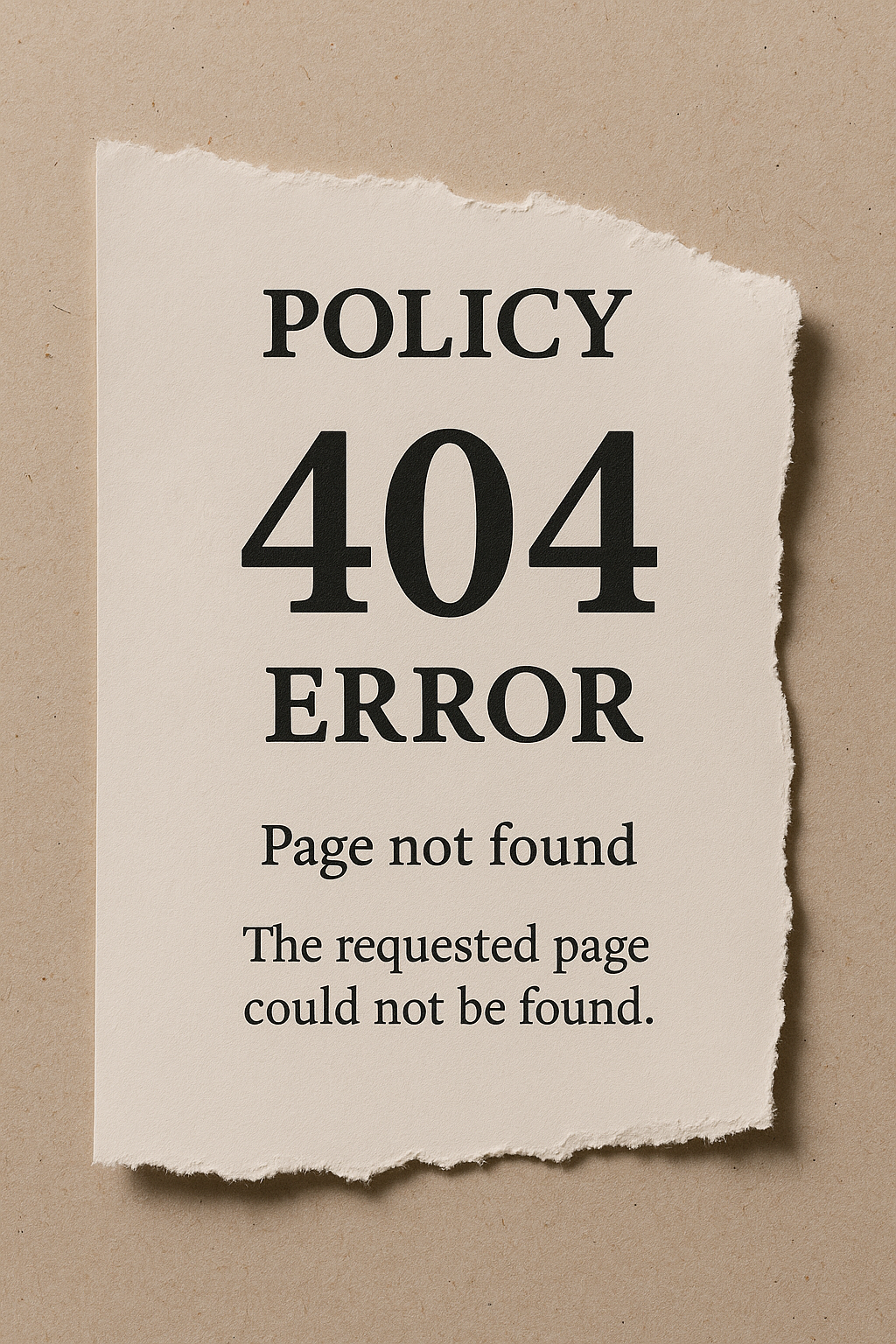
Each entry is impeccably dressed - plausible titles, prestigious journals, tidy page spreads, even DOI strings - yet every hyperlink lands on the same empty 404 desert.
Investigators have stitched together an overnight timeline: the counterfeit references were bulk-inserted on 3 May at 19:42, six hours before the file was encrypted and shuttled to the Government Printing Works.
An internal e-mail shows a junior analyst waving a red flag over dead URLs; the reply came as a single, stark sentence: “Deadline immovable - proceed with SharePoint version.”
Empty Laws, Loaded Models
South Africa still governs silicon helpers with legislation drafted before the transformer boom.
The Protection of Personal Information Act arrived in 2013, too early to mention neural networks, while the National Data and Cloud Policy has been stuck in inter-ministerial circulation since 2021.
Into that vacuum departments shop for AI like stationery: DHA bought 250 licences for a document-summariser in January 2023, quietly categorising the invoice under “miscellaneous cloud services” to dodge bespoke-software oversight.
The Auditor-General’s latest report shows the trick worked - no impact assessment, no tender board grilling, no audit trail beyond a line item.
Discipline inside the department has become a freestyle exercise.
Staff tell of “silent AI whispering”: managers urge experimentation yet issue zero guidance on prompt hygiene, hallucination triage, or acceptable-use checklists.
One analyst recounts feeding a 200-page report through a paraphrasing bot overnight; every statistic emerged nudged by a few percentage points - small enough to slip past a tired reviewer, large enough to bend a ministerial brief.
The suspended directors are not scapegoated novices: the Chief Director steered Immigration Policy for 23 years and captained the 2017 White Paper on International Migration; the Director chaired the technical committee that knitted the new paper into planned amendments of the Births and Deaths Registration Act.
Their sudden removal has frozen key workflows: a biometric-integration round-table with the Border Management Authority is shelved, and Sweden’s migration agency has paused data-sharing talks until “authentication standards are clarified.”
Numbers Don’t Lie - But Models Might
External forensic linguists ran a diff-check between the October 2022 draft and the May 2023 cabinet version.
Average sentence length jumped 37 % and Latinate vocabulary climbed 4.5 % - both well-documented fingerprints of unedited large-language-model text.
The phrase “pathway to regularisation” balloons from two appearances to nineteen, hinting that fine-tuning data over-amplified a slogan the model saw too often.
A Johns Hopkins study released in March shows legal prompts coax false precedents 58 % of the time when citations are requested - triple the hallucination rate of general-knowledge queries.
South Africa’s migration corpus - an uneven patchwork of statutes, common-law judgments, and half-digitised international conventions - sits squarely in that danger zone.
The scandal has already spilled beyond Pretoria.
UNHCR’s country office, poised to anchor a new statelessness-determination memorandum on the White Paper, is now verifying every line in-house.
The European Union Delegation has quietly frozen a R180 million capacity-building package that demanded “credible policy alignment,” according to internal funding notes.
Inside the department, calendars are being cleared: stakeholder workshops postponed, bilateral data exchanges suspended, and an “AI Incident Response Desk” hastily cobbled together from secondees of the Government Communication and Information System.
Vendor Pitches and a Call for a Sovereign Safety Net
Technology suppliers smell opportunity.
Microsoft South Africa dangled “Azure Government GPT,” a sovereign-cloud copy that keeps data on-shore and logs each prompt for future court rooms.
A University of Cape Town consortium proposes a “Policy Tech Hub” where drafts would be stress-tested against a vetted knowledge graph of national legislation before seeing daylight.
Even the perennially under-fire State Information Technology Agency has yanked its “Responsible AI in the Public Service” framework forward, promising public comment in late 2024 instead of the previously mooted 2025.
Yet legal minds warn that reputational corrosion may outlast any quick tech fix.
Professor Jane Duncan at the University of Johannesburg points to the 2012 Doctors for Life judgment, which entrenches meaningful public participation in law-making: “Consultation becomes a farce when the consulted sources are digital phantoms.”
For now, the department has yanked the disputed file from its website, stamped it “incomplete and under review,” and dispatched logistics crews - usually reserved for election ballots - to recall printed copies from provincial libraries.
Whether Footnote-gate ends as a quirky anecdote or sparks a sovereign-code statute depends less on the fallen managers than on how fast legislators, civil society, and an increasingly tech-literate electorate demand accountability - not only from human officials but from the opaque models now sketching the borders of citizenship itself.
What is "Footnote-gate" in South Africa?
"Footnote-gate" refers to a scandal where South Africa's draft Citizenship White Paper, a cabinet-approved document, contained a bibliography with fabricated sources generated by an AI language model. These "ghost citations" led to serious consequences, including suspensions of officials, halted international collaborations, and raised significant questions about AI's appropriate role in government policy-making.
How was the use of AI-generated content discovered?
The AI-generated content was discovered when the bibliography, which included plausible-looking titles, journals, and even DOI strings under headings like "Emerging Best Practice in Algorithmic Visa Adjudication," was found to link to empty 404 pages. Internal investigations revealed the counterfeit references were bulk-inserted just hours before the document was encrypted and sent to the Government Printing Works, despite a junior analyst flagging dead URLs.
What were the immediate consequences of "Footnote-gate"?
Immediately following the scandal, two branch heads from the Department of Home Affairs were placed on precautionary suspension. Key international projects were frozen, including a biometric-integration round-table with the Border Management Authority and data-sharing talks with Sweden's migration agency. The UNHCR and the European Union also put collaborations and funding packages on hold, citing concerns about authentication standards and credible policy alignment.
What broader issues did this incident expose regarding AI governance in South Africa?
The incident highlighted significant gaps in South Africa's AI governance framework. Existing legislation like the Protection of Personal Information Act predates the widespread use of advanced AI, and policies like the National Data and Cloud Policy are still in development. Departments were found to be purchasing AI tools, such as document summarizers, by categorizing them under "miscellaneous cloud services" to bypass proper oversight, impact assessments, and tender board scrutiny.
How did AI alter the White Paper's content beyond just footnotes?
Forensic linguistic analysis revealed that the AI not only generated fake footnotes but also subtly altered the text of the White Paper itself. A comparison between earlier drafts and the cabinet version showed a 37% increase in average sentence length and a 4.5% rise in Latinate vocabulary – both hallmarks of unedited large language model text. Additionally, certain phrases, like "pathway to regularisation," saw a significant increase in frequency, suggesting that the AI over-amplified specific slogans from its training data.
What are the long-term implications and proposed solutions following "Footnote-gate"?
"Footnote-gate" has led to reputational damage that experts believe may outlast quick technical fixes. Proposed solutions include private sector offerings like "Azure Government GPT" for secure, auditable AI use, academic proposals for a "Policy Tech Hub" to stress-test drafts against national legislation, and the State Information Technology Agency accelerating its "Responsible AI in the Public Service" framework. The scandal underscores the critical need for comprehensive AI governance, clear guidelines for AI use in government, and accountability for both human officials and the AI models shaping public policy.

Amanda Wilson is a Cape Town-born journalist who covers the city’s evolving food scene for national and international outlets, tracing stories from Bo-Kaap spice shops to Khayelitsha micro-breweries. Raised on her grandmother’s Karoo lamb potjie and weekend hikes up Lion’s Head, she brings equal parts palate and pride to every assignment. Colleagues know her for the quiet warmth that turns interviews into friendships and fact-checks into shared laughter.
View all articles →