
What Cape Town is spending on homes, roads and the N2 wall
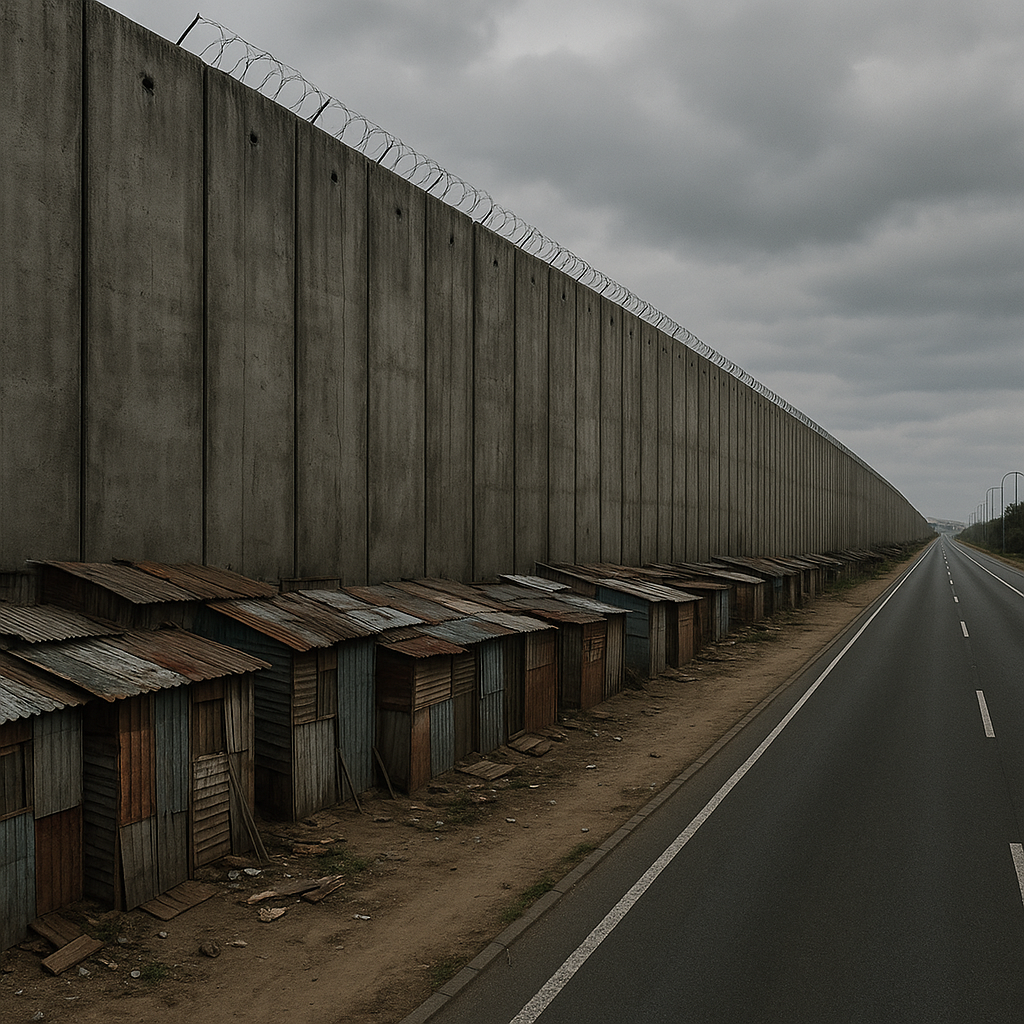
Cape Town's N2 "Edge wall": A R115-million barrier sparking debate on crime, poverty, and urban development. Will it bring safety or just divide?
Cape Town plans an "Invisible Wall" along the N2 highway: a 9 km, R115-million barrier of concrete and palisade. This wall aims to stop crime by separating the freeway from nearby informal settlements. While some see it as vital for safety, others call it a harsh, old-fashioned solution. It's causing big talks about safety, fairness, and how the city grows.
What is the "Invisible Wall" planned for Cape Town's N2 highway?
Cape Town's "Invisible Wall" is a proposed 9 km, R115-million concrete and palisade barrier along the N2 highway. Officially a "vertical road-restraint system," it aims to deter crime, separating the freeway from adjacent informal settlements. Critics argue it's a divisive apartheid-era solution, while proponents see it as a necessary safety measure.
Get Cape Town news in your inbox
Stay updated with the latest stories from the Mother City.
1. From Spreadsheet to Headline – How a Budget Line Became a Lightning Rod
Cape Town’s proposed N2 “Edge Wall” still exists only as a row of numbers in the 2025–28 capital budget, yet it already dominates talk-radio, dinner tables and taxi queues.
The item is priced at R115 million - R7 million for design, R108 million for brick-and-mortar labour - earmarked across three financial years.
In a R46,8 billion municipal capital plan the amount is pocket change, barely 1,3 % of the R8,2 billion mobility vote, but for the 270 000 drivers who crawl the 22 km “hell-run” between the airport and the CBD it has become a symbol of either salvation or insult.
Newspapers rushed the story after a mid-October shoot-out: a gunman with a semi-automatic rifle stepped from the Borcherds Quarry embankment, emptied a magazine into peak-hour traffic and disappeared into the adjacent shacks before Metro Police could swing a U-turn through the median.
Within 48 hours the mayoral committee for urban mobility issued a one-page brief: the existing tattered fence that separates the freeway from Joe Slovo, Khayalam, Barcelona, Silvertown and Rasta would be “upgraded” to a 9 km barrier - taller, brighter, studded with child-safe gates - yet no sketch, no start chainage, no environmental authorisation number was supplied.
All that arrived was a price tag and a pledge that “public participation will follow soon,” a vagueness that gifted fresh ammunition to critics who say the City drafts policy with Excel instead of empathy.
2. Apartheid Blueprints, 2025 Ballots – Why the Geography Still Hurts
The N2’s 1976 alignment sliced across what planners of the day labelled “unproclaimed Crown land,” a euphemism for the commons where Cape Flats shepherds, brick-yard workers and families evicted from neighbouring townships had built tin shacks.
Each upgrade cycle - 1982, 1994, 2010 - widened the carriageway and added diamond interchanges, yet left the original logic untouched: the asphalt trench would hide black poverty from white-ratepayer gaze.
Fast-forward to the current voter roll: Joe Slovo alone holds roughly 18 000 registered voters, Khayalam’s creche receives municipal subsidies and its hall doubles as a Covid-19 station.
The proposed barrier therefore no longer divides “city” from “homeland”; it cleaves the city from itself, ramming a concrete wedge through the very constituency that now helps elect it.
Engineers call the concept a “vertical road-restraint system” (VRRS): 2,8 m precast plinth, 1,2 m powder-green palisade on top, weep-holes every 3 m, CCTV every 50 m, LED masts every 40 m doubling current lux levels.
Total concrete volume equals 6 200 m³, enough to pour a 1,2 km one-metre-wide sidewalk - an irony activists love to point out while trudging the parallel dirt track the municipality never paved.
3. Crime Heat-Maps vs. Flooded Yards – The Battle of Statistics and Side-Effects
JP Smith, the safety mayco member, keeps a laminated heat-map on his office wall: 3 870 recorded crimes within 500 m of the N2 over five years, 42 % violent, red blobs hugging the shack fence-line like a rash.
Saturation patrols, high-mast lights, licence-plate cameras and a 42-vehicle Highway Patrol unit have failed to cool the corridor, he argues; a physical barrier is “the last affordable layer of defence,” backed by an extra R48 million for 24/7 rapid-response bases.
The Socio-Economic Rights Institute counters that hardware never cures structural exclusion.
They demand a full Environmental and Social Impact Assessment, warning the wall will trap shack-fire smoke, interrupt storm-water runoff and raise ambient particulate levels inside a shadow corridor already starved of breeze.
Inside the settlements the maths gets personal.
Asive Kanamtu, 27, runs an off-ramp car-wash and says he loses two clients a week to smash-and-grabbers; a barrier could let him hire another employee.
Sibongile Masembatha, raising two children within sight of runway lights, wants the shooting to stop - “Let them build, but bring toilets too.”
Yet backyard mechanic Babalo Dunywe calculates that R108 million could install 18 km of water reticulation, giving every shack a yard tap, while youth chair Cowen Buyambo insists R10 million would train 200 welders annually - ”They can forge their own gates.”
4. Walls Elsewhere, Windows of Opportunity – Can Cape Town Rewrite the Ending?
Johannesburg’s 750 m M1 wall cut car-jackings 38 % in year one, only to displace crime westward and worsen Alexandra flooding; Nairobi’s Thika barriers reduced pedestrian deaths but birthed police extortion alcoves; Los Angeles’s 10 km riverine wall became the world’s longest mural, then the planet’s longest lawsuit over heat-island effects.
Cape Town’s drafters say they’ve absorbed the warnings: 600 mm see-through mesh band at the top, public open-data CCTV feed, lateral drainage holes, emergency foot-gates every 200 m.
Tender documents drop in September 2025 and value-engineering could still dilute the concessions.
Meanwhile the City has quietly bought 13 ha of private land on the settlement side - sparking speculation that the wall is merely Phase 1 of a lucrative double-frontage redevelopment, similar to the upscale eKhaya precinct that followed the 2008 N2 Gateway build.
Activists aren’t opposed to concrete per se; they want a co-production deal.
Twenty-seven community groups have formally requested a Bogotá-style design charrette and demand that every kilometre of wall be matched by one kilometre of internal upgrades - graded footpaths, solar lights, ablution blocks, free Wi-Fi hotspots - citing the Municipal Systems Act and the White Paper on Local Government’s “co-production” clause.
Lawyers are now scrambling to see if such a social-infrastructure swap can be embedded in a tender without violating procurement rules that frown on “extraneous considerations.”
For now the N2 “Edge Wall” remains a ghost: lines on a CAD screen, a smell of wet cement that hasn’t been poured, a R115-million promise that could either harden into apartheid’s last echo or become the bargaining chip that finally delivers taps, training centres and safe sidewalks to the people who live in the highway’s shadow.
What is Cape Town's "Invisible Wall" and what is its purpose?
Cape Town's "Invisible Wall" is a proposed 9-kilometer, R115-million barrier planned along the N2 highway. It will be constructed using concrete and palisade, officially termed a "vertical road-restraint system." Its primary purpose is to curb crime by physically separating the freeway from adjacent informal settlements.
How much will the "Invisible Wall" cost and where does the funding come from?
The total cost of the "Invisible Wall" is R115 million. This budget is allocated across three financial years within Cape Town's 2025–28 capital budget. R7 million is earmarked for design, while the remaining R108 million is for construction (brick-and-mortar labor). Despite its high cost, it represents a small fraction (1.3%) of the city's R8.2 billion mobility vote within the larger R46.8 billion municipal capital plan.
What are the main criticisms and controversies surrounding the project?
Critics argue that the "Invisible Wall" is a harsh, old-fashioned, and divisive solution reminiscent of apartheid-era policies, as it physically separates communities. Concerns include that it will trap shack-fire smoke, interrupt stormwater runoff, and raise ambient particulate levels in the settlements. Activists also highlight that the R108 million for construction could instead be used for essential infrastructure like water reticulation or skills training for residents.
What are the arguments in favor of building the "Invisible Wall"?
Proponents, such as safety mayco member JP Smith, argue that the wall is a vital and

Isabella Schmidt is a Cape Town journalist who chronicles the city’s evolving food culture, from Bo-Kaap spice merchants to Khayelitsha microbreweries. Raised hiking the trails that link Table Mountain to the Cape Flats, she brings the flavours and voices of her hometown to global readers with equal parts rigour and heart.
View all articles →