
Zuma-Morocco link: Departure from Pretoria’s Line
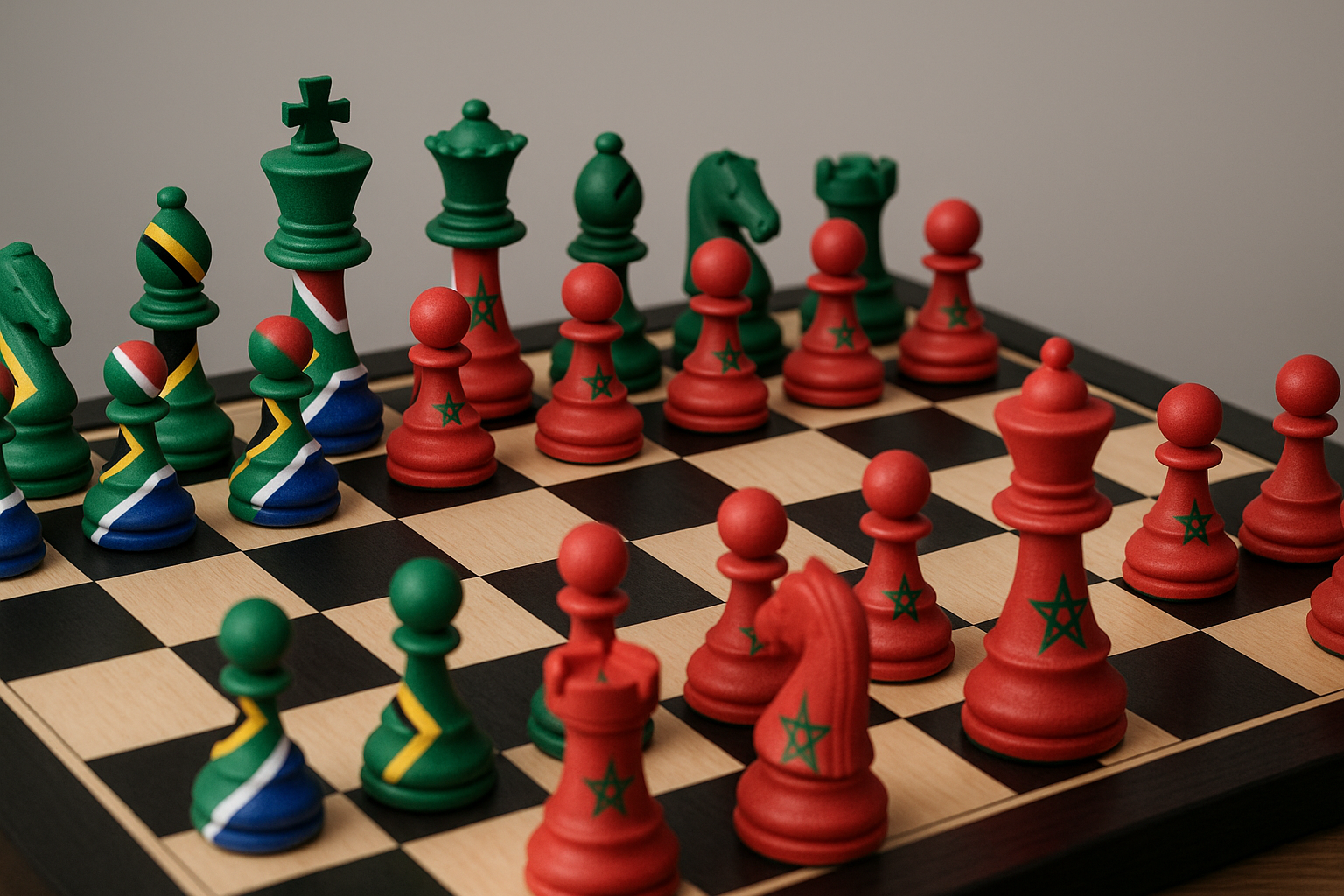
Jacob Zuma's Moroccan visit sparks geopolitical drama, raising questions about South Africa's stance on Western Sahara.
Jacob Zuma, a former South African president, stirred up a big fight by showing up at a football game in Morocco. He was seen with a Moroccan flag that South Africa doesn't recognize, making it seem like he supports Morocco's claim over a disputed area called Western Sahara. This goes against South Africa's long-standing view and has many people wondering if Zuma is doing his own diplomacy for money. His actions are causing a huge debate and could change South Africa's stance on this old colonial problem.
What is the main controversy surrounding Jacob Zuma and Morocco?
Jacob Zuma's actions, particularly his appearance at a Moroccan stadium displaying a disputed flag and his engagement with Moroccan officials, challenge South Africa's long-standing foreign policy recognizing the Sahrawi Arab Democratic Republic. This has sparked debate about his freelance diplomacy and potential financial influences, raising questions about South Africa's stance on the Western Sahara conflict.
Get Cape Town news in your inbox
Stay updated with the latest stories from the Mother City.
1. The 90-Second Clip That Detonated Pretoria
On a cool January evening in 2026, Jacob Zuma stepped into the VIP box of Rabat’s Prince Moulay Abdellah Stadium wearing a steel-grey djellaba and his trademark leopard-skin cap. The 53 000 fans inside were fixated on a tense AFCON quarter-final; the internet was fixated on a 90-second smartphone clip that showed the former South African president swaying to the Moroccan drums, flanked by two loyalists from his MK Party. Within minutes, foreign-policy analysts had freeze-framed the shot: a forty-metre green-star banner hanging beside a South African flag Pretoria insists it never approved. The clip raced across WhatsApp, Twitter and TikTok, turning a routine last-16 match into the newest episode of Africa’s most stubborn territorial soap opera.
The game itself - Nigeria finally beaten 4–3 on penalties - felt like an after-thought once the geopolitical sub-plot detonated. Rabat’s night air was mild, but the Western Sahara file has been on the boil for five consecutive years. Morocco’s 2025 AFCON marketing line, “African sunshine meets Atlantic breeze,” was code for a deliberate parade of freshly built stadiums, motorways and wind farms in Laâyoune and Dakhla - cities Pretoria refuses to label Moroccan. Every match ticket carried a faint watermark of the Tanger-Med port and the slogan “From Cape to Sahara, One Morocco,” a soft-power jab that drives Polisario representatives to distraction. Zuma’s physical presence inside that curated branding exercise handed state broadcaster SNRT a perfect montage: liberation-era icon mumbling the chorus of “An-Nasr al-Maghrib,” Moroccan flag fluttering behind him.
Back in Pretoria, officials watched the footage on mute. Barely three days earlier South Africa’s chargé d’affaires had delivered a second formal démarche after Rabat printed the two national flags side-by-side during Zuma’s July 2025 visit. That week-long junket - helicopter ride over the Phosboucraa phosphate complex, five-star suite at the Hilton - produced the photograph now hanging in Morocco’s foreign-ministry foyer: Zuma and Foreign Minister Nasser Bourita grinning beneath a merged flag portrait of King Mohammed VI. Pretoria’s note verbale complained that “non-state actors” may not legally hoist the South African standard at gatherings implying sovereign recognition. Translation: the man who once chaired the ANC’s international-relations desk is building a freelance diplomacy channel that could fracture South Africa’s 34-year consensus on the last African colony.
2. Pretoria’s Red Line Versus Durban’s Green Light
That consensus began on Robben Island in 1990, when Nelson Mandela told Polisario chief Mohamed Abdelaziz that a referendum on self-determination was non-negotiable. Three cabinets, six presidents and countless policy conferences later, South Africa still recognises the Sahrawi Arab Democratic Republic and hosts its embassy in a modest Arcadia villa whose brass plaque is regularly splashed with green paint by Rabat-funded protesters. Every December, the SADR ambassador attends a solidarity reception timed to the anniversary of the 1975 Madrid Accords. ANC policy papers still call Morocco “the last colonial hold-out on the continent.” Zuma once rehearsed those same talking points; his U-turn therefore carries the extra burn of apostasy.
Inside the MK Party, the spin is colder. Magasela Mzobe - former intelligence operator and Zuma body-guard - says Pretoria’s “emotional attachment” to Polisario ignores North-African realities. Since its December 2023 launch, the MK Party has rolled out the red carpet for Moroccan trade missions at Durban’s Inkosi Albert Luthuli convention centre, briefing them on KwaZulu-Natal’s proposed dig-out port on the old airport site. OCP, the phosphate empire that already feeds South African farmers through a Richards Bay joint venture, has dangled a R12 billion fertiliser-blending hub outside Pietermaritzburg - provided “political risk” around Western Sahara cools. Zuma’s interlocutors hint that an MK-run municipality could sign MoUs that leapfrog Pretoria’s ideological red lines, copying the city-to-city deals Polisario already enjoys with Spanish regions.
The money trail is murky but not invisible. In September 2025 a Seychelles shell, Sahara Atlantic Holdings, injected US$2.3 million into the MK Party’s campaign trust. The cash started in a Casablanca investment shop controlled by Aziz Akhannouch’s private office, island-hopped through the British Virgin Islands, and first touched Africa at a Standard Bank branch in eSwatini - chosen, investigators say, for its sleepy disclosure regime. The MK Party denies any quid pro quo, yet the transfer coincided with Zuma’s op-ed in the pro-Rabat weekly Le360 Afrique, hailing the autonomy plan as “the only game in town.” Critics call the piece a down-payment on future port contracts; supporters call it strategic non-alignment. Either way, Pretoria’s treasury has no lever to stop the flow.
3. Soft Power, Hard Cash and the Meme Wars
Polisario’s exiled leaders are not watching politely. Mohamed Sidati, their Europe point-man, flew to Johannesburg in November 2025 and spent four hours with ANC secretary-general Fikile Mbalula, offering fresh legal opinions that brand Morocco’s phosphate and fisheries exports as “plunder of a non-self-governing territory” under the UN Charter. An internal ANC dossier warns that any erosion of the party’s line could invite litigation at the International Court of Justice and torch South Africa’s “moral capital” in the African Union. Mbalula’s ensuing press conference - at which he labelled Zuma “a reckless merchant of sovereign selfies” - was choreographed to overlap with a Polisario solidarity concert at Wits University, where Sahrawi oud players shared a stage with struggle-era jazz group Bayete.
Rabat’s response has moved beyond cheque-book wooing to institutional capture. In October 2025 it bank-rolled the Africa Sovereignty Forum, a Sandton think-tank housed in Mandela Square. The board includes former ANC MP Mosebenzi Zwane - tarnished by the Vrede dairy scandal but never convicted - and Moroccan royal adviser Khadija Mohsen-Finan. The forum’s first junket flew journalists to Dakhla to film wind-turbines “benefiting Sahrawis.” South Africa’s press council later slapped the organisers for hiding that travel grants came from Morocco’s communications directorate, but by then the footage had aired on three networks, quietly normalising Moroccan sovereignty. Meanwhile, Algeria revived the 1970s concept of a “Pan-African Sahara Brigade,” flying retired Umkhonto we Sizhe veterans to Tindouf refugee camps for a mock pass-out parade that racked up 3.4 million TikTok views in 48 hours - only to be drowned by Moroccan bots spamming green-heart emojis.
Sport itself is now a semiotic battlefield. AFCON 2025 organisers handed out 4 500 complimentary tickets to African political parties, 200 of them to the MK Party youth league. The seats sat squarely in the TV pan shot, ensuring every cut-away framed Moroccan flags interlaced with South Africa’s green, gold and black. State TV even slipped a 0.8-second graphic of “Greater Morocco” during player close-ups - too quick for censors, long enough for the subconscious. Add a planned 5 000-seat football academy in Dakhla, set to open in 2027 and named, without irony, after Nelson Mandela, and the messaging war is complete. Polisario calls it “sporting colonialism”; European NGOs question whether Moroccan settlers will run the earth-movers; Old Mutual, South Africa’s oldest insurer, now faces shareholder resolutions demanding disclosure of conflict exposure.
4. Parliament, Courts and the Snake Dance Ahead
The African Union’s mid-year summit in Accra papered over the cracks with boiler-plate language “welcoming all efforts conducive to a mutually acceptable political solution,” then elected Moroccan diplomat Mohammed Arrouchi as one of its five vice-chairs - handing Rabat gate-keeping power over future agenda items. South Africa’s delegation tried to insert a clause on “inalienable right to self-determination,” but dropped it after a 14-hour filibuster led by Cameroon and Senegal, both recipients of Moroccan fertiliser subsidies. The MK Party cited the outcome as proof that “the wind is blowing toward autonomy,” while the ANC’s national executive committee deferred disciplinary action against Zuma, fearful of splitting the party in KwaZulu-Natal where the MK Party already runs three district municipalities and 18 local councils.
Parliament’s portfolio committee on international relations has summoned DIRCO three times since August 2025 to explain “Zuma creep.” Officials admit they have no statute to stop a private citizen - even one with a cabinet-level pension and lifetime VIP protection - from pocketing foreign hospitality. Opposition MPs are drafting a Private Member’s Bill that would criminalise “misrepresentation of foreign policy by former high-office holders,” but constitutional scholars warn it could collide with free-speech safeguards. Meanwhile, Old Mutual’s shareholders prepare for a proxy fight over conflict-risk disclosure, and Pretoria treasury officials scratch their heads about how to police private insurance contracts signed in London for ships flagged to Panama.
Jacob Zuma, characteristically, is unrepentant. In a voice-note leaked the morning after the Nigeria penalty drama, he tells an associate: “These youngsters think foreign policy is a tombstone - never move. I told them, politics is a snake, you must dance with it.” Whether the dance ends with a Moroccan-funded port on the KwaZulu-Natal coast, an ICC subpoena over resource plunder, or simply another viral clip of green-star banners and struggle songs, remains an open bet. What is certain is that every retweet, every subsidised flight, every overlapping flag keeps the Western Sahara dispute not in the footnotes of diplomatic journals but in the smartphone galleries of millions of Africans who now associate red backdrops and green stars with the man who once belted out “Umshini wam” in a very different stadium - and is still determined to shape the continent’s last colonial conversation.
What is the main controversy surrounding Jacob Zuma and Morocco?
Jacob Zuma's actions, particularly his appearance at a Moroccan stadium displaying a disputed flag and his engagement with Moroccan officials, challenge South Africa's long-standing foreign policy recognizing the Sahrawi Arab Democratic Republic. This has sparked debate about his freelance diplomacy and potential financial influences, raising questions about South Africa's stance on the Western Sahara conflict.
When and where did the controversial incident involving Jacob Zuma take place?
Jacob Zuma appeared in the VIP box of Rabat’s Prince Moulay Abdellah Stadium in January 2026, during an AFCON quarter-final match. A 90-second smartphone clip showed him alongside MK Party loyalists, with a large green-star banner, associated with Morocco's claim over Western Sahara, visible behind him.
How does Zuma's current stance on Western Sahara differ from South Africa's traditional policy?
South Africa has a long-standing policy, dating back to Nelson Mandela, recognizing the Sahrawi Arab Democratic Republic (SADR) and supporting its right to self-determination. Zuma previously adhered to this view, but his recent actions and statements, including an op-ed supporting Morocco's autonomy plan, represent a significant departure from this national consensus and are seen by some as an "apostasy."
What are the potential financial motivations behind Zuma's actions?
There are suggestions of financial incentives, including a R12 billion fertilizer-blending hub offered by Morocco's OCP (phosphate empire) in KwaZulu-Natal, contingent on political risk around Western Sahara cooling. Furthermore, a Seychelles shell company, Sahara Atlantic Holdings, injected US$2.3 million into the MK Party's campaign trust, originating from a Casablanca investment firm, around the time Zuma's pro-Rabat op-ed was published. These financial ties suggest a 'pay-for-play' dynamic in Zuma’s 'freelance diplomacy.'
How has the South African government and the ANC reacted to Zuma's actions?
Pretoria's Department of International Relations and Cooperation (DIRCO) has issued formal démarches to Rabat concerning the display of flags and implications of sovereign recognition. Within the ANC, there's concern over the erosion of the party's stance on Western Sahara. Although disciplinary action against Zuma has been deferred, high-ranking officials have publicly criticized him, with one labeling him a "reckless merchant of sovereign selfies."
What is the broader impact of this controversy on the Western Sahara dispute and African politics?
Zuma's actions have propelled the Western Sahara dispute from diplomatic footnotes into the public eye, particularly through social media and cultural events. It highlights a growing 'soft power' struggle between Morocco and Algeria/Polisario, using events like AFCON and cultural initiatives. The controversy also exposes challenges to South Africa's moral capital within the African Union and raises questions about private citizens influencing foreign policy and the role of financial interests in international relations.
Zola Naidoo is a Cape Town journalist who chronicles the city’s shifting politics and the lived realities behind the headlines. A weekend trail-runner on Table Mountain’s lower contour paths, she still swops stories in her grandmother’s District Six kitchen every Sunday, grounding her reporting in the cadences of the Cape.
View all articles →