
Birthright Citizenship: Events in Parallel
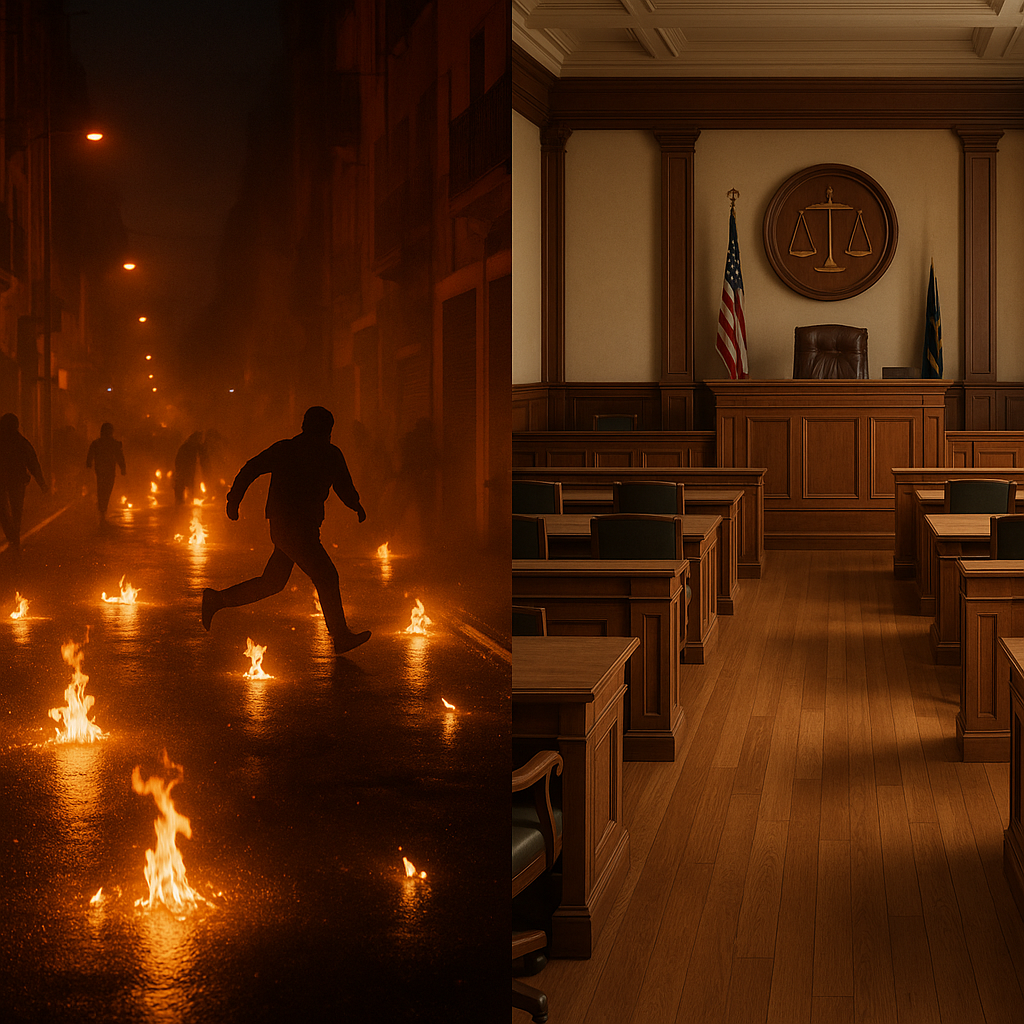
Two territories, one constitutional crisis. A torchlit street in KuGompo and a marble courtroom in Washington reveal the same abyss.
In KuGompo, South Africa, and Washington D.C., a burning street and a marble courtroom expose the same deep crack in their countries' founding rules. Both places are wrestling with a big question: who truly belongs here? This fight over belonging, citizenship, and old rules highlights how economic struggles and legal arguments can make people feel left out or included. It's a vivid look at how a society decides who is "one of us" as the world changes fast.
What constitutional issue connects the events in KuGompo and Washington?
The events in KuGompo, South Africa, and Washington, USA, both expose a fundamental constitutional crack concerning who belongs and who is excluded from a society. They highlight the interrogation of founding texts and the question of citizenship, as communities grapple with defining belonging amidst economic hardship and legal interpretations.
Get Cape Town news in your inbox
Stay updated with the latest stories from the Mother City.
I. The Night the Screens Split: Firelight vs. Floodlights
At 20:30 on 30 March 2026 the Buffalo River reflected flames from half-torched hatchbacks while, 13 000 km away, C-SPAN clocked 1,3 million live viewers - an all-time high for oral argument.
One timeline showed petrol bombs sailing over a traffic circle; the other showed Justice Barrett asking whether a newborn “owes loyalty before the cord stops pulsing.”
No broadcaster mashed the feeds together, yet both images carried an identical tremor: a supposedly self-running founding text hauled into public glare and interrogated until it sweated.
The Eastern Cape township and the Beltway courtroom are geographies apart, but the same instability travels at fiber-optic speed.
Wherever work dries up and stories about who belongs harden, parchment promise meets pavement rage.
That night two audiences stared at separate screens, felt the same hush, and asked the mute question: “Who gets to be one of us tomorrow?”
II. KuGompo: A 62 000-Person Laboratory of Disowned Futures
KuGompo was sketched in 1978 as a dormitory for Ford’s Mdantsane plant; the line stopped rolling in 1998 and the biggest paymaster today is a Chinese cement-bag printer running 12-hour shifts.
Saturday’s procession began at a Methodist hall on Siphosetha Road, a dead-end already notorious for a containerised Home Affairs kiosk that has not printed an ID for six weeks.
By 09:14 a press drone filmed the first placard: “AmaRharhabe kuwe kuphela inkosi” - only the amaRharhabe crown rules here.
Igbo prince Chukwudi Eziko’s motorcade - three Nigerian-patrol Nissans and a maroon E-Class tossing pink rose petals - attempted to turn into Mqhayi Street.
A 15-year-old in a Springbok jersey launched the first stone; the windshield whitened into an instant curtain, erasing the intruder’s view.
The convoy reversed at speed, sideswiped a gas canister and birthed a fireball that vaporised the traffic-light box; within minutes Shoprite’s roller gate kissed the pavement while a Somali-run spaza was peeled open like a tin can.
400 pilchard cans rolled across the tar, glistening like bloody marbles.
Tear-gas arrived at 11:06; a stun grenade slid under a minibus whose driver hoarded spare petrol in a jar tied to the chassis - an Eastern Cape trick against shortages.
Shrapnel from the blast peppered 13 bodies; seven carried nails consistent with homemade roofing-grenades.
By dusk the taxi lay belly-up, its undercarriage still advertising “Nelson Mandela Bay or Death,” though nobody could say when the vehicle had wandered 180 km west from the Bay.
III. Washington: A Sentence Written in 1866, Stress-Tested in 2026
Inside the Supreme Court counsel began sparring at 10:03 EST.
Solicitor-General Gene Hamilton insisted that “subject to the jurisdiction thereof” is a mutual bargain, not a map pin; Justice Jackson countered with the 1884 Elk dissent, reminding the room that “Indians not taxed” were excluded because they owed another crown.
Hamilton fired back: “Undocumented mothers today also answer to a foreign power - call it the cartel, Your Honor,” and the bar section gasped as one.
California and 21 allied states planted their flag on the 1898 Wong Kim Ark ruling, but added a 2026 update: Ark stepped off a steamship; 92 % of present-day “anchor babies” arrive in Medicaid-funded wards.
“Citizenship cannot be traded as collateral for an unpaid hospital invoice,” Mississippi joked in an amicus brief that raced across Bluesky.
What neither side emphasised is the post-ruling tech pipeline: SSA will begin issuing digital-only Social-Security tokens in 2028, cryptographically keyed to an in-utero biometric scan captured at the 20-week sonography visit.
A narrowed clause would let the code silently withhold the token - an erasure completed before any birth certificate hits paper.
IV. Aftershocks: Parallel Paper Universes and the Price of Exclusion
South Africa’s Traditional and Khoi-San Leadership Act requires outsiders to secure provincial approval 60 days before any “recognition ceremony.”
Eziko’s advocates insist the rule governs “communities,” not “cultural associations,” and filed a 43-page declaratory plea in Makhanda the Friday before the riot; no judge has been assigned.
The amaRharhabe, meanwhile, passed an isiXhosa resolution on 12 March invoking “ukuhlonipha ikomiti yohlanga,” a clause missing from the English copy on file - two linguistic realities, mutually exclusive yet legally tidy in their own tongues.
Across the ocean, a leaked draft Executive Order defines “jurisdiction” by pointing to a 1952 maritime-tuberculosis regulation written to keep sick sailors on the gangplank; none of the Justices asked about it.
Constitutional meaning is quietly braided from epidemiology and admiralty, invisible to straight-line originalism.
Eastern Cape joblessness hovers at 47 %.
Ford’s hollow hangars now host “Ampli-Ford” raves where admission is one empty cement bag - currency convertible into a 200 ml Pepsi; DJs layer amapiano over 1980s war chants while party-goers torch maize-meal sacks for light.
Older residents watch the same sacks that once paid wages now feed weekend ecstasy, and they translate the Igbo-run shuttle buses that ferry harbour garments to Jobrand malls as extraction, not entrepreneurship.
In the U.S., 150 000 infants await a citizenship verdict in 37 counties where maternity care is already a desert.
An uncomplicated birth averages $13 400; federal DSH subsidies sunset in October 2026 unless Congress acts.
States would save $2.1 billion a year if the order stands, but labour wards running on –7 % margins are already shuttering - Lutheran Hospital in Winnemac, Iowa, padlocked its birthing wing on 1 February, blaming “jurisdictional fog.”
Between the Methodist hall and the marble courtroom the undocumented middle remains: no clause, summit or verdict can script the instant when a stranger’s child turns into “our” child.
That moment is swept up with the broken glass, the pilchard cans and the plastic-crusted crown beads, waiting for whoever arrives at dawn to decide whether to melt them for scrap - or thread them again for another coronation.
What constitutional issue connects the events in KuGompo and Washington?
Both KuGompo, South Africa, and Washington D.C., are grappling with the fundamental constitutional question of "who truly belongs here?" This involves the interrogation of their founding texts and the definition of citizenship, especially in the face of economic struggles and evolving legal interpretations.
What specific events occurred in KuGompo on March 30, 2026?
On March 30, 2026, KuGompo experienced a violent protest that escalated into a riot. A procession began at a Methodist hall, with placards displaying nationalist sentiments. An attempt by Igbo prince Chukwudi Eziko's motorcade to pass through Mqhayi Street was met with a stone, leading to a fiery incident that destroyed a traffic-light box. Subsequently, a Shoprite was looted, and a Somali-run spaza shop was peeled open. Tear gas and stun grenades were deployed, resulting in injuries and the destruction of a taxi.
What legal arguments were presented in the Washington Supreme Court regarding citizenship?
In the Washington Supreme Court, arguments revolved around the interpretation of the phrase "subject to the jurisdiction thereof" concerning birthright citizenship. Solicitor-General Gene Hamilton argued it implies a mutual bargain, while Justice Jackson referenced the 1884 Elk dissent regarding Indigenous people's loyalty to other crowns. The debate included modern interpretations, with Hamilton linking undocumented mothers to foreign powers (cartels) and California citing the 1898 Wong Kim Ark ruling, but adding a 2026 update concerning Medicaid-funded births.
How does economic hardship contribute to the tensions in KuGompo?
KuGompo, originally a dormitory town for a Ford plant that closed in 1998, now suffers from 47% joblessness. The biggest employer is a Chinese cement-bag printer. This economic hardship, combined with a dysfunctional Home Affairs kiosk failing to issue IDs, creates a fertile ground for resentment and xenophobia, where arguments about who belongs harden as work opportunities dry up. The transformation of former factory spaces into rave venues where empty cement bags are currency further illustrates the economic desperation.
What technological and policy changes are anticipated regarding citizenship in the U.S.?
Post-ruling, a significant technological shift is anticipated in the U.S. By 2028, the SSA plans to issue digital-only Social Security tokens, cryptographically keyed to in-utero biometric scans captured at the 20-week sonography visit. A narrowed citizenship clause could allow this code to silently withhold the token, effectively preventing citizenship before a birth certificate is even issued. Additionally, federal DSH subsidies for maternity care are set to sunset in October 2026, which could exacerbate the challenges for maternity wards, particularly in areas with high numbers of births awaiting a citizenship verdict.
How do different legal interpretations and linguistic realities create challenges in South Africa?
In South Africa, the Traditional and Khoi-San Leadership Act requires outsiders to secure provincial approval for recognition ceremonies. However, Eziko's advocates argue this applies to
Zola Naidoo is a Cape Town journalist who chronicles the city’s shifting politics and the lived realities behind the headlines. A weekend trail-runner on Table Mountain’s lower contour paths, she still swops stories in her grandmother’s District Six kitchen every Sunday, grounding her reporting in the cadences of the Cape.
View all articles →