
CPUT shuttle and golden arrow bus crash in district six
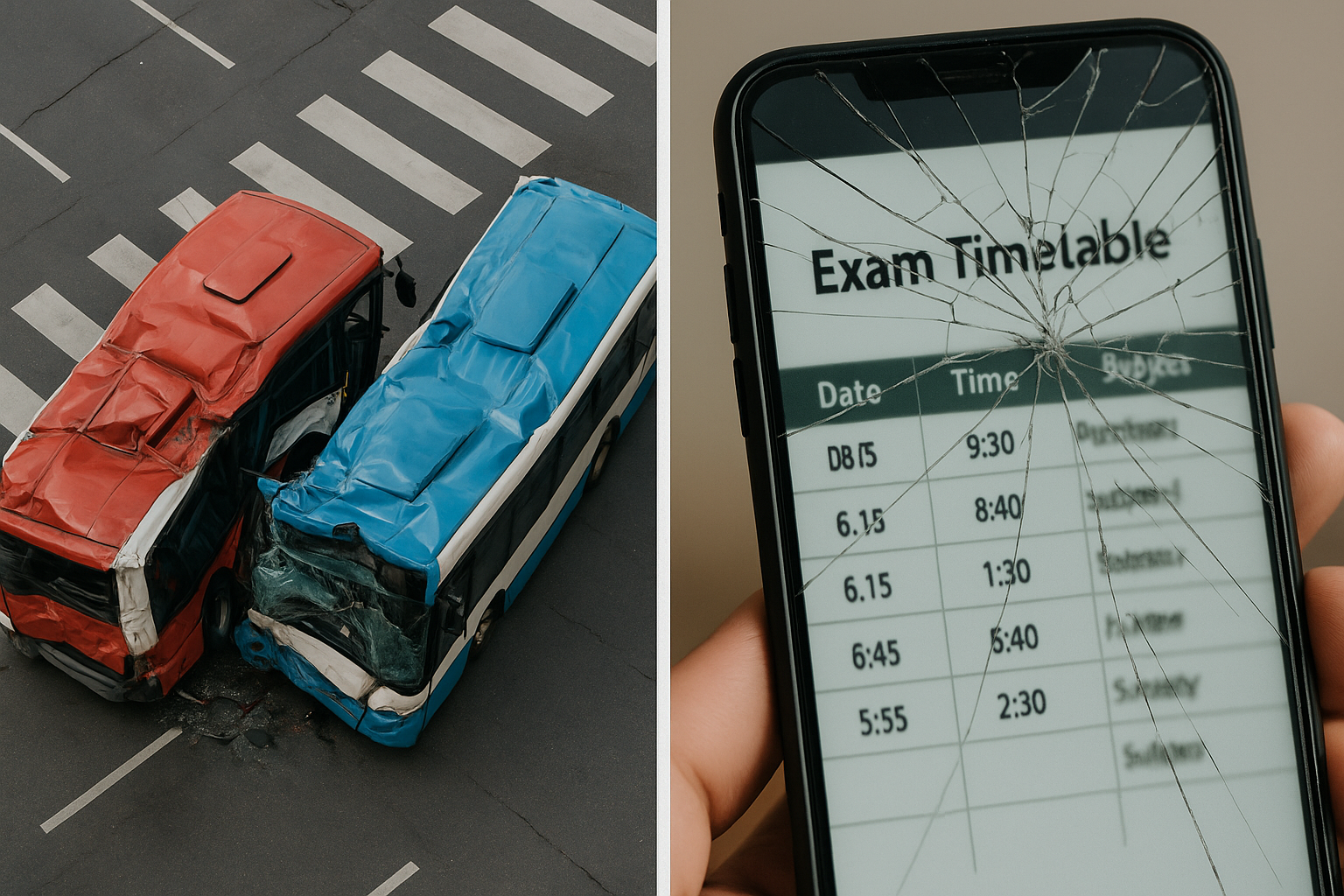
A university shuttle collision in District Six sparks debate on student transport, road safety, and campus policy. Fatalities narrowly avoided.
A university shuttle crashed into a bus in Cape Town, causing chaos and injuries on an exam morning. Budget cuts led to overcrowded shuttles, and poor road design made the crash worse. This accident exposed big problems with student transport, like old signs and drivers working too long. Now, everyone is talking about how to make student travel safer.
What caused the university shuttle collision in District Six?
The collision in District Six was caused by a combination of factors including a significant budget cut to the university's transport, leading to fewer shuttles and overcrowding. Additionally, inadequate traffic infrastructure at the intersection and the Golden Arrow bus performing a "rolling stop" contributed to the high-speed impact.
Get Cape Town news in your inbox
Stay updated with the latest stories from the Mother City.
1. The 80 km/h Bang That Shook District Six
What should have been a quiet scramble for end-of-semester seats became a thunderclap heard three blocks away. At 07:03 on a muggy Friday, a 65-seat university shuttle collided with an empty Golden Arrow bus on the lower shoulder of District Six. Kitchen staff inside the CPUT cafeteria thought a transformer had exploded; students on the pavement saw books and cellphones arc through the air like startled birds. Within seconds, WhatsApp voice notes contradicted one another - some screamed “bus skipped the stop,” others swore “shuttle flipped,” a few warned of bodies in the road. The noise, investigators later calculated, came from a closing speed of roughly 80 km/h compressed into a single, metallic cough.
District Six acts as a concrete funnel where four traffic streams - taxis, delivery vans, private cars and university shuttles - are squeezed into four narrow lanes. That geography turned a two-vehicle crash into a public flash-point, reviving complaints that students are forced to roll the dice every dawn. By 07:10, the intersection resembled a theatre set: coolant steam, glittering glass, and half-written exam notes sliding across the tar. The first civilian to wade in was a retired oncology nurse on her way to Groote Schuur; she used a student’s tartan scarf as a tourniquet on the shuttle driver’s gushing thigh, probably saving his life before paramedics even keyed their radios.
Six ambulances, two rescue vans and a fire engine with hydraulic shears arrived within nine minutes. Field medics tagged three students red: two 19- and 22-year-old women with suspected spinal injuries, and a 24-year-old man whose ribcage had kissed the seat in front. The shuttle driver - 46-year-old Henry Plaatjies, father of four - was pinned by a fractured femur. Golden Arrow’s driver came out with facial cuts from his shattered windscreen; the 21-year-old trainee conductor wobbled away with whiplash but managed to walk. A private trauma hospital in Panorama cleared its “green corridor,” normally reserved for gun-shot VIPs, after CPUT’s student-affairs director made an urgent call. By 08:00, the red-tag trio were cannulated, collared and racing toward CT-scans instead of the Computer Systems paper they had crammed for all night.
2. Fleet Logs, Empty Buses and a Rolling Stop Caught on Dash-cam
Fleet telemetry shows the shuttle - unit 14B on the Bellville–District Six loop - left campus at 06:40, seventeen minutes after an en-route inspector ticked “compliant” on tyres, brakes and fire-extinguisher expiry. Forty-one passengers clambered aboard behind the Student Centre: 38 undergraduates hugging see-through file sleeves, two residence advisers escorting exchange students, and a housing officer ferrying maintenance forms. Three latecomers squeezed into the aisle, nudging the vehicle over capacity, an unofficial but exam-period tradition of “one more won’t hurt.” By 06:52 the shuttle crested the N2 descent toward the city bowl, every seatbelt clicked yet no curtain airbags poised - those were deleted in the 2016 cost-saving spec sheet common to outsourced student fleets.
Golden Arrow bus 4017, an eight-year-old 85-seater Mercedes, rolled out of Roodebloem depot at 06:48 for the 07:05 Route 106 trip. Because the first pick-up is Salt River, only driver Aubrey Kwinana and a trainee conductor rode inside. Traffic-camera frames show the bus pausing 2.3 seconds at the four-way stop on Canterbury and Chapel, then nosing forward. The shuttle flashed into view 0.8 seconds later. Impact point: front-left corner of the bus, mid-section of the shuttle - classic T-bone complicated by a 6 % downhill grade and a low winter sun that chopped visibility to 120 m. Airbags blossomed only on the bus; inside the shuttle, unsecured backpacks became projectiles, smashing against window frames already spider-webbed by torsional force.
Conflicting numbers surfaced before the wreckage cooled. The SRC’s impromptu roll-call, scribbled on an exam timetable under a St. Mark’s Church tree, listed 58 self-declared occupants. CPUT’s official midday release spoke of nine hospital assessments and only one scan - illustrating the chronic fog of mass-casualty maths. Delayed presentations soon tilted the scale: by Saturday afternoon Groote Schuur logged four extra students with neck pain and acute anxiety, none of whom appeared on the original tally. Golden Arrow, meanwhile, suspended Kwinana on full pay within two hours and ordered refresher training for all Route 106 staff. Union sources whisper the driver had clocked only five hours off after a 14-hour split shift - legal under Sectoral Determination 9, yet an obvious fatigue red flag.
3. Budget Cuts, Rusty Signage and the R1.2 Million “Saving”
The crash yanked the covers off CPUT’s 2024 transport budget, trimmed by 12 % in a bid to save roughly R1.2 million. The sacrificed slot was a 06:25 departure that once soaked up early-bird students; its cancellation now funnels nearly 60 commuters into a single 65-seater at peak squeeze. Miss that ride and the options are stark: fork out R25 for a minibus taxi or twiddle thumbs for 90 minutes until the next loop. Critics argue the austerity dividend evaporates the moment one serious injury claim lands - never mind the psychic toll on a campus already juggling fee protests, load-shedding and a 42 % first-year dropout rate.
City engineers reopened a 2018 traffic-impact study that begged for traffic lights and a pedestrian refuge at Canterbury–Chapel; treasury shortfalls shelved the upgrade. Instead, larger stop signs and rumble strips were laid, strips now often drowned under autumn leaves or winter run-off. Dash-cam footage from a parked delivery van captured the bus performing the archetypal “rolling-stop,” a habit born from sparse camera enforcement and impatient peak-hour queues. Golden Arrow has temporarily detoured morning buses along Cecil Road, adding six minutes but sidelining the cursed intersection until an internal risk review is complete.
Insurance adjusters arrived before the final ambulance left. CPUT’s fleet falls under government Transversal Contract RTC-17, which caps passenger liability at R5 million per incident - adequate if injuries stay soft-tissue, disastrous should long-term disability claims stack. Golden Arrow carries third-party cover of R100 million, yet contributory negligence findings could dilute pay-outs. Both institutions have already retained forensic reconstructionists to calculate delta-V, map skid marks and pull engine-control-unit data to see whether cruise control, braking or speed governors were awake at the moment of truth.
4. Prayer Circles, Petitions and Policy Aftershocks
While crash investigators measure tyre temperatures, students are counting emotional costs. CPUT’s counselling unit stayed open until 20:00; the SRC handed out food vouchers and 1-gig data bundles so trauma-affected commuters could phone home without burning their own bundles. Two exams - Computer Systems and Analytical Chemistry - were postponed under Section 16 of the Assessment Policy, but one defiant lecturer kept a midday deadline, 15 % late penalty intact. His “life is full of setbacks” email ignited a Change.org petition that soared past 3 000 signatures in eight hours, proving that academic callousness can go viral faster than accident footage.
By Saturday, bouquets poked through the Parow police pound fence where the mangled shuttle sat under tarps. A laminated placard read: “We were only trying to write our futures.” In Bellville residence halls, first-years formed prayer circles while arguing over Instagram ads promising “no win, no fee” class actions. Some feared litigation might bankrupt the shuttle contractor and axe their only affordable ride, leaving them hostage to taxi strikes and rail arson. The SRC will table an emergency motion Tuesday demanding reinstatement of the second morning shuttle, dash-cams in every fleet cab, and talks with the provincial transport department on dedicated N2 feeder bus lanes.
Investigators say a full docket will take six to eight weeks, but policy ripples are already spreading. The Road Traffic Management Corporation hints at a nationwide “student transport safety audit” that could standardise everything from tyre age to psychometric screening for the 26 public universities. Until then, Canterbury Street bears ghost skid marks that greet thousands of daily commuters. Every driver who hits that slope now feels an involuntary flinch - a reminder that an ordinary exam run can shatter into metal, glass and unanswered questions in less than a heartbeat.
[{"question": "What were the immediate consequences of the shuttle collision?", "answer": "The collision, which occurred at a closing speed of approximately 80 km/h, resulted in significant chaos and injuries. Three students were categorized as 'red-tag' with suspected spinal injuries and ribcage trauma, while the shuttle driver suffered a fractured femur. The Golden Arrow driver sustained facial cuts, and a trainee conductor experienced whiplash. Books and cellphones were strewn across the scene, and within minutes, six ambulances, two rescue vans, and a fire engine arrived. A private trauma hospital in Panorama cleared a 'green corridor' for the severely injured students. Many other students experienced neck pain and acute anxiety in the following days, indicating a broader impact than initially reported."}, {"question": "What factors contributed to the severity of the crash?", "answer": "Several factors contributed to the crash's severity. Budget cuts at the university led to the cancellation of an early morning shuttle, forcing more than 60 students into a single 65-seater, overcrowding the vehicle. The intersection itself was problematic, described as a 'concrete funnel' where four traffic streams converge into narrow lanes, and a 2018 traffic-impact study recommending traffic lights and a pedestrian refuge was never implemented due to treasury shortfalls. The Golden Arrow bus driver performed a \"rolling stop\" at the four-way intersection, further exacerbating the situation. Additionally, the shuttle's cost-saving specifications meant no curtain airbags were present, and unsecured backpacks became dangerous projectiles during impact."}, {"question": "How did budget cuts impact student transport safety?", "answer": "CPUT's 2024 transport budget was cut by 12%, saving approximately R1.2 million. This led to the cancellation of a 06:25 shuttle departure, which previously absorbed early-bird students. As a result, nearly 60 commuters were funnelled into a single 65-seater at peak times, leading to overcrowding. Critics argue that any financial 'saving' from these cuts is quickly negated by the costs associated with serious injury claims and the immense emotional and academic toll on students. The lack of funding also indirectly contributed to the persistence of inadequate traffic infrastructure at the crash site."}, {"question": "What were the broader policy and safety implications highlighted by the incident?", "answer": "The crash exposed significant flaws in student transport safety and urban planning. It revealed the dangers of budget cuts leading to overcrowded shuttles and the neglect of crucial traffic infrastructure. The incident also brought to light issues such as drivers potentially working excessive hours, as the Golden Arrow driver had only five hours off after a 14-hour split shift. In response, the SRC is demanding the reinstatement of the second morning shuttle, the installation of dash-cams in all fleet cabs, and discussions with the provincial transport department for dedicated N2 feeder bus lanes. The Road Traffic Management Corporation is now considering a nationwide 'student transport safety audit' to standardize safety regulations across all 26 public universities."}, {"question": "How did the university and students respond in the aftermath of the crash?", "answer": "In the immediate aftermath, CPUT's counselling unit extended its operating hours, and the SRC provided food vouchers and data bundles to affected students. Two exams, Computer Systems and Analytical Chemistry, were postponed. However, one lecturer's decision to maintain a midday deadline with a late penalty sparked a Change.org petition that garnered over 3,000 signatures in eight hours. Students organized prayer circles and discussed potential 'no win, no fee' class actions, though some feared such litigation could jeopardize their affordable transport options. The SRC plans to table an emergency motion addressing transport safety improvements."}, {"question": "What legal and financial ramifications are expected from the collision?", "answer": "Insurance adjusters are involved, with CPUT's fleet liability capped at R5 million per incident under Transversal Contract RTC-17, which might be insufficient for long-term disability claims. Golden Arrow carries third-party cover of R100 million, but contributory negligence findings could reduce payouts. Both institutions have hired forensic reconstructionists to investigate the crash details, including speed, braking, and engine data. The Golden Arrow driver was suspended on full pay, and refresher training was ordered for Route 106 staff. While a full police docket is expected in six to eight weeks, the policy implications are already unfolding, with potential nationwide student transport safety audits.", "id": "0"}]

Lerato Mokena is a Cape Town-based journalist who covers the city’s vibrant arts and culture scene with a focus on emerging voices from Khayelitsha to the Bo-Kaap. Born and raised at the foot of Table Mountain, she brings an insider’s eye to how creativity shapes—and is shaped by—South Africa’s complex social landscape. When she’s not chasing stories, Lerato can be found surfing Muizenberg’s gentle waves or debating politics over rooibos in her grandmother’s Gugulethu kitchen.
View all articles →