
Critics say Cape Town’s R114m N2 wall hides poverty, not crime
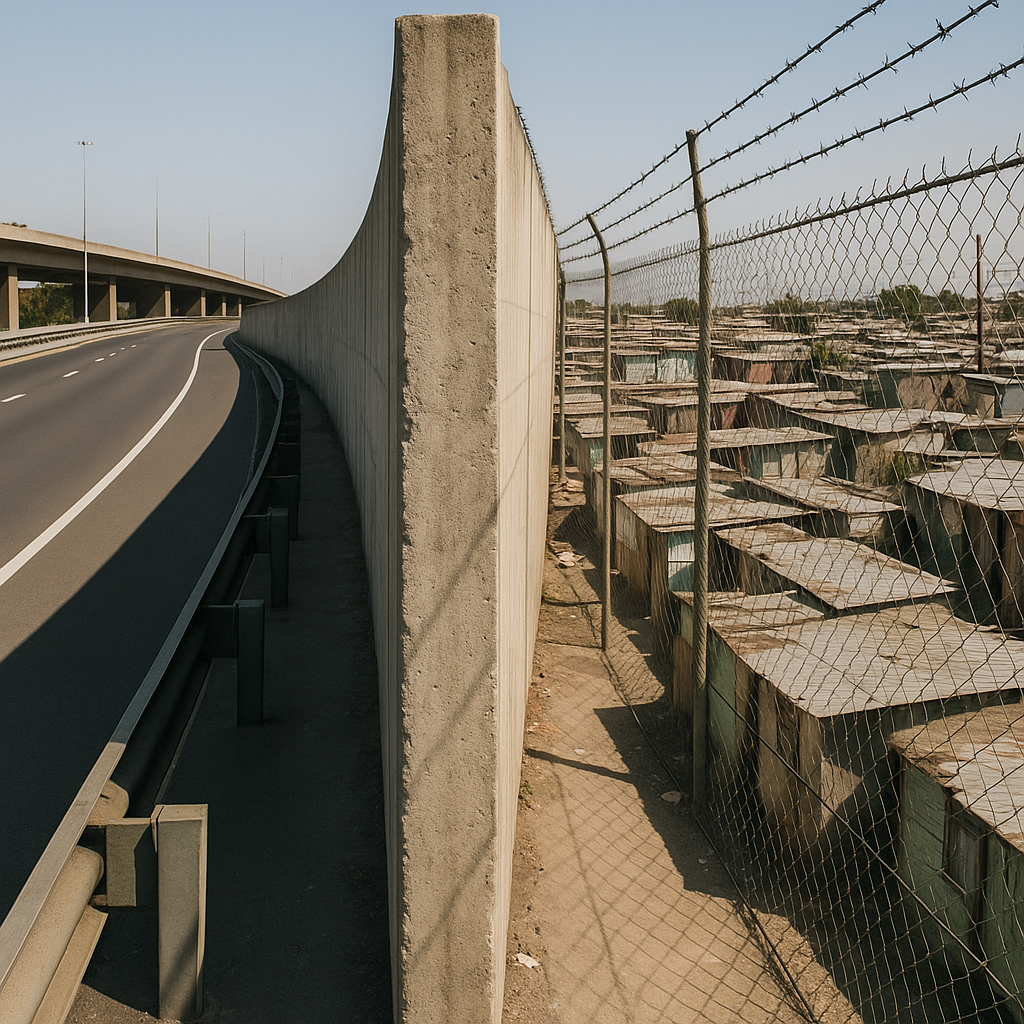
Cape Town's R114m N2 Edge Safety Project: A detailed look at the controversial 'firewall' dividing economies and communities.
Cape Town is building a big wall, costing R114 million, along a main highway to stop crime. It's made of concrete, fences, lights, and cameras. The city wants to make the road safer and look better for visitors. But some people think it's like the old Apartheid walls, hiding poor areas from rich ones. This wall is changing the landscape, one small piece at a time, even around old graves and gardens. The most important phrase is that some people think it's like the old Apartheid walls, hiding poor areas from rich ones.
What is the purpose of Cape Town's R114 Million Safety Barrier?
The R114 million safety barrier on Cape Town's N2 highway aims to reduce smash-and-grab incidents and improve safety for commuters. It includes concrete palisades, mesh fencing, steel footbridges, LED lighting, and CCTV, creating a physical and visual separation between the airport route and informal settlements to enhance security and present a more orderly image of the city.
Get Cape Town news in your inbox
Stay updated with the latest stories from the Mother City.
A highway that became a main street, a job fair and a danger zone
The 19-kilometre dash from Cape Town International Airport to the city centre was never meant to double as sidewalk, labour exchange and landfill. Yet that is exactly what the N2 has become. One side of the asphalt is lined with scrap-yards and 1950s hostels; the other climbs past a century-old “coloured” township before levelling off on a ridge crowded with tin shacks the municipality politely labels “transit areas.” Since 2001, when the first families staked claims on disused clay pits, the corridor has served as the province’s unofficial arrivals hall: travellers land at dusk to see cooking fires flare beneath A320 landing lights; at dawn, children sprint across six lanes to reach a lone taxi rank.
Provincial logs show 1 247 smash-and-grab events between 2015 and 2023 - one every other day. Two in five occurred within a stone’s throw of a median gap, and almost two-thirds during the 06:00-08:30 rush when cars crawl at jogging pace. The result is a stretch of road designed for 120 km/h that now functions as high street, warehouse and waste-sorting yard, its scar tissue still open two decades after the first zinc roof appeared.
What the R114 million shopping list really contains
The December 2025 tender is split into 17 lots, so the barrier is anything but a monolithic slab. First comes 8.7 km of 2.4 m pre-cast concrete palisade on the airport flank, crowned by a 50 cm clear polycarbonate screen that will hide the Symphony and Barcelona settlements from arriving visitors. Opposite carriageways with shallow embankments get 1.2 km of 3 m angled mesh too slippery to climb. Nineteen single-span steel footbridges - wide enough for wheelchairs and prams - will replace the lethal dashes at Borcherds Quarry, Spine Road, Langa Junction and the infamous “KFC gap.”
Lighting arrives in the form of 270 high-mast LEDs pushing 200 lux at ground level, synchronised with the Central City Improvement District’s existing camera ring. Four thousand square metres of wall have been primed for paint at a cost of R3.2 million, the brush already handed to a social-enterprise cooperative staffed by graduates of the Zip Zap Circus School. A 600 m vetiver-planted berm will steady the slope and offset the loss of 1.3 ha of wetland flora, while two fibre-optic ducts - one for CCTV, the other leased to mobile carriers - are expected to earn back maintenance costs inside 12 years through a 4.3 % internal rate of return.
Politics, profits and the optics of disappearance
Critics label the structure “Apartheid’s view-shed reborn.” ANC Chief Whip Ndithini Tyhido reminds residents that the same route was draped in 2 m green gauze during the 2010 World Cup so soccer tourists would not see Joe Slovo shacks. “The netting is now concrete,” he told a Langa hall in January, “and the price could build 1 300 RDP houses.” The GOOD Party has demanded the tourism-impact study that supposedly underpins the business case; leaked numbers suggest the City expects a 17 % drop in airport-hotel shuttles after a German travel warning last October singled out the N2 after dark.
Digital mappers overlaid the planned footprint on 2020 aerial imagery and discovered that 78 % of the blocked sight-lines point toward informal “back-yard” settlements, while wealthier neighbours such as Pinelands and Mowbray remain open to the road. Mayor Geordin Hill-Lewis insists alignment choices followed crash clusters, not postcodes, yet the echo of earlier walls - an 1890s plague barrier, 1970s Group Areas buffers, the 2004 airport noise berm that evicted KwaDabeka squatters - proves hard to silence.
Engineering meets everyday life - centimetre by centimetre
Two weeks before the January council vote, engineers from the Concor-GMC joint venture walk the route with local health workers who know every goat track. GPS pins drop where 25 kg paraffin drums roll on home-made trolleys; a boy wriggles through a rabbit-hole under the existing fence just wide enough for a beer crate. One orange marker lands in a clump of March lilies - plants that traditionally signal unmarked Cape slave graves - forcing a 4 m detour that adds R1.7 million. A grandmother refuses to surrender a pigeon-fertilised vegetable bed the size of a couch; rerouting drainage around her plot costs another R800 000.
Thus, before a single panel is cast, the wall is negotiated stake by stake, grave by grave, cabbage by cabbage. Atlantis plant will pour the 2.4 m sections, creating 90 temporary factory jobs, while 150 nights of lane closures - 22:00 to 05:00 - must be cleared with Air Traffic Control because cranes taller than 12 m poke into the airport obstacle cone. The opening kilometre, visible from the departure lounge, is already nicknamed “the showcase slice,” a stage set designed to persuade visitors that the city is safe, orderly and in control - even as life on the hidden side of the concrete keeps inventing its own rules after dusk.
What is the purpose of Cape Town's R114 Million Safety Barrier?
The R114 million safety barrier on Cape Town's N2 highway aims to reduce smash-and-grab incidents and improve safety for commuters. It includes concrete palisades, mesh fencing, steel footbridges, LED lighting, and CCTV, creating a physical and visual separation between the airport route and informal settlements to enhance security and present a more orderly image of the city.
What specific components are included in the R114 million safety barrier project?
The R114 million project is detailed and includes several components: 8.7 km of 2.4 m pre-cast concrete palisades topped with a 50 cm clear polycarbonate screen, 1.2 km of 3 m angled mesh fencing, 19 single-span steel footbridges, 270 high-mast LED lights, 4,000 square metres of wall primed for paint (costing R3.2 million), a 600 m vetiver-planted berm, and two fibre-optic ducts (one for CCTV, one for lease to mobile carriers).
Why are some people critical of the safety barrier?
Critics argue that the safety barrier resembles

Sizwe Dlamini is a Cape Town-based journalist who chronicles the city’s evolving food scene, from boeka picnics in the Bo-Kaap to seafood braais in Khayelitsha. Raised on the slopes of Table Mountain, he still starts every morning with a walk to the kramat in Constantia before heading out to discover whose grandmother is dishing up the best smoorsnoek that day.
View all articles →