
Earth’s invisible ocean could hold more water than all surface seas
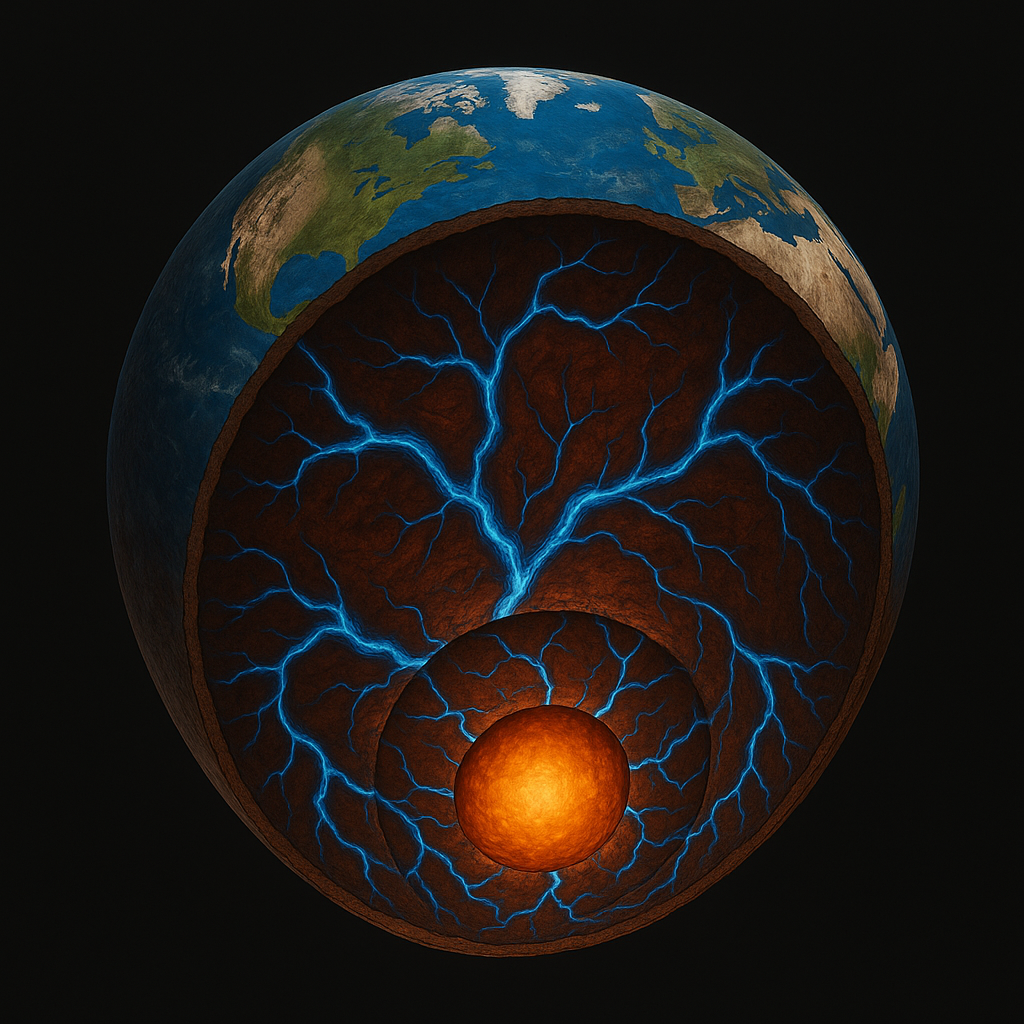
Earth's mantle may hold oceans of water in ringwoodite, affecting geology, climate, and even life. New tech explores this hidden world.
The Blue Veins of Gaia – How a Mantle-Mineral Sponge May Rewrite Earth’s Water Budget
Scientists found a hidden ocean of water deep inside Earth, stored in a special mineral called ringwoodite. This discovery means our planet holds way more water than we thought, not just on the surface. This deep water affects huge things like how mountains form and even the air we breathe. It's like Earth has a giant, secret sponge inside that constantly fills and empties, influencing everything above.
What is ringwoodite and how does it store water?
Ringwoodite is a high-pressure form of olivine, capable of storing significant amounts of water within its crystal lattice. Under immense pressure (above 18 GPa), its structure can incorporate protons and oxygen, effectively holding up to 2.6 weight percent H₂O. This allows Earth's mantle to act as a vast internal reservoir for water.
Get Cape Town news in your inbox
Stay updated with the latest stories from the Mother City.
The Seismic Whisper Beneath Our Feet
On 11 March 2011 the planet shuddered. While cameras captured the Tōhoku tsunami, a silent army of USArray seismometers registered something subtler: shear-waves arriving half a heartbeat late and slightly twisted - the calling card of water-laden ringwoodite predicted years earlier by theorists. The same lagging signal re-appeared under Brazil, Spain, Indonesia and the central Pacific, always pinned to the same depth: 660 km, the exact boundary where the upper mantle kisses the lower. By 2014 the archive held 5.3 million travel-time residuals; fed into a Monte-Carlo tomography engine they resolved a planet-girdling mesh of slow corridors - blue varicose veins inside the rock. Hydrated rock inside those conduits occupies 1.8–2.3 billion cubic kilometres, three to four times the 1.37 billion cubic kilometres of water found in every ocean, glacier, cloud and raindrop on the surface.
The observation rewrote a textbook truism overnight. Water was no longer a thin surficial film; it had a twin repository hidden in crystal lattices more than halfway to the core. The transition zone - sandwiched between 410 km and 660 km - had been promoted from barren rock furnace to the planet’s largest aquifer, an internal ocean pressed into mineral form.
Yet the discovery is only half the story. The same seismic toolkit that exposed the reservoir is now tracking how it breathes, filling and draining like a lung over geological time. Understanding that pulse has become urgent: it governs everything from the rise of mountains to the air we breathe.
Ringwoodite: Earth’s Accidental Reservoir
Ringwoodite is olivine reborn under pressure. Above 18 GPa - roughly the weight of Mount Everest balanced on a postage stamp - its lattice morphs into a spinel framework whose Mg²⁺ and Fe²⁺ sites are just roomy enough to snatch a pair of protons plus an oxygen already on the payroll. A single unit cell can pack up to 2.6 wt % H₂O, the equivalent of one Atlantic Ocean for every 100 km slice of fully charged mantle. Diamonds blasted to the surface in kimberlite fireworks sometimes carry flecks of this blue mineral; when analysed, many approach the theoretical water maximum, proof that the mantle can soak itself to saturation.
Cold subducting plates ferry this sponge downward. Where the Pacific plate tilts beneath the Philippines, low temperature and high stress keep ringwoodite stable to ~700 km. But if the same rock warms inside a rising plume, the mineral surrenders its water in milliseconds, disgorging a jet of super-critical fluid that rockets upward metres per second. Earth is therefore not a dry silicate orb wetted by chance, but a colossal sorption engine that injects and withdraws its working fluid from a 400-km-thick pressure cooker.
The consequences ripple upward. Laboratory rigs at the Bayerisches Geoinstitut show that 0.1 wt % H₂O drops olivine viscosity a hundredfold. A hydrated transition zone behaves like a grease layer, letting tectonic plates skate sideways for thousands of kilometres. GPS stations in the central Andes record sudden eastward lurches of 5–8 mm yr⁻¹; each jump lines up with inferred dehydration events 660 km beneath Bolivia. Water escapes, the overlying mantle weakens, the Nazca plate steepens its dive, and the Andes surge skyward in a geological eye-blink. Deep water, not just plate collision, becomes the pacemaker of topography.
Reading the Planet’s Hidden Pulse
Direct sampling stops at 12 km, so seismology is the only stethoscope long enough. Three complementary signals are now monitored daily:
- P-to-S conversions at 410 km and 660 km discontinuities: a velocity drop of only 2 % translates to 0.2–0.5 wt % H₂O.
- SS and PP precursors that stack constructively when bounce points sit atop broad low-velocity lids; combining 300–600 events resolves layers only 5 km thick.
- Free-oscillation splitting of spheroidal modes ₀S₂₅–₀S₃₅, exquisitely sensitive to the integral of shear velocity and density; a wet transition zone lowers eigenfrequencies by 0.05–0.08 %.
Blend all three and the recent MEREMAP consortium delivers REM-Water2023, a 3-D grid assigning a water fraction to every 0.5° × 0.5° × 25 km voxel between 410 km and 800 km. Prominent lobes appear beneath the western Pacific, the Tethyan corridor and the Scotia Sea - precisely where geodynamic models predict stagnant slabs piling up and leaking water.
The numbers are staggering. Subduction zones currently inject 750 billion kilograms of water annually; 180 billion kilograms reaches 200 km depth, and about 60 billion kilograms survives past 410 km. The remainder vents back through arc volcanoes, feeding explosive eruptions that loft steam and oxygen into the sky. Without this hidden dehydration flux, mantle oxidation would stall and surface chemistry would remain reducing. Mass-balance models imply the Great Oxidation Event 2.4 billion years ago owed as much to deep Earth plumbing as to photosynthetic microbes. Life’s breath is, in part, a by-product of a leaky interior sponge.
From Deep Time to Distant Worlds
Isotopic bookkeeping tightens the tale. Olivine crystals in 2.7-billion-year-old Belingwe komatiites trap melt whose hydrogen isotopes (δD = −90 ‰) match today’s mid-ocean ridge source. Carbonaceous chondrites clock in at −220 ‰, and solar nebula gas would have read −870 ‰. The mantle’s D/H signature rules out a late comet veneer; instead, planetesimals that formed between 1 and 2 AU delivered rock already laced with OH⁻ in amphibole and phlogopite. This primordial hydrogen survived the Moon-forming impact and 4.4 billion years of convection, proving the transition zone loaded itself before Earth reached half its final mass.
The insight catapults beyond Earth. A planet smaller than ours chills quickly; its transition zone may never enter ringwoodite stability, trapping water only in a cold lid easily lost once volcanism dies. Super-Earths, however, shove the ringwoodite field past 1,000 km, stashing up to ten ocean masses inside. Seismic detectability scales inversely with radius squared; for a 5-Earth-radius planet orbiting a nearby M-dwarf, next-generation transit-timing paired with tidally driven volcanic pulses could betray a wet mantle. Future telescopes might screen habitable-zone candidates for internal water cycling, a prerequisite for climates stable enough to survive the red-giant tantrums of their stars.
Down here, technology is racing to keep up. Distributed acoustic sensing converts mundane fibre-optic cables into 10,000-channel strain gauges; the 15,000 km SEA-ME-WE-5 line between Singapore and France already samples the 660 km discontinuity every 30 seconds. Rotational seismometers now clock the ground’s rigid twist, giving direct shear-velocity jumps instead of inferred P-S differences. The planned MantleScope array - 8,000 stations across Africa and the Indian Ocean - will marry both advances, promising a 50 km-resolution water map of the top 1,000 km by 2030. Real-time movies of slabs dumping their cargo are no longer fantasy.
Could anything live down there? Temperatures at 700 km exceed 1,600 °C, incinerating any organic hope. Yet dehydration creates nanometre-thick hydrous films where pressure depresses freezing points below 200 °C and keeps pH around 9–10. Molecular-dynamics hints these films could act as cryo-archives, preserving organic signatures from cooler epochs. No one claims a biosphere, but ultra-deep xenoliths lofted by rare kimberlite pipes that kiss the 700 km horizon may yet yield chemical fossils older than any surface rock.
For surface dwellers, the hidden ocean is already a silent partner. GRACE-FO satellites sense secular gravity trends over the Amazon and Congo that align with modeled mantle discharge; a 2 mm uplift pulse tilts entire river basins, subtly shifting rainfall from land to sea. Over eons these feedbacks act as a planetary thermostat, ensuring continents stay emergent and rivers keep delivering nutrients. The cup of coffee you sip and the tomato you water both ride on a deep heartbeat that prevents the surface from ever running completely dry.
[{"question": "What is ringwoodite and how does it store water?", "answer": "Ringwoodite is a high-pressure form of the mineral olivine, found deep within Earth's mantle. It stores water within its crystal structure by incorporating protons and oxygen. Under immense pressure (above 18 GPa), its atomic lattice can effectively hold up to 2.6 weight percent H\u2082O, making it a significant internal reservoir for water within the planet."}, {"question": "How was this 'hidden ocean' discovered?", "answer": "The hidden ocean was discovered through seismic observations. Scientists analyzed shear-waves from earthquakes that arrived late and slightly twisted, indicating the presence of water-laden ringwoodite. This phenomenon was first observed after the 2011 T\u014Dhoku earthquake and later confirmed by similar signals under various locations globally, always at a depth of 660 km, the boundary between the upper and lower mantle. Advanced seismic tomography then created 3D maps of these \"blue varicose veins\" of hydrated rock."}, {"question": "How much water is stored in this deep Earth reservoir compared to surface oceans?", "answer": "The hydrated rock within the transition zone, primarily composed of water-laden ringwoodite, is estimated to occupy 1.8 to 2.3 billion cubic kilometers. This immense volume is three to four times the 1.37 billion cubic kilometers of water found in all of Earth's surface oceans, glaciers, clouds, and rainfall combined."}, {"question": "What role does this deep water play in Earth's geological processes?", "answer": "This deep water plays a crucial role in several geological processes. It acts as a \"grease layer\" in the mantle, significantly reducing the viscosity of olivine and allowing tectonic plates to move more easily. Dehydration events within the mantle can lead to the weakening of overlying rock, influencing the steepness of subducting plates and contributing to the uplift of mountain ranges, such as the Andes. It's a key driver in the planet's topography."}, {"question": "How does the deep Earth's water cycle influence the air we breathe and Earth's climate?", "answer": "The deep Earth's water cycle significantly impacts atmospheric composition. Subducting plates carry water deep into the mantle, but a portion of this water is released back to the surface through arc volcanoes, feeding explosive eruptions that release steam and oxygen into the atmosphere. This \"dehydration flux\" is essential for mantle oxidation, and mass-balance models suggest it played a role in the Great Oxidation Event 2.4 billion years ago, making it a contributing factor to the oxygen levels necessary for life."}, {"question": "Could life exist in this deep water reservoir?", "answer": "While temperatures at 700 km depth exceed 1,600 \u00b0C, making the existence of conventional life impossible, dehydration processes create nanometer-thick hydrous films. In these films, pressure depresses freezing points below 200 \u00b0C and keeps the pH around 9-10. Molecular dynamics hints that these films could potentially act as \"cryo-archives,\" preserving organic signatures from cooler epochs. Although a biosphere is not claimed, ultra-deep xenoliths from kimberlite pipes might one day yield chemical fossils older than any surface rock, providing clues about ancient conditions."}]

Michael Jameson is a Cape Town-born journalist whose reporting on food culture traces the city’s flavours from Bo-Kaap kitchens to township braai spots. When he isn’t tracing spice routes for his weekly column, you’ll find him surfing the chilly Atlantic off Muizenberg with the same ease he navigates parliamentary press briefings.
View all articles →