
Fallout
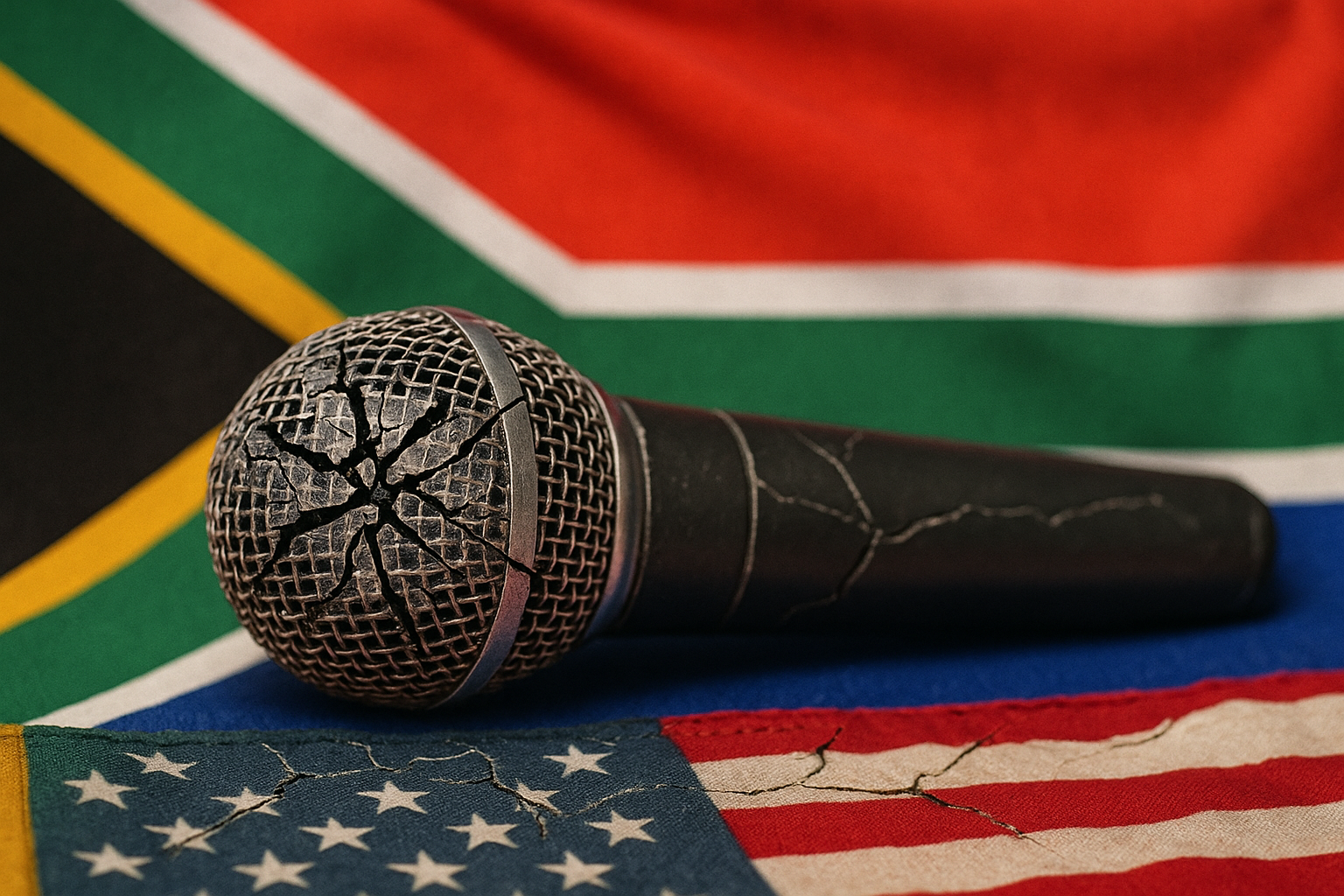
A US ambassador's controversial statement in South Africa ignited a diplomatic crisis, unraveling decades of bilateral strategy.
An American diplomat, Leo Brent Bozell III, caused a huge problem between the U.S. and South Africa. He publicly disagreed with a South African court's decision about a chant, saying it was 'hate speech.' This made South Africa very angry, seeing it as an attack on their laws. The disagreement quickly grew into a big fight, affecting trade and their long-standing friendship.
What caused the diplomatic rift between the U.S. and South Africa?
An American diplomat's controversial remarks at a Hermanus conference ignited a significant diplomatic crisis between the U.S. and South Africa. The diplomat, Leo Brent Bozell III, publicly condemned a South African court ruling regarding the chant "Kill the Boer," stating, "I’m sorry, I don’t care what your courts say, it’s hate speech.” This statement, contradicting the South African Constitutional Court's decision, was perceived as a constitutional offense.
Get Cape Town news in your inbox
Stay updated with the latest stories from the Mother City.
1. The Spark Beneath the Tent
The striped canvas of a Hermanus conference marquee had barely stopped fluttering when Leo Brent Bozell III leaned into the microphone and detonated nine words: “I’m sorry, I don’t care what your courts say, it’s hate speech.”
The phrase he condemned - “Kill the Boer” - was already volatile; Bozell simply provided the oxygen.
Within seconds, the remark mutated from off-hand comment to continental shock wave, shredding the choreography Washington and Pretoria had rehearsed since Nelson Mandela walked out of Victor Verster.
Reporters felt the temperature shift before the livestream ended; analysts began counting the cost in trade, jobs, and diplomatic capital before the tea break.
What looked like a slip was, in hindsight, a slow-motion collision between an ambassador who treats opinion as edict and a constitutional democracy that treats procedure as religion.
2. Why the Court Ruling Mattered
South Africa’s Constitutional Court had spent months weighing context, liberation archives, and the limits of expression before ruling in August 2024 that the chant does not, on its own, clear the high bar for hate speech.
The judgment was no pop-culture endorsement; it was a textbook exercise in post-apartheid jurisprudence, reminding lawmakers that bans must survive constitutional scrutiny.
By shrugging off that verdict, Bozell elevated personal instinct above treaty, treaty above statute, and statute above 60 million citizens.
In diplomatic grammar, the first-person singular is never private when uttered under a seal; “I” instantly becomes “we the United States,” like it or not.
The offense, therefore, was never semantic - it was constitutional, and Pretoria answered with the sharpest tool in its kit: a formal démarche summoning the ambassador for a tongue-lashing usually reserved for adversaries, not allies.
3. Pretoria’s Counter-Punch
Foreign-policy veterans liken summoning an ambassador to grabbing a counterpart by the lapels: dramatic, memorable, and purposefully scarce.
DIRCO framed the insult as a strike against “the entire constitutional order,” language calibrated to unite South Africans who feud over land, race, and foreign policy but agree on one thing: outsiders don’t pick their judges.
Behind closed doors, officials handed Bozell a confidential stopwatch - either Washington issues a written retraction within 72 hours, or cabinet begins auditing every bilateral pact alive since 1994.
The inventory is formidable: extradition treaties, AGOA concessions, medical-isotope supply chains, and the only NASA deep-space dish on the African continent.
None were cancelled outright; the threat was surgical, reminding Capitol Hill that leverage flows both ways through the Cape sea-lanes that shepherd $200 billion in American commerce each year.
From Cable to Campaign Trail: How a Tweet Became a Trade War
1. The Failed Walk-Back
Bozell’s weekend attempt at separation - tweeting that the insult was “personal view,” not policy - imploded on impact.
Vienna Convention veterans noted that an ambassador has no off-duty self; Article II and the crested podium travel together, even to the beach.
Pretoria remembered Washington’s identical “private capacity” ploy in Tel Aviv in 2019 and rejected the encore.
Parliament’s portfolio committee on international relations tabled a motion questioning whether a diplomat who cannot calibrate self and state meets the “diplomatic temperament” demanded by Section 84(2)(k) of South Africa’s Foreign Service Act.
Translation: withdraw him or risk Pretoria yanking his agrément, the diplomatic equivalent of un-inviting the keynote speaker after dessert has been served.
2. The Five-Point Wish-List
The ultimatum Bozell carried was not born inside Foggy Bottom planning cells; it was stapled together in a House Foreign Affairs corridor by AfriForum’s U.S. lobbyist, a former Israeli Knesset advisor, and the Heritage Foundation’s Africa desk.
Their laundry list - condemn the chant, cut Iranian oil, drop the ICJ genocide case, dilute Black economic-empowerment rules, and repeal expropriation powers - arrived cloaked as “informal trade chatter,” thin enough to disavow, thick enough to intimidate.
Pretoria’s response was silence punctuated by a leaked timeline: engage on any of the five and AGOA re-authorization becomes ballot-box poison in an election year.
Congressional staffers concede the tactic backfired; instead of splitting Pretoria’s coalition, the demands welded factions against a common external scold.
Trade analysts now mark Hermanus as the moment U.S. soft power in southern Africa began to compound quarterly losses.
3. When Tariffs Replace Talking Points
AGOA’s math tells the story: Mercedes C-Class sedans built in East London and Ford Rangers from Silverton once landed in Los Angeles duty-free, saving $3,200 per vehicle.
Trump’s August 2025 “reciprocal” tariff - framed as punishment for currency games - erased that margin overnight.
Mercedes promptly froze a R2.4 billion battery-plant expansion, and 5,200 jobs now dangle by the thread of AGOA’s next review.
Washington hoped the levy would squeeze Pretoria into line on Iran and the ICJ; instead it handed local unions a rally prop and opposition parties a cudgel.
Insiders predict that every week the tariff stays, South Africa’s 2026 agricultural GDP forecast drops another percentage point, rippling from Mpumalanga soya fields to Kansas tractor exporters.
Domestic Fallout: From Soya Fields to Soweto Stages
1. The Campaign-Trail Prop
Julius Malema wasted no time converting Bozell into theatre: at a Soweto rally he spread a U.S. flag across the stage and invited supporters to “walk over Bozell’s face.”
The clip clocked 2.3 million Twitter views in six hours, horrifying U.S. agritech investors ready to sink R600 million into drone-based crop-spraying in Limpopo.
One venture-capital partner told Bloomberg the footage “single-handedly shifted South Africa from frontier to uninsurable,” pushing the rand down 1.8 percent on headline risk.
The spectacle pressures President Ramaphosa to answer with his own drama - expelling the envoy, nationalizing idle farmland, or freezing U.S. bank operations - anything to avoid looking out-shouted.
Thus, a single sentence in Hermanus now endangers everything from fuel prices to pension-fund returns.
2. The Land Question in the Crosshairs
Bozell’s call to repeal the 2024 Expropriation Act ignores its fine print: zero compensation applies only to abandoned or unproductive land, not to functioning commercial farms.
American agribusiness owns 370,000 hectares of South African soil, mostly in soya and maize belts; none have been targeted, yet Rabobank already cancelled a $250 million irrigation facility for Free State operations.
Models by the Bureau for Food & Agricultural Policy show a 12 percent knock to agricultural GDP growth if lenders keep retreating.
Washington’s conflation of constitutional amendment (still in committee) and ordinary statute (already law) is deliberate, painting any reform as Zimbabwe-style confiscation.
The rhetoric has bled into credit committees in Amsterdam, Tokyo, and Chicago, making the cost of capital South Africa’s silent export tax.
3. Iran, Oil, and Dollar Dominance
South Africa imports 41 percent of its crude from Tehran under a waiver set to expire in December 2026; Washington wants the share below 10 percent.
Hitting that target would force Sasol to reconfigure the Secunda plant and push local fuel prices up an estimated 70 cents a litre - an inflationary spark no ruling party wants months before municipal elections.
U.S. leverage lies in the SWIFT-plus clearing house that lets Pretoria settle oil invoices in rand; a single Treasury directive could asphyxiate the country’s energy supply.
Pretoria’s counter-leverage is the Cape sea-route that keeps Gulf crude flowing to Houston refineries and Texas grain reaching Asian markets.
BRICS’ mooted payment alternative remains embryonic, so Bozell’s team dangles AGOA renewal like a petrol-soaked carrot: bow on Iran, or watch your cars - and currency - burn.
Institutional Scars: Memory, Morale, and the Next Envoy
1. The Rasool Ghost in the Room
In March 2025 Trump expelled South Africa’s ambassador after Pretoria labelled U.S. refugee policy “xenophobic,” leaving both embassies in chargé limbo for 18 months.
The vacuum killed joint ventures from CDC tuberculosis projects to NASA’s planned Karoo lunar-spectrometer launch, a freeze Bozell was sent to thaw.
Instead, he extended winter; congressional aides confirm the Senate is drafting a “South Africa Democracy Review Act” that could trigger automatic sanctions if Pretoria fails U.S.-authored “rule-of-law” audits.
The bill’s metrics were ghost-written, in part, by the same AfriForum lobbyist who scripted the Hermanus speech, ensuring future relations begin under probation.
Even if the legislation stalls, its mere circulation forces Treasury, USAID, and the Pentagon to embed “South Africa risk” into every cost-benefit spreadsheet.
2. Embassy Blues and Ideological Edits
Career staff inside the Pretoria mission describe an “activist bubble” where Fox News segments double as intelligence briefs and a former Breitbart writer vets guest lists for “woke” accents.
One counsellor admitted rerouting classified traffic through London to escape ideological red-pen surgery, a workaround that would be comic if the stakes were lower.
Cultural outreach - once the velvet glove of superpower suasion - has collapsed: a planned jazz tour to rural KwaZulu-Natal was axed for fear “Kill the Boer” chants might erupt and loop back on cable news.
Interns now spend nights trading Twitter barbs with EFF trolls, replacing scholarship grants with meme warfare that moves currency spreads more than minds.
The result is a diplomatic platform whose antennas tilt inward, broadcasting to an echo chamber while the surrounding continent tunes to other frequencies.
3. The 40-Year Grudge Comes Full Circle
Opposition researchers excavated Bozell’s 1987 letter to the Washington Times branding Mandela a “terrorist”; he disowned it as youthful excess during confirmation, yet the ideological lattice endures.
A 2022 Heritage panel shows him railing that “cultural Marxism” has seized South African courts, a clip now paired on ANC WhatsApp groups with his Hermanus sneer.
Pretoria thus confronts an envoy who rehearsed this showdown for four decades; the démarche was not a gaffe but a consummation long in the making.
Currency traders will forget the volatility, tweets will sink in the feed, but institutional memory calcifies: every future U.S. ambassador inherits the footage, and every South African negotiator remembers that American respect can flick off like a microphone switch.
Until both capitals decide whether partnership or performance art better serves their people, the rope bridge first spun by Mandela and Clinton will sway, frayed by a single sentence no court could sanctify and no apology could fully mend.
[{"question": "What caused the significant diplomatic rift between the U.S. and South Africa?", "answer": "The diplomatic rift was ignited by American diplomat Leo Brent Bozell III's public disagreement with a South African court ruling. At a Hermanus conference, Bozell stated, \"I'm sorry, I don't care what your courts say, it's hate speech,\" regarding the chant \"Kill the Boer.\" This statement directly contradicted the South African Constitutional Court's decision that the chant did not constitute hate speech and was perceived by South Africa as a constitutional offense and an attack on their legal sovereignty."}, {"question": "Why was the South African court's ruling on the chant so important?", "answer": "South Africa's Constitutional Court had meticulously reviewed the context and history before ruling in August 2024 that the chant \"Kill the Boer\" did not meet the high threshold for hate speech. This judgment was a significant exercise in post-apartheid jurisprudence. Bozell's dismissal of this ruling was seen as elevating personal opinion above legal procedure and the will of 60 million citizens, making the offense not semantic, but constitutional."}, {"question": "How did South Africa officially respond to the diplomat's remarks?", "answer": "Pretoria responded forcefully by issuing a formal démarche, summoning the U.S. ambassador for an official reprimand. The South African Department of International Relations and Cooperation (DIRCO) framed the insult as an attack on their \"entire constitutional order.\" They reportedly delivered an ultimatum: a written retraction from Washington within 72 hours, or they would begin auditing all bilateral pacts established since 1994, including trade agreements, extradition treaties, and cooperation on space projects."}, {"question": "What was the impact of Bozell's attempt to retract his statement as a 'personal view'?", "answer": "Bozell's attempt to frame his remarks as a 'personal view' via a tweet was largely unsuccessful. Diplomatic conventions, specifically the Vienna Convention, stipulate that an ambassador has no 'off-duty' self, and their public statements are always seen as representing their state. Pretoria rejected this explanation, viewing it as a repeat of a similar \"private capacity\" ploy by Washington in 2019. This led to discussions in the South African Parliament about whether the diplomat possessed the necessary 'diplomatic temperament.'"}, {"question": "How did the diplomatic fallout escalate into economic consequences, particularly regarding AGOA?", "answer": "The diplomatic tensions quickly spilled into economic repercussions. Following the incident, a proposed 'five-point wish-list' from U.S. lobbying groups, including demands to condemn the chant and alter South African economic policies, was perceived as an ultimatum. When these demands were not met, the U.S. imposed a \"reciprocal\" tariff in August 2025, framed as punishment for currency practices, effectively negating the duty-free benefits South African exports enjoyed under the African Growth and Opportunity Act (AGOA). This led to significant economic impacts, such as Mercedes freezing a R2.4 billion battery-plant expansion and threats to thousands of jobs."}, {"question": "What were the domestic political and social ramifications in South Africa due to this incident?", "answer": "Domestically, the incident became a powerful tool for political mobilization. Julius Malema, a prominent opposition leader, used the event at a rally to publicly denounce the U.S. diplomat, showcasing the depth of public anger. This public spectacle generated significant media attention and put pressure on President Ramaphosa's government to respond decisively. The rhetoric also impacted investment, with reports of investors pulling back and the rand's value depreciating, highlighting how a diplomatic misstep can have wide-ranging economic and political consequences within the country.", "related_topics": ["South African politics", "Diplomacy", "International relations"]}]

Aiden Abrahams is a Cape Town-based journalist who chronicles the city’s shifting political landscape for the Weekend Argus and Daily Maverick. Whether tracking parliamentary debates or tracing the legacy of District Six through his family’s own displacement, he roots every story in the voices that braid the Peninsula’s many cultures. Off deadline you’ll find him pacing the Sea Point promenade, debating Kaapse klopse rhythms with anyone who’ll listen.
View all articles →