
Fisherman, 70, missing after being swept off rocks at Herolds Bay
A detailed account of an intensive search and rescue operation for a missing angler off the South African coast.
Oom Jaap, a 71-year-old fisherman, vanished from Voelklip after being swept off the rocks. A massive 48-hour search by many teams, including NSRI and police divers, found no trace of him. This sad event fits a common pattern for older men drowning while fishing without life jackets in the evening. His family still waits by the sea, hoping for an answer, as the search continues with new technology and old traditions.
What happened to Oom Jaap, the missing fisherman from Voelklip?
Oom Jaap, a 71-year-old experienced fisherman, went missing after being swept off the rocks at Voelklip during an ebb tide. Despite an extensive 48-hour search involving NSRI, police divers, drones, and K9 units, he was not found. His disappearance aligns with common rock-and-surf drowning statistics for older males during twilight hours without flotation devices.
Get Cape Town news in your inbox
Stay updated with the latest stories from the Mother City.
1. The Call That Shattered Dinner Time
At eight-forty-seven on the final Wednesday of March, the sleepy scatter of cottages at Voelklip shook to a single crackle on channel 16: “Man overboard - gully mouth, ebb tide, moon up.”
Within six minutes the Wilderness NSRI coxswain thumped the scarlet switch that uncorks four decades of drilled reflex: pagers howl in kitchens where boerewors burns, dry-suits spill from lockers like startled pigeons, diesels thunder awake. By twenty-to-nine the twin-hulled St Blaise Rescuer is skimming the Kaaimans mouth, LEDs flicking crimson-emerald against basalt walls. Behind her, Spirit of Rotary launches from Mossel Bay - twenty nautical miles east - carrying four rescue swimmers and a trauma doctor who has already slit open an airway kit on the dashboard. George Fire’s rope-access platoon barrels down the N2 with 300 m of kernmantle, hydraulic shears and a night-vision drone that can read a life-jacket serial at four hundred feet.
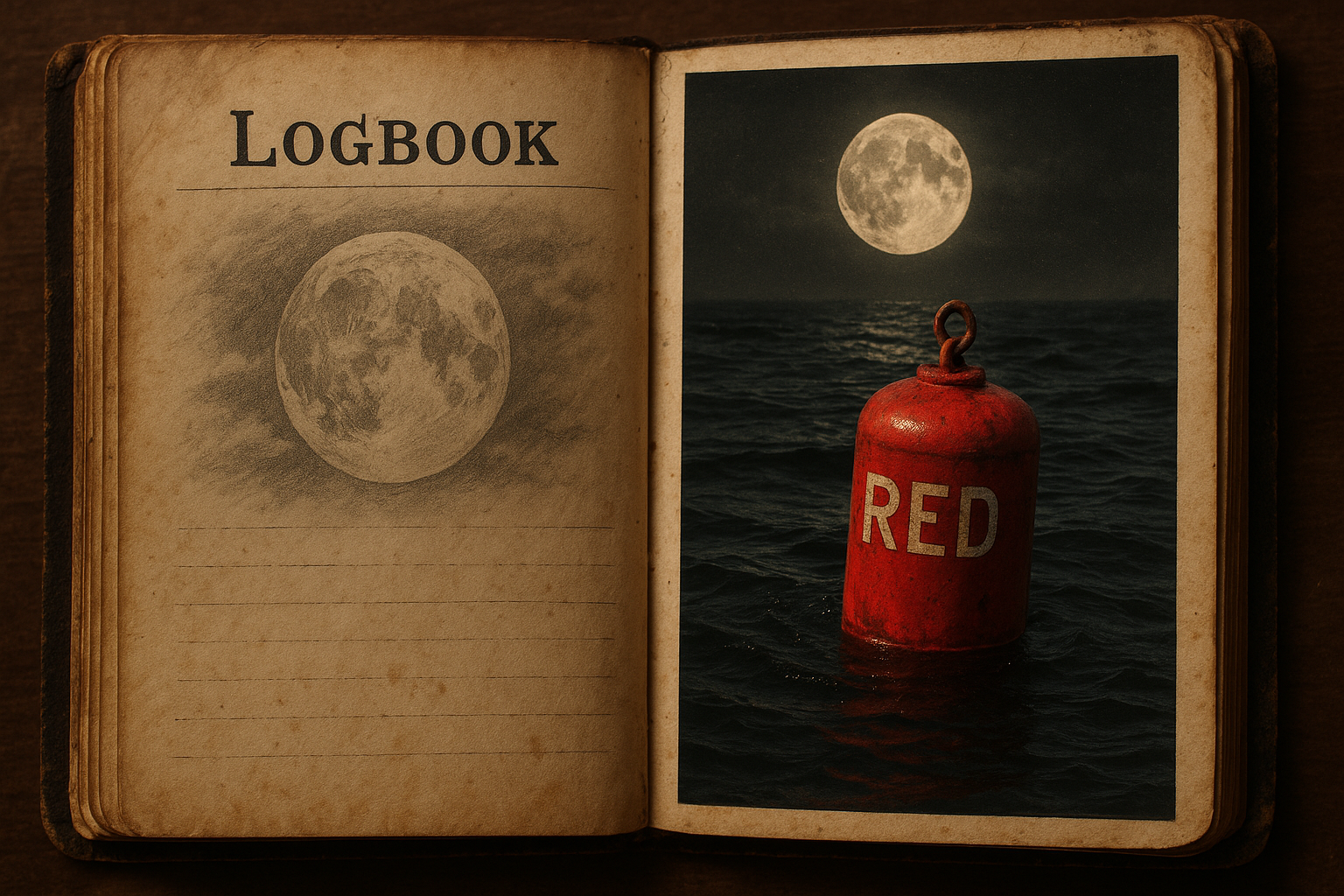
The missing man - family ask he be called “Oom Jaap” - has fished those gneiss ledges for fifty-one seasons. Locals swear he archives every galjoen and blacktail in a tide-curled exercise book: moon, barometer, bait. Wednesday’s entry, now sloshing inside a peanut-butter jar in his pack, says: “Low 19:14, 0.9 m, SE 6 kn, prawn & red bait. Go in 18:30, out 21:00. Full moon.”
Witnesses on the cliff-top braai swear they saw nothing dramatic - no splash, no shout - just the sea drawing a slow breath and a phosphorescent outline sliding backward into dark water.
NSRI doctrine for “rock-sweep” events runs a three-layer net: surface, subsurface, sand. Surface begins with a datum buoy lobbed at the last-seen point, drifting south-east at just under a knot. Rescue swimmers drop 200 m seaward, spacing themselves fifty metres apart, sweeping laterally under 2 000-lumen glare. Sub-surface brings police divers of the WPDS, arriving at twenty-two-ten, free-falling the gully in pairs, torches carving 22 °C plankton-hazed water. Visibility: four metres. Current: lazy. They surface after two minutes with only an orange bait elastic snagged on kelp. Shoreline teams in night-vision monoculars pick their way across three kilometres of boulders, peering into rock pools tight as mirrors. Still nothing.
2. Algorithms, Thermals and the Cruel Math of Drift
At twenty-three-oh-four the EMS drone cell flings up a DJI M300 RTK carrying a 640×512 thermal eye. Flying an eighty-metre grid, it overlays the NSRI’s predictive engine - software co-written with the Council for Scientific and Industrial Research that chews wind, tide, victim stats and spits out ever-tightening probability polygons. The 23:30 run assigns a 42 % chance the body is inside 600 m of the gully, 38 % it has slipped seaward beyond the backline, 20 % it has crept back under the incoming push. Coxswains widen the box to a mile-and-a-half radius, engines muttering in slow rectangles.
While machines parse probabilities, humans absorb collateral damage. At twenty-three-fifty the NSRI grief counsellor - ex-trauma nurse - perches on a bakkie tailgate beside Jaap’s daughter, explaining why hope must stay elastic until sunrise. The family hand over a photo: Jaap grinning, fish-blood on peak, 4 kg galjoen pressed to chest. The image is WhatsApped to every crew so they know the shape of what to want back.
By 02:10 Thursday the swell has eased to 1.2 m and wind clocks to a kitten-paw north-west. Coxswains idle engines and listen; in night ops sound often outruns sight - the gasp of an exhausted swimmer, the click of torch on rock. Only swell slap and the distant Victoria Bay reef-break reply. At three the incident commander triggers “limited suspension”: one boat on thirty-minute loops, shoreline patrols continued, divers told to rest for first light.
3. Dawn, Dogs and the Data-Driven Return Zone
First light at 05:48 heralds a peach sky that photographers love and rescuers hate for its glare. WPDS divers re-enter, towing side-scan sonar between twin kayaks. The fresh 800-kHz head can spot a 5-cm target in twenty metres. Three 600-m transects paint fridges, boulders, two lead sinkers - no human silhouette.
On land, a Community Policing Forum volunteer finds Jaap’s cooler box four metres up a dune: two klipfish, half-eaten vetkoek, keys, wallet intact. The discovery drags probability landward. George K9 is summoned; trailing dogs lift a scent from the cooler, ghost it 300 m to a milkwood cave, then lose it on spray-slick rock. Behaviour says the cave was visited, but not recently.
Social media, meanwhile, erupts. Facebook threads whisper “second fisherman” and “tackle theft.” Each hoax siphons resources; SAPS chase and kill every rumour. What Facebook does not see is the slow gyre beneath the glassy skin. Oceanographers at Nelson Mandela University crunch Lagrangian particles: shelf drops to 30 m, then plunges into the 180 m Outeniqua Basin; long-shore drift shoves south-west at 0.4 m/s, but upwelling-fed counter-currents curl landward at half that speed. A neutrally-buoyant object could orbit seaward on top, inward at mid-water, and revisit the reef in 18–24 hours. The model spits out a 400-m band opposite the derelict timber slipway, a kilometre west. At 13:00 both craft reposition there and divers roll again.
4. Textbook Tragedy, Torpedo-Shaped Hope and the Watch That Never Ends
By Friday the Easter swarm arrives - surfers, kite-flyers, ice-cream queues. Lifeguards extend patrols, parking a 4×4 on the cliff for fifteen-minute binocular sweeps. SUP boards are donated so guards can peer into boat-shy gullies. A ski-club volunteer tows a souped-up metal detector - normally a beachcomber’s toy - seeking sinkers or, grimly, hooks still in cloth. Nothing larger than a bottle-cap registers.
Inside the NSRI ops room the “sweep report” notes Jaap’s outfit: dark raingear, non-slip deck shoes - fabrics that gulp water yet trap air, postponing descent. No PFD, no reflective tape. Sunset was 18:52; civil twinkle died 19:18, so the 19:14 low left ledges ink-black. The profile mirrors 68 % of South African rock-and-surf drownings since 2015: male, over 50, twilight hours, zero flotation. He is a statistics lecturer’s perfect exemplar.
Technology keeps tilting the table. Saturday morning a pipeline-survey firm offers an autonomous torpedo-shaped sonar. Launched from Mossel Bay, it mows the seabed at 3 knots, 5 m altitude, 3-cm pixels. Analysts will chew 18 GB for straight-line rods, oval torsos, pale palms - results still pending.
Meanwhile ritual replaces radar. Each dawn and dusk Jaap’s family walk the cliff path, flanked by friends clutching thermoses. They do not speak; they stare at the water for ten minutes, turn back. It is a vigil older than diesel, older than GPS - a promise that someone will watch until the sea replies.
The operation is technically “active”. Police divers stay on a two-hour leash; NSRI crews sleep with radios under pillows; lifeguards scan through polarised glass that turns every shadow into a question mark. The tide turns, the moon thins, and on Jaap’s kitchen table an exercise book lies open to a blank line that someone may yet have to fill for him.
What happened to Oom Jaap, the missing fisherman from Voelklip?
Oom Jaap, a 71-year-old experienced fisherman, went missing after being swept off the rocks at Voelklip during an ebb tide. Despite an extensive 48-hour search involving NSRI, police divers, drones, and K9 units, he was not found. His disappearance aligns with common rock-and-surf drowning statistics for older males during twilight hours without flotation devices.
How did the search for Oom Jaap begin and what resources were deployed?
The search began at 8:47 PM on a Wednesday after a "man overboard" call on channel 16. Within minutes, the Wilderness NSRI launched the St Blaise Rescuer, followed by the Spirit of Rotary from Mossel Bay with rescue swimmers and a trauma doctor. George Fire's rope-access platoon with a night-vision drone also joined. Police divers arrived later to conduct subsurface searches, and shoreline teams used night-vision monoculars.
What technology was used in the search efforts?
Advanced technology played a significant role, including a DJI M300 RTK drone with a 640x512 thermal camera, which worked with the NSRI's predictive engine software to identify probability polygons for Oom Jaap's location. Side-scan sonar was used by WPDS divers to search the seabed, and oceanographers used Lagrangian particle models to predict drift patterns. Later, an autonomous torpedo-shaped sonar was offered to map the seabed with high-resolution pixels.
What challenges did the search teams face, and what patterns were observed?
The search faced challenges from the start, including the dark conditions of a full moon ebb tide. Rumours and hoaxes on social media siphoned resources. Oom Jaap's profile - an older male, fishing during twilight hours without a life jacket - unfortunately mirrored 68% of South African rock-and-surf drownings since 2015, highlighting a common and tragic pattern.
How did the community and Oom Jaap's family cope during the search?
The community rallied, with a Community Policing Forum volunteer finding Oom Jaap's cooler box. Lifeguards extended patrols, and a ski-club volunteer used a metal detector. Oom Jaap's family provided a photo of him to help crews identify him and maintained a silent vigil each dawn and dusk on the cliff path, a tradition "older than diesel, older than GPS," signifying their enduring hope and watch.
Is the search for Oom Jaap still ongoing?
The operation is technically still "active." Police divers remain on a two-hour leash, NSRI crews sleep with radios, and lifeguards continue to scan the waters. While the intensive 48-hour search found no trace, the official status indicates that the search has not been completely called off, and new technology, like the torpedo-shaped sonar, offers continued hope for answers.

Tumi Makgale is a Cape Town-based journalist whose crisp reportage on the city’s booming green-tech scene is regularly featured in the Mail & Guardian and Daily Maverick. Born and raised in Gugulethu, she still spends Saturdays bargaining for snoek at the harbour with her gogo, a ritual that keeps her rooted in the rhythms of the Cape while she tracks the continent’s next clean-energy breakthroughs.
View all articles →