
Muizenberg beachfront enters new phase of major upgrade
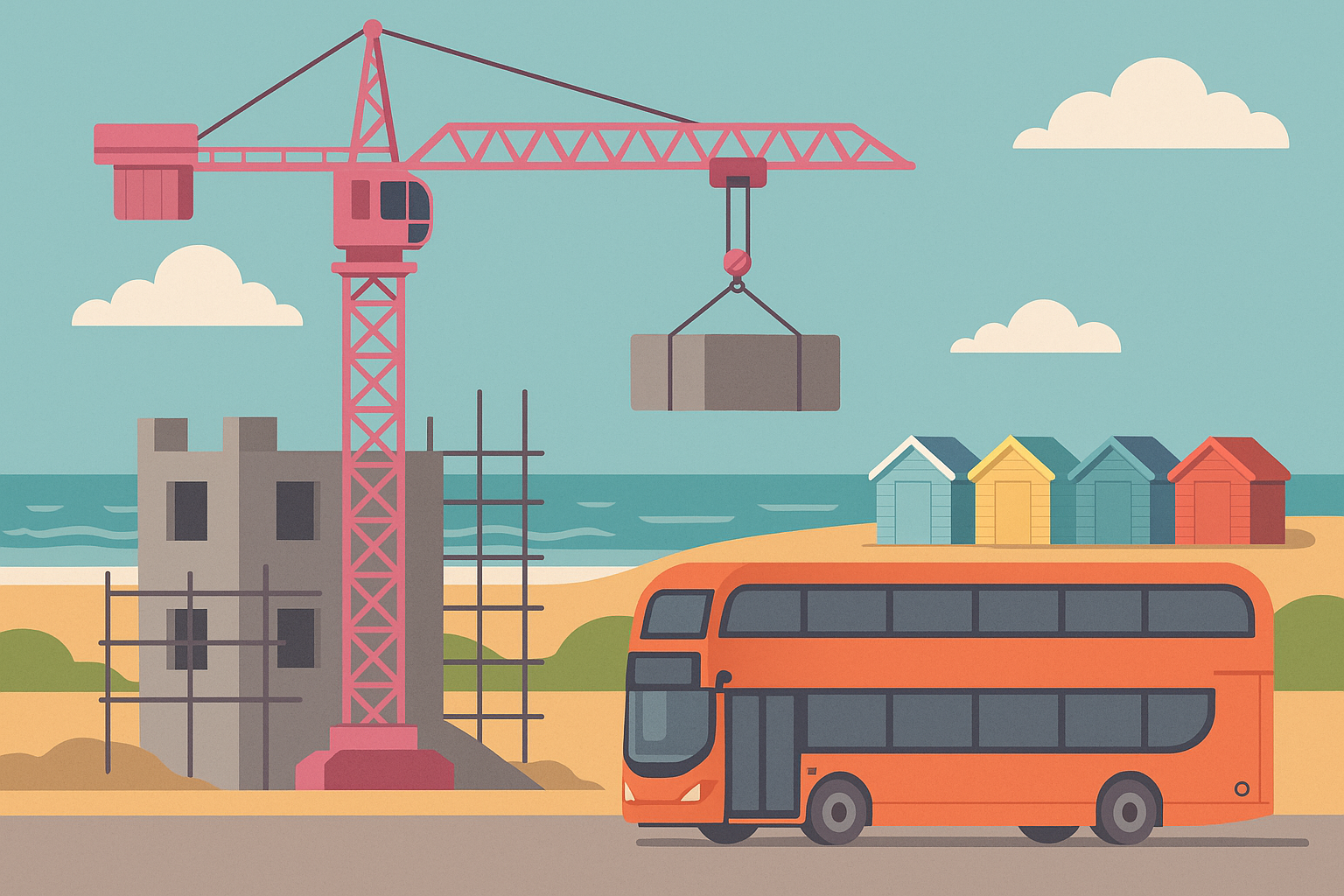
Muizenberg's shoreline transforms: new infrastructure, eco-friendly design, and community engagement reshape its future with the ocean.
Muizenberg is getting a dramatic makeover to fight rising seas and powerful storms. Old crumbling structures are being replaced with super-strong, eco-friendly concrete, like giant Lego blocks that double as seats. Even the famous beach huts are moving to higher ground, carefully placed to respect ancient history. Digital magic, like drones and online models, helps engineers from around the world work together to build a tougher, smarter shoreline. From colorful cranes and safari-style toilets playing Kwaito music, to double-decker buses and self-tracking rocks, this project is a vibrant mix of old wisdom and new tech, all to protect this beloved coast.
What is the “Muizenberg Re-coded” project about?
The “Muizenberg Re-coded” project is a significant coastal reconstruction effort in Muizenberg, South Africa. It involves rebuilding infrastructure like toilets and promenades with low-carbon concrete, utilizing advanced digital modeling and sustainable materials, and integrating community input and ecological considerations to protect the shoreline from increasing storm surges.
Get Cape Town news in your inbox
Stay updated with the latest stories from the Mother City.
Dawn Shift: 06:30 Toolbox Talk in Three Tongues
Orange safety mesh flaps like a bright flag where postcard sand used to greet sunrise selfies. Generators cough diesel bass-lines while impact wrenches keep snare-high tempo; gulls and breakers are still part of the chorus, only now they share the score with 140 pairs of steel-toed boots. By 07:00 the kilometre strip is sliced into four colour-coded zones, the same palette that glows on the site manager’s phone lock-screen. No one stands still; the ocean is knocking harder each winter and the city has answered with shift rosters, hard-hats and a bilingual safety chant that ends with “Amandla!” – power, but also permission to rebuild.
The 1972 brick toilets that stank of ammonia and old surf wax are already rubble. In their place, 1,800 t of low-carbon concrete will soon step down toward the sea like a Roman amphitheatre for sunset watchers. First, though, 270 interlocking steel sheet-piles – each as long as a suburban driveway – must bite through a buried mess of harbour ash, train clinker and 1920s ballast jettisoned from the SS Walmer Castle. That flaky geological layer, nicknamed “historic fill”, is the reason every storm surge now steals a little more land; three times since 2020 the Agulhas Current shoved plus-2.3 m of water into these parking bays, turning what was once a once-in-fifty-year headache into an annual calendar alert.
Nothing you remember sits where you left it. Eight candy-stripe beach huts were jacked, dollied on skates and parked behind the derelict Putt-Putt lane, looking like lost caravans queuing for a ferry that will never arrive. Their old footprint is now a checkerboard of geo-fabric and crushed stone waiting to sprout dune sedge and sour fig – a home-made kidney that will strain chip-fat and cigarette tips from storm-water before it reaches the breakers. When the huts return they will perch 1.9 m higher and 11 m west, a move brokered with Khoi knowledge holders because the new grid clips an ancient shell midden. The peace deal: a thick glass panel set into the prom so future feet can hover above layers of mussel shell, 1950s Coke glass and train tickets without grinding them to dust.
Mid-Mix: Candy-Pink Crane, 6.2-Tonne Lego and a Laptop in a Green Container
The crane everybody selfies is a 55-ton Liebherr wearing a candy-pink counterweight; its outriggers fit exactly inside nine lost parking bays. It rolled in at dawn on five low-loaders, cops halting milk vans long enough for the boom to tip up before Surfer’s Corner regulars had waxed a single board. Each 6.2-tonne step it lifts is cast off-site with basalt-fibre mesh instead of steel, so the next generation will not curse rusted rebar. The blocks lock like oversized Lego; at spring high-tide a grommet can still find dry perch, while at neap low the same riser seats two hundred parents cheering junior nippers in the shallows.
Beneath the crane ballet, a shipping container painted tennis-court green hides the “digital twin” studio. Every 24 hours a UCT graduate feeds fresh drone data into a point-cloud accurate to three millimetres. Coastal engineers in Amsterdam open the same file over morning coffee; London insurers refresh risk curves; Shark Spotters verify that the rising prom will not block sightlines to the inshore channel. When a July storm stripped fourteen metres of sand overnight, the model updated before the tide returned, Dutch algorithms adding another row of snowflake-shaped accropodes to the shopping list before site tea-break.
Traffic has been choreographed like an eThekwini dance troupe. Cars spiral one-way past the station, skirting a taxi rank that migrated last March. Their asphalt is laced with ground printer cartridges, an accidental dividend from the city’s e-waste drive. Pedestrians approach on gum-pole boardwalk; cyclists dismount at a sand lane, wheel through, remount at the future plaza. English and isiXhosa signs greet them, but QR plaques add Khoekhoegowab after a Langa Grade-9 learner reminded officials her grandmother still says “ǁHuiǃgaeb” – place where salt nibbles toes. Scan the code and you land on a pronunciation clip that has leaked onto TikTok, racking up likes from kids who have never heard the Nama tongue spoken aloud.
Midday Pulse: Safari Toilets, Double-Decker Bets and Stone that Phones Home
The city had seventy-two hours to replace the demolished loos before peak season. Four flat-pack safari modules arrived from Botswana, clad in wine-estate cork off-cuts and roof-lit by water-bottle bottoms. Inside: solar fairy-lights, a dolphin mural by Strandfontein artists, and a kwaito beat that runs exactly twenty seconds – long enough for proper hand-wash. Patrons vote weekly on the track list; a wave-splashed remix of “Jerusalema” currently leads. The pop-up looks like Oslo meets township hair salon, and the queue often snakes past the hydration station where rooibos iced tea chills next to aloe gel and a jar of sheep-tail fat older fishermen still swear by.
Loss of forty-two parking bays sparked uproar from the Muizenberg Improvement District; surf tourism, they reminded council, injects R 240 million a year. Compromise arrived in crimson: a 1966 London double-decker repowered electric, shuttling riders from a Zandvlei satellite lot. Kids travel free if they blurt three shark species in ten seconds; the record is seven, set by a nine-year-old before the kneeling ramp touched tarmac. Informal car guards traded high-vis bibs and a daily wage above minimum, contingent on evening classes in coastal ecology run by Two Oceans Aquarium. Last week’s homework: build a sushi-bar of invasive mussels and serve it to hungry anemones.
Stone arrives by barge when swell allows. Each granite block is radio-tagged; drift more than fifty metres and a drone lifts off to photograph the fugitive. Data feeds Deltares’ open-source atlas, helping Lagos and Lima calibrate designs for African wave energy. One three-ton rogue wandered 1.2 km to the SS Kakapo wreck; instead of retrieval, engineers etched QR codes on three faces and dropped an underwater camera. Within days the livestream starred pajama sharks, shysharks and a Roman seabass anglers thought extirpated. The reef is already tagged #NewSpots on local fishing WhatsApp groups.
Night Shift & Future Tides: Philosophy in Phosphorescence, Cake Sales at 8.5 Index
At 01:00, when spring tide empties the bay, commercial divers slip into liquid emerald glow. LED helmets light their way as they check new concrete against Jurassic bedrock, talking topside through baby monitors zip-locked against salt. When plankton blooms, fin kicks sketch galaxies of green fire; security guards wake kids sleeping in bakkies to watch the underwater aurora. One diver, ex-Rhodes philosophy student, calls it “Plato’s cave redesigned by a municipal engineer with a kelp budget”, a line now stencilled on the hydration container beside the sheep-fat jar.
Even the 1938 tidal pool, beloved by grannies and grommets, receives silent augmentation. Its concrete wall stays, but a stainless lip bolts on as a marine ladder. Rung spacing was crowdsourced: 1.3 million smartphone photos hashtagged #MuizenbergTidalPool fed an algorithm that counted octopus, sea hare and klipvis to find optimal climb gaps. On completion a thumb-sized bronze plaque will quote Ingrid Jonker: “I am the pool that mirrors the sky, and the child that enters me becomes a fish.” Already teenagers rehearse selfie captions they will etch into captions when the plaque is welded.
Weather itself is curated inside a sky-blue container tweeting every ten minutes: temperature, gust, wave height, plus a “stoep-sit-faktor” predicting balcony comfort at Empire Café. The index is trained on twenty-eight years of pensioner chai Fridays; hit 8.5 and the café flashes half-price cake for wetsuit-clad patrons. Dawn surfers sprint across Atlantic Road, boards under arm, icing sugar comet-tailing behind them. By the time the 2026 season unfurls, the crane will be gone, smart bolts will guard the huts, and a cloned radio voice will still announce “Next stop, Surfer’s Corner.” Yet beneath the accropode armour and curated kelp gardens the older stories will beat on: midden shells, LED galaxies, sheep-tail fat, double-decker timetables, kwaito hand-wash rhythms – Muizenberg’s new choreography for a sea that no longer keeps its old promises, taught one tide, one QR scan, one sunrise toolbox talk at a time.
What is the “Muizenberg Re-coded” project about?
The “Muizenberg Re-coded” project is a significant coastal reconstruction effort in Muizenberg, South Africa. It involves rebuilding infrastructure like toilets and promenades with super-strong, eco-friendly concrete, utilizing advanced digital modeling, and integrating community input and ecological considerations to protect the shoreline from increasing storm surges and powerful storms. The project aims to blend old wisdom with new technology to create a more resilient and sustainable coast for Muizenberg.
Why is Muizenberg undergoing this dramatic makeover?
Muizenberg is undergoing this makeover primarily to combat the effects of rising sea levels and powerful storms. The existing infrastructure was crumbling, and the area was experiencing increasing land loss due to frequent storm surges. The project replaces old structures with stronger, more sustainable materials and designs to protect the beloved coastline from future environmental challenges.
What new technologies and materials are being used in the project?
The project employs a variety of innovative technologies and materials. This includes the use of super-strong, eco-friendly concrete blocks that interlock like Lego, basalt-fibre mesh instead of steel rebar to prevent rust, and digital modeling using drone data to create a "digital twin" of the site. Coastal engineers worldwide collaborate on these models. Additionally, radio-tagged granite blocks are used to track their movement, and QR codes are integrated into plaques and even on submerged rocks for information and data collection.
How is the project addressing environmental and historical considerations?
The project is highly conscious of both environmental and historical aspects. For example, the famous beach huts are being moved to higher ground, a decision made in consultation with Khoi knowledge holders to respect an ancient shell midden. A thick glass panel will be installed in the promenade to allow viewing of this historical layer without disturbance. Environmentally, the project incorporates dune sedge and sour fig for stormwater filtration and utilizes low-carbon concrete. The tidal pool's ladder rung spacing was even crowdsourced by analyzing photos of marine life.
What unique community and cultural elements are integrated into the project?
The project features several unique community and cultural integrations. Safari-style flat-pack toilets from Botswana are clad in wine-estate cork and play Kwaito music, with patrons voting on the weekly playlist. A restored 1966 London double-decker bus, repowered electrically, transports people, with kids traveling free if they can name three shark species. QR plaques include Khoekhoegowab pronunciation clips, and local artists contributed dolphin murals. Informal car guards are receiving coastal ecology classes from the Two Oceans Aquarium.
How does the project manage daily operations and future planning?
Daily operations are meticulously managed with multi-lingual toolbox talks, color-coded zones, and shift rosters. Digital tools are central, with daily drone data updates feeding into a "digital twin" that allows engineers globally to monitor progress and adjust plans, such as adding accropodes after a storm. Weather conditions are curated and tweeted from a sky-blue container, even predicting "stoep-sit-faktor" for local cafes. The project plans for resilience, with features like smart bolts for the beach huts and ongoing data collection from tracked rocks to inform future wave energy designs.

Lerato Mokena is a Cape Town-based journalist who covers the city’s vibrant arts and culture scene with a focus on emerging voices from Khayelitsha to the Bo-Kaap. Born and raised at the foot of Table Mountain, she brings an insider’s eye to how creativity shapes—and is shaped by—South Africa’s complex social landscape. When she’s not chasing stories, Lerato can be found surfing Muizenberg’s gentle waves or debating politics over rooibos in her grandmother’s Gugulethu kitchen.
View all articles →