
OLD JOE AND THE LOWVELD LEGACY
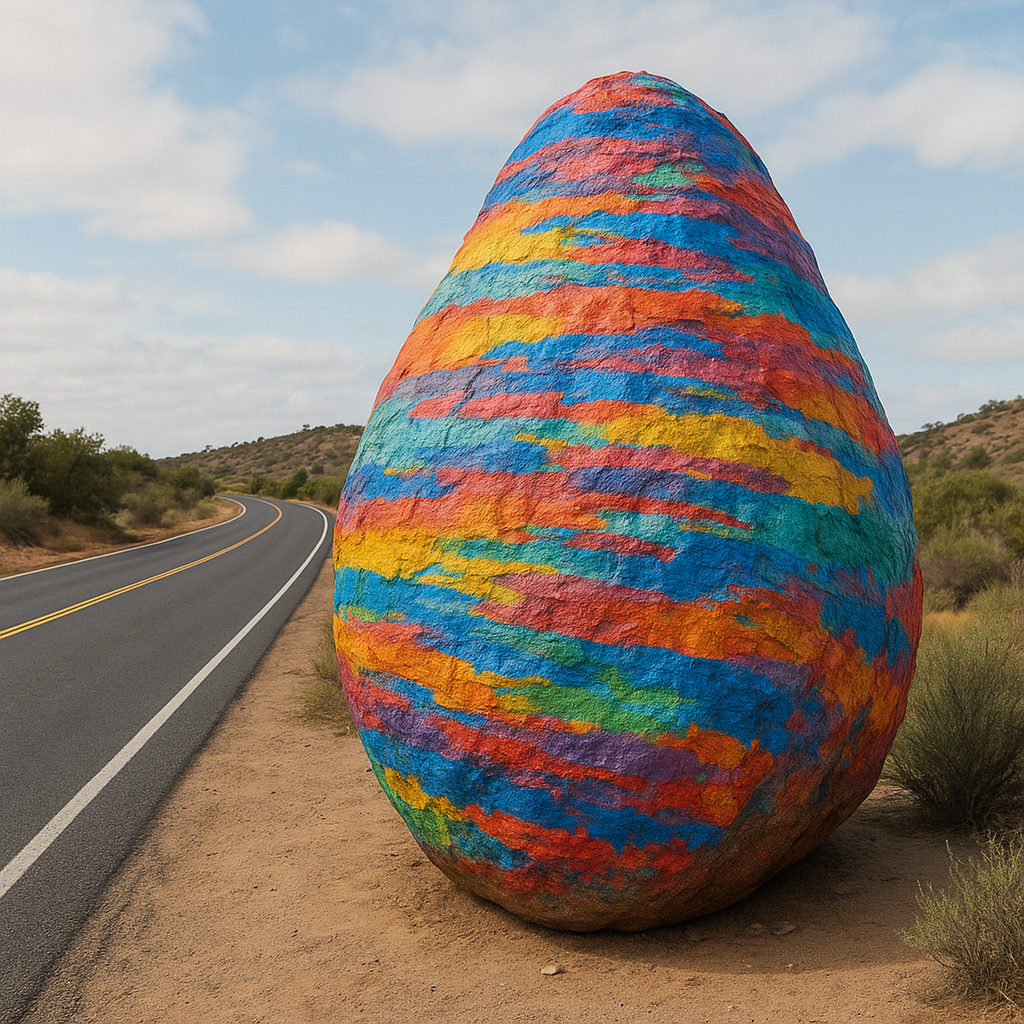
Discover the fascinating story of Old Joe, a painted boulder on South Africa's N4 highway, a cultural icon reflecting history and community.
Meet Ou Joe, South Africa's most colorful national monument! This ordinary roadside boulder has been painted since 1927, becoming a living canvas for history. Each layer of paint tells a story, from convict art to political statements and festive celebrations. Motorists greet him, artists protect him, and even scientists study his painted surface. Ou Joe is more than just a rock; he's a vibrant, ever-changing diary of a nation, cherished by all who pass by.
What is Schoemanskloof's 'Ou Joe'?
Schoemanskloof's 'Ou Joe' is an ironstone boulder on South Africa's N4 highway, transformed into a national monument through layers of paint since 1927. Originally marked by Italian convict laborers, it serves as a cultural diary reflecting historical events, social changes, and personal expressions, making it a unique roadside landmark and a symbol of communal identity.
Get Cape Town news in your inbox
Stay updated with the latest stories from the Mother City.
Where the Escarpment Breathes: First Sight of a Roadside Legend
Motorists climbing the N4 from Belfast feel the altitude in their ears before they see the steamy Lowveld spread below. At the precise moment aloes surrender to fever trees and the horizon widens, a chest-high ironstone boulder appears on a shaved bank. No brown sign advertises it, yet almost every driver taps the hooter, flicks headlights or mutters “Morning, Joe.” The greeting is inherited muscle-memory, passed from grandparents who rattled over the 1930s gravel pass.
The stone itself is unremarkable in scale - taller than most men, tapered like a pear - but its skin is unique. Layer upon layer of household enamel has fossilised into a seven-millimetre cultural varnish that adds an estimated 180 kg to Joe’s bulk. Road engineers have never sand-blasted the surface; to do so would erase a communal diary thicker than many archaeological digs.
Travelers towing boats to the dam, racing to Kruger’s gate or simply commuting between Mbombela and eMalahleni all perform the same wordless ritual. The gesture binds strangers into an impromptu congregation, a rolling congregation that lasts only until the next bend, yet repeats every few minutes from dawn to long after midnight.
From Dynamite to Dimples: The Birth of Ou Joe in 1927
The first entry in the diary was written by Italian convict labourers and Pedi stonemasons widening the ox-wagon track in 1927. Archival photographs catch Dutch foreman Johannes “Barbas” van der Merwe squinting over a theodolite while prisoners wrestle a winch. A dynamite charge split the hillside and revealed the suggestive boulder. Work halted; banter flew; someone stirred red-lead primer used for culvert pipes and dabbed on two eyes and a moustache. The shape reminded no one of Barbas himself, yet the nickname “Ou Joe” stuck, partly because the seSotho word Patatanek (baboon) already sounded like “Joe” to Afrikaans ears.
Within days, the first Model-T drivers were braking to photograph the “man who holds up the cliff.” Newspapers of the era ran coy paragraphs about the “rude rock,” ensuring the legend travelled faster than the road improvements. By the time the first coat dried, Joe had become a waypoint between the Highveld goldfields and the Lowveld heat - an informal mileage marker that laughed back at travellers.
The stone’s first forced migration came in 1938 when a bulldozer shunted it twenty metres to make room for a drainage ditch. The second relocation, in 1974, required a crane to lift Joe onto a freshly cast concrete plinth while engineers carved a four-lane highway around him. Each move amplified his reputation; farmers from as far as Marble Hall began timing Saturday shopping loops so they could sip thermos coffee beside “die klip,” their roosterkoek steaming in the early light.
Paint as Time Machine: Decoding South Africa Through Color
Every decade has left its signature pigment. The earliest coats were fish-oil oxides that sun-bleached to pastel within months. The 1950s glossy enamels gave Joe sudden lipstick-pink cheeks. A conscript in 1977 vented national-service angst with army brown; the 1985 school boycott streaked black across his eyes, soon over-painted by proud parents in PW-blue. The thickest stratum, fluorescent orange, was splashed in April 1994 by a hitch-hiker drunk on first-time voting euphoria.
University of Pretoria geologists once cored the paint stack; the cylinder - labelled “Anthropocene, Schoemanskloof Formation” - now sits in a glass cabinet, a stratigraphic stand-in for the country’s emotional seismograph. Each micron carries election hope, labour unrest,世界杯 fever or Valentine whim, making Joe a pop-culture ice-core that can be “read” like tree rings.
Consumer history is equally visible. The jump from matte oxide to polyurethane mirrored South Africa’s post-war industrial boom; the sudden availability of Day-Glo in the late 1980s announced the arrival of beach-culture imports. Even the 2020 nurse’s gold-leaf mask - 800 g of 14-carat foil drilled into the stone for the first time - marked the moment private healthcare cash met public art.
Guardians, Profiteers and the Commons: Who Owns Joe Today?
In 2005 Mbombela muralist Wouter de Witt - tag name “Ghost” - noticed lichen creeping over Joe’s crown and feared irreversible decay. Armed with scaffolding, wire brushes and a Belgian NGO grant, he removed only flaking layers, sealed the surface with breathable silicone, then repainted Joe as a Victorian farmer: waistcoat, pocket-watch, stalk of grass between stone lips. Within hours a Facebook page exploded with comments, radio stations rang off the hook, and TRAC N4 - the concession company - realised it had an asset too valuable to ignore.
TRAC offered Ghost an annual “refresh budget” on two conditions: no political slogans and imagery safe for family selfies. The deal turned a counter-culture pastime into a semi-official landmark. Ghost’s calendar now reads like a Lowveld almanac: 2008 saw Joe morph into a 440-volt purple jackalberry to publicise alien-plant eradication; 2010 brought a soccer mascot with vuvuzela arms; 2015’s reflective rhino horn slowed night-time traffic by 12 % as motorists braked for photos.
Micro-economics blossomed around the icon. A vegetable stall 300 m west claims tomato sales leap 40 % whenever Ghost works. A Belgian couple flew in to paint a Valentine heart, booked four lodge nights, hired local dancers and donated to the Kruger-to-Canyons biosphere. A Johannesburg gin distillery now prints annual Joe labels; one rand per bottle funds future paint-stripper - an ironic admission that nothing, not even fame, is permanent.
Yet custodianship remains contested. Archaeologists warn that every wire-brush stroke erases 3.2-billion-year-old greenstone evidence. Ghost counters with full documentation: high-resolution photos, laser scans and 3-D models archived with the University of Mpumalanga, creating an open-source digital palimpsest. In 2021 a masters student extracted drought-year pollen from 1972 emerald flakes, proving the paint strata can yield climate data traditional cores miss.
Rituals, Rumours and the 21st-Century Roadside
Folklore mutates faster than paint. Truckers swear that skipping the greeting invites a puncture before Malelane. A sangoma scatters bone-throw coins at the base every new moon, claiming the rock shelters a wandering spirit that once guided Shangaan miners home. Parents threaten naughty kids with “I’ll leave you at Old Joe for the night,” a provincial shorthand for exile. Even the toll-tag algorithm winks: complete the Middelburg-Nelspruit run in under 95 minutes and your statement reads “Route JOE.”
Night supplies the most surreal theatre. Because the plinth sits in a cutting, east-bound headlights project a twenty-metre shadow of Joe onto the opposite rock-face - a wavering silhouette that “waves” whenever a vehicle crests the rise. Long-exposure photographers call it “phantom Joe”; one award-shortlisted shot captured lightning stitching the sky behind the shadow, aptly titled “Current Events.”
Environmental pressure mounts. The Lowveld has warmed 1.1 °C since 1980, accelerating paint chalking. Flash floods in 2012 undercut the plinth, forcing a ring of shot-crete. TRAC’s plan for a second carriageway could strand Joe on a traffic island reachable only by north-bound lanes. Public meetings already sketch a pedestrian bridge so selfies remain possible without becoming roadside casualties. Ghost quietly proposes a relay system: quarry a twin boulder, paint in rotation so one Joe is always on display while the other rests or undergoes conservation - an idea that delights engineers but horrifies purists who insist the soul resides in the original stone.
Corporate predators circle. A telecom giant wanted to beam 5G adverts onto Joe after dusk; community outrage killed the scheme in 48 hours. A craft brewery suggested shrink-wrapping the rock in vinyl; Ghost answered by painting Joe as a judge hammering a beer bottle, caption “Contempt.” The brewery retreated, instead donating art supplies to a local school. The lesson repeats: Joe belongs to the commons, and the commons guards its own.
Future Skins, Future Stories: What the Next Coat Might Say
Educational off-shoots keep multiplying. Grade-9 geography classes model weathering rates; tourism students cost a hypothetical visitor centre; life-science clubs trap insects attracted to floodlights and compare biodiversity before and after a repaint. The university’s civil-engineering faculty buried a micro-seismograph under the plinth; data show hooting trucks produce a six-hertz vibration spike - nicknamed “the Joe Wave” - that doubles after Springbok rugby wins, suggesting a national morale monitor.
Seasonal rituals crystallise. The first Saturday in May hosts a “paint-swap” market where farmers barter leftover enamel for seedlings, reducing toxic dumping. Winter solstice brings the “Night of a Thousand Torches,” when motorcyclists park nose-in, headlights blazing, while Ghost daubs reflective silver onto Joe’s pupils. Summer heralds the “Splash Walk”: hikers start at Montrose Falls, follow the Crocodile River and reach Joe for an outdoor breakfast; entry fee is a tin of paint - any colour, no questions asked.
Digital tools extend participation beyond the pass. An Instagram AR filter overlays any past Joe design onto a user’s local boulder; #TakeJoeHome trended in Sweden. A drone-racing club slaloms through Joe’s limbs, streaming footage to spectators wearing FPV goggles in a Mbombela parking lot. Meanwhile Cape Town maker-spaces sell dissolving 3-D-printed Joe replicas: drop one in water and the outer paint washes away, revealing the next design - a children’s toy that teaches stratigraphy through play.
Yet the essential transaction stays stubbornly analogue: a person, a tin, a brush, a wish to declare “I was here.” Ghost’s request ledger runs to 2029: a matric class dreams of graduation robes; a gay-pride collective imagines a sunrise gradient; a group of sangomas envisions ancestral beadwork in ochre and fat. Every plea is tagged with the supplicant’s hometown GPS, building an accidental map of social connection. Overlay it on economic data and you see the heaviest paint donations arrive during recession years - paint as catharsa, cheaper than therapy and brighter than despair.
Stone, pigment, story, speed - the four elements fuse where the N4 tips into subtropical air. Dawn strikes fresh epoxy and for a heartbeat Joe gleams like a lighthouse. Trucks brake, butterflies smack windscreens, a hadeda ibis scolds from a coral tree. In that flicker the boulder is both immutable and brand-new: yesterday’s headlines wrapped around a Precambrian soul, hurtling together toward the next immaculate coat.
[{"question": "What is Ou Joe?", "answer": "Ou Joe is an ordinary ironstone boulder located on the N4 highway in Schoemanskloof, South Africa, that has been continuously painted since 1927. It has evolved into a unique national monument and a living canvas reflecting South African history, culture, and personal expressions, making it a cherished roadside legend."}, {"question": "How did Ou Joe get its start?", "answer": "Ou Joe's history began in 1927 when Italian convict laborers and Pedi stonemasons were widening an ox-wagon track. After a dynamite charge revealed the boulder, someone humorously painted two eyes and a mustache on it using red-lead primer. The shape earned it the nickname \"Ou Joe,\" a playful nod to the seSotho word for baboon, Patatanek."}, {"question": "What makes Ou Joe a \"living canvas for history\"?", "answer": "Each layer of paint on Ou Joe represents a different period in South African history. From convict art and political statements (like 'PW-blue' or fluorescent orange for the 1994 elections) to festive celebrations and everyday expressions, the boulder's surface acts as a 'cultural varnish' or 'pop-culture ice-core' that can be 'read' like tree rings, revealing societal changes and sentiments over time."}, {"question": "Who maintains and protects Ou Joe today?", "answer": "Initially, Ou Joe was a community-maintained landmark, but now Mbombela muralist Wouter de Witt, known as 'Ghost,' is officially responsible for its upkeep. He receives an annual 'refresh budget' from TRAC N4 (the concession company) with conditions against political slogans and a focus on family-friendly imagery. Various individuals, communities, and even scientists also contribute to its preservation and study."}, {"question": "Are there any rituals or folklore associated with Ou Joe?", "answer": "Yes, Ou Joe is steeped in local folklore. Truckers believe skipping a greeting to Joe invites a puncture. A sangoma performs new moon rituals at its base, believing it shelters a spirit. Parents use 'I'll leave you at Old Joe for the night' as a provincial threat for misbehaving children. Even the toll-tag algorithm winks, with statements reading 'Route JOE' for fast drives between Middelburg and Nelspruit."}, {"question": "What does the future hold for Ou Joe?", "answer": "The future of Ou Joe involves ongoing conservation efforts, adaptation to environmental changes, and continued community engagement. Plans include potential solutions for environmental pressures like increased warming and flash floods, and discussions about a second carriageway that might require a pedestrian bridge for continued access. There are also ongoing educational and digital initiatives, ensuring its legacy as a cherished landmark endures."}]

Michael Jameson is a Cape Town-born journalist whose reporting on food culture traces the city’s flavours from Bo-Kaap kitchens to township braai spots. When he isn’t tracing spice routes for his weekly column, you’ll find him surfing the chilly Atlantic off Muizenberg with the same ease he navigates parliamentary press briefings.
View all articles →