
The calculation dressed up as statecraft
Roelf Meyer, architect of South Africa's transition, faces new diplomatic challenges in Washington amidst complex US-SA relations.
Roelf Meyer, a former architect of South Africa's post-apartheid constitution, now faces a tough job as ambassador to Washington. He has to explain his country to Americans who have fixed ideas about it, battle wrong stories, and get important money deals done. He also has to deal with a tricky refugee problem, all while politics and race tensions are high. He'll use his past experiences, like helping enemies talk, to try and bridge the divide.
What is Roelf Meyer's main challenge as South Africa's ambassador to Washington?
Roelf Meyer's primary challenge is to navigate the complex political landscape of Washington D.C., interpreting South Africa's evolving identity and policies to a US administration and public with preconceived notions. He must counter narratives, secure crucial financial agreements, and address the nuanced refugee crisis, all while battling a charged atmosphere of political and racial division.
Get Cape Town news in your inbox
Stay updated with the latest stories from the Mother City.
1. The Highway That Split History
Roelf Meyer’s diplomatic journey to Washington did not start at any VIP lounge. It began on a grim December morning in 1991, when his National Party convoy veered off the R24 and rolled toward the World Trade Centre for the opening plenary of CODESA. The mall had been stripped of tenants overnight; shops were shuttered, yet the escalators kept turning, their mechanical hum mixing with delegates’ footsteps to form an accidental drumbeat for a nation learning a new cadence. Meyer clutched a soft leather folder still stamped with the apartheid crest; inside lay the first skeleton of what would become the interim constitution. Cyril Ramaphosa approached the same building from the opposite carriageway, escorted by UDF marshals who, twelve hours earlier, had argued in a Soweto church hall whether bargaining with the regime constituted betrayal. That stretch of asphalt - Meyer heading east, Ramaphosa west - has since hardened into the unofficial spine of South Africa’s transition: two lanes that kept delivering adversaries to the same midpoint.
Thirty-four years later the same road glides past a fresh landmark: Washington’s new embassy, a six-storey glass block that opened in 2023 on Atholl-Oaklands corner. The façade is a sandwich of blast-resistant glazing; within, the consular hall is lined with quotes from Mandela and Lillian Wald, the American nurse who denounced the pass laws in 1904. Each weekday dawn, Afrikaner parents - many clutching tattered Dutch Reformed hymnals and toddlers - spill onto the sidewalk to lodge asylum claims under the Trump administration’s 2025 edict, which labels “white South African minorities” victims of “state-sanctioned racism.” The queue has become so familiar that an entrepreneur now sells vetkoek and coffee from a fold-up table, advertising in Afrikaans: “Vryheid kom met ’n vuller en ’n vinger” - freedom comes with a form and a fingerprint.
Meyer’s ambassadorial posting strikes this tableau like a dropped stone, sending out rings of symbolism, each carrying its own cargo of history. To the White House he is the Afrikaans voice who can interpret Pretoria for a president who gleans his Africa briefing from YouTube montages of farm attacks. To the South African left he is a walking reminder of a settlement that left economic power largely untouched. To the State Department’s Africa desk - staffed by career officers who have lacked a South African counterpart for fifteen months - he is the first contact who can quote both Krog’s Country of My Skull and the Federalist Papers. To the families in line he is either a sell-out to the volk or their final hope that someone in Washington will answer when their asylum file stalls.
2. A Passport That Argues With Itself
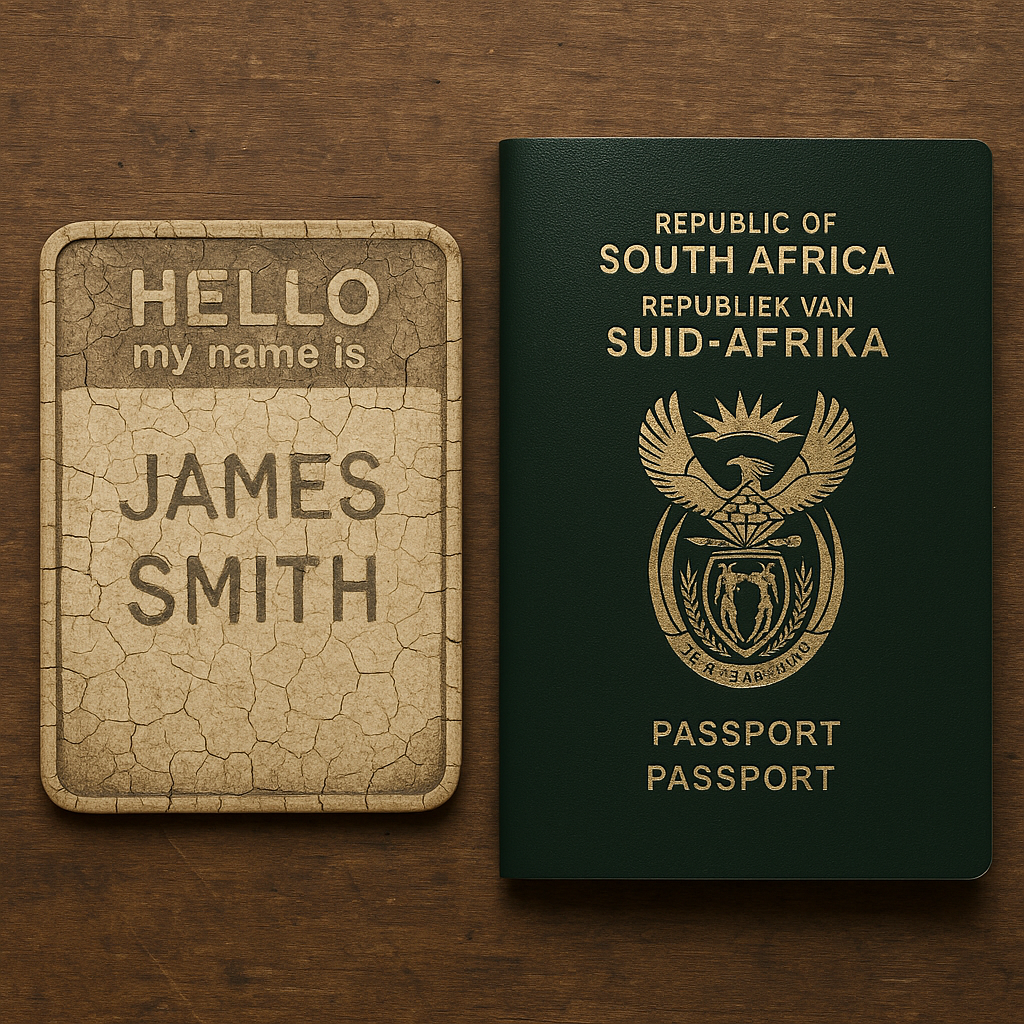
The contradictions are sewn into the very passport he will present. South African envoys travel on a document whose cover still carries the springbok and protea, yet the first inside page was rewritten in 2022. The traditional plea to “allow the bearer to pass freely without let or hindrance” vanished, replaced by a pledge committing the Republic to “the achievement of equality, human rights and peaceful coexistence.” It is, so far as anyone can tell, the only passport whose issuing authority prints a slice of constitutional preamble inside. Meyer helped craft that wording; now he must hand it to a US immigration official who has already let in 4,477 compatriots precisely on the grounds that those rights are being trampled at home.
He will not disembark with the standard briefing kit - no memory stick crammed with AGOA renewal bullet points, lithium supply-chain memos, or classified cables about Russian frigates at Simon’s Town. Those dossiers exist, but his real preparation is catalogued in memory, trigged by the smell of red dust rising from dirt tracks where he has spent two decades teaching guerrillas and generals how to holster their rifles. In Juba in 2014 he persuaded Riek Machar’s team to ink a cessation-of-hostilities accord inside a tent so leaky the rain smudged every copy. In Bogotá in 2015 he landed fresh from heart-bypass surgery, South African blood-thinners rattling in a cooler, and still cajoled FARC’s Iván Márquez to accept a verification mechanism both sides had spurned for three years. In Naypyidaw in 2018 he sat in a military mess where a gold-plated Shwedagon model towered over the table, listening to Tatmadaw brass recite Mandela’s line about “talking to the enemy” - a quote they had lifted from a 1997 Time interview Meyer himself had set up.
Each episode deposited a layer of method. Meyer stores them in a private vocabulary he calls “the three rooms.” Room One is the corridor where adversaries vent fury before reaching the table; CODESA stumbled on it by forcing delegates to tramp half a kilometre past shuttered shopfronts - by the time they sat down, cold had muted their anger. Room Two is the side-table where you park a single page no one requested yet which tilts the agenda; in Belfast it was a concise note on South Africa’s amnesty formula, left on David Trimble’s chair after a tea break. Room Three is the off-ramp: a clause letting the stronger camp declare win while yielding the substance; Meyer once drafted the provision that let the apartheid military retain its ranks while folding into a multi-racial command council. He will need every room in Washington, but the floor-plan has shifted: corridors are cable-news cycles, side-tables are senators’ iPhones, exit ramps are tweets that can vanish before sunrise.
3. Coal, Refugees and Pop-Up Whiteboards
His first crucible arrives in October at the G20 finance ministers’ meeting. South Africa’s absence from the April gathering in Miami cost National Treasury an estimated USD 1.3 billion in pledges for the Just Energy Transition deal. The money - earmarked to shut fourteen coal units and cushion Eskom - depended on a co-financing trigger that required full G20 sign-off. When Enoch Godongwana and Lesetja Kganyago were turned back at Dulles, the trigger lapsed; within days Moodies placed Eskom under review and the rand crashed through 21 to the dollar. Meyer’s opening brief, then, is brutally technical: get Treasury officials readmitted to the pre-meeting working groups where coal-exit metrics are thrashed out. That means convincing Treasury Secretary John Rose - an Alabama libertarian who once tweeted “wokeness killed Eskom” - to lift his block on Pretoria’s participation. Meyer’s gambit, aides reveal, will invoke Alabama’s own 2019 compact with the Tennessee Valley Authority, where federal guarantees allowed six coal plants to close without a single job lost at the Muscle Shoals wire-winding plant. It is an argument pitched at a man who prides himself on grid minutiae.
The second crucible is the refugee issue. Meyer has already petitioned the State Department’s Office of Population, Refugees and Migration for raw asylum data. The figures undermine the lobby’s PR: 62 percent of successful applicants are white, but 38 percent are Black South Africans alleging persecution by farmers or traditional leaders. Meyer plans to publish that nugget in an op-ed for the Dallas Morning News, a paper Devin Nunes’ team clips daily. The aim is to fracture the shorthand that equates “South African refugee” with “white farmer,” forcing Republican staff to defend a racial sieve that now spurns some of their own anti-ANC petitioners. It is vintage Meyer: weaponise the opposition’s paperwork against itself.
Meanwhile the embassy is being retro-fitted for siege conditions. The glass cube was designed for 180 staff; Congress has capped South Africa’s complement at 112 until “religious freedom violations” are probed. Meyer has therefore converted the fourth floor - intended for USAID contractors - into a pop-up negotiation hub. He imported a dozen portable whiteboards from Arizona State’s McCain Institute, sheets of static-cling plastic that adhere to any glossy surface. Each board is pre-printed with a timeline: 1902 Treaty of Vereeniging, 1948 apartheid election, 1976 Soweto uprising, 1985 US sanctions, 1994 transition, 2017 state capture, 2025 refugee order. Visitors stick Post-its under any year. After a fortnight the 2025 column is half-full: MAGA stickers, apartheid-flag emojis, a crayon windmill. Meyer photographs the collage nightly and WhatsApps it to the online graduate seminar he still convenes. Assignment: find the narrative holes, craft a 400-word counter-story. The paragraphs - half by American, half by African students - will feed future speeches delivered everywhere from think-tanks to county fairs.
4. Portraits, Proverbs and the Art of Dog-Whistle Fluency
At home the nomination has detonated a fresh fracas inside the ANC National Executive Committee. At July’s policy indaba a younger bloc, led by Gauteng chair Panyaza Lesufi, moved that dispatching a white envoy “externalises the colonial gaze” and rubber-stamps Trump’s racial taxonomy. The motion fell by six votes. Countering, Parks Tau argued that Meyer’s presence inside the West Wing exposes the canard that Pretoria is run by an anti-white cabal. It replays an older duel: in 1992 Winnie Madikizela-Mandela warned “the Boers will negotiate us into a trap,” while Walter Sisulu replied that “you defeat the adversary by making him recognise you as human.” The dialectic never ended; it simply migrated from township halls to WhatsApp threads.
Yet even inside the embassy the contradiction lingers. Meyer has requested his official portrait - a compulsory fixture in every ambassador’s reception area - not be shot by the State Department lensman but by Zanele Muholi, the visual activist whose monochrome images of queer Black South Africans have hung in Tate Modern and Zeitz MOCAA. Muholi agreed on condition that the backdrop be Robben Island’s lime quarry, the pit where Nelson Mandela’s sight was scarred by glare. The photo will depict Meyer in a dark suit, but super-imposed on the rock will be faint prisoner silhouettes. The aim is to remind viewers - congressional aides, Homeland Security officers, the odd tourist - that the ambassador’s biography does not begin in 1948, when he was born into National Party rule, but in 1652, when the first supply ship dropped anchor at Table Bay and set in motion centuries that would produce both apartheid and those who dismantled it.
Whether that visual argument survives the next news-cycle is uncertain. Meyer lands in Washington three weeks before mid-term primaries, and GOP strategists have already booked USD 7 million of airtime in Michigan and Wisconsin featuring grainy farm-murder footage and the tagline “Send a Farmer, Not a Politician.” The spots never name Meyer, but the subtext is plain: any Afrikaner who serves a Black-majority government is a traitor. His counter-move, honed in hotel lobbies from Belfast to Bogotá, is to localise the issue. He has slated his first public stop for Kalamazoo, Michigan, a town that shed 1 200 paper-mill jobs in 2022. The venue is a decommissioned factory floor; the crowd will include former mill-hands re-skilled to fit heat-pumps. Meyer will contend that South Africa’s coal-transition finance - if unlocked - can generate procurement contracts for Michigan’s small metal-bending shops. It mirrors the pitch he once made to Afrikaner bureaucrats spooked by affirmative action: recast existential threat as economic opportunity, then attach a spreadsheet.
Finally, there is the matter of tongue. Meyer speaks fluent Afrikaans, English and enough isiXhosa to open a meeting with “Molweni, ndicela intethe.” But Washington in 2026 is a city fluent in dog-whistle. When Secretary Rose says “energy reliability,” he means coal; when Senator Katie Britt says “protecting vulnerable minorities,” she means white Christians. Meyer’s task is to smuggle in a new vernacular - one that renders “non-racial constitutionalism” intelligible to a Republican Party that no longer recognises constitutional norms. He has begun by memorising Federalist No. 10, Madison’s caution that factions dissolve only when interests multiply. He quotes it in hearings, substituting “race” for “faction,” trusting the anachronism will lodge in the brain of a 28-year-old staffer who will one day draft legislation.
The stone is still falling; the ripples have not yet kissed the far bank. Inside the glass cube the whiteboards fill each night, the vetkoek seller outside the consulate has added a gluten-free skuinskoek, and Meyer’s suitcase - hauled across the Atlantic - contains a single keepsake: the plastic name-tag he wore at CODESA, cracked at the corners yet still readable. On the reverse he has inked, now fading, the isiZulu adage “Uhlanga lwezwe alupheli” - a country’s lineage does not terminate. He will pin it above his desk in Washington, a microscopic act of defiance against an administration that has already dismissed the country he represents as a collapsed state. The next chapter of the corridor begins there.
What is Roelf Meyer's main challenge as South Africa's ambassador to Washington?
Roelf Meyer's primary challenge is to navigate the complex political landscape of Washington D.C., interpreting South Africa's evolving identity and policies to a US administration and public with preconceived notions. He must counter narratives, secure crucial financial agreements, and address the nuanced refugee crisis, all while battling a charged atmosphere of political and racial division.
How did Roelf Meyer's past experiences prepare him for his current role?
Meyer's extensive experience as an architect of South Africa's post-apartheid constitution and a seasoned negotiator in various conflict zones (like Juba, Bogotá, and Naypyidaw) has equipped him with unique methods for bridging divides. He uses a private vocabulary called "the three rooms" – strategies for managing initial fury, subtly influencing agendas, and providing face-saving exits for adversaries – which he will adapt to Washington's fast-paced, digital environment.
What makes the South African passport unusual, and how does it relate to Meyer's mission?
South African envoys carry a passport that, since 2022, explicitly pledges commitment to "the achievement of equality, human rights and peaceful coexistence" on its first inside page, rather than the traditional plea to pass freely. Meyer helped craft this wording, and now he must present this document in a country where some of his compatriots are seeking asylum precisely on the grounds that these rights are being violated at home, highlighting the contradictions he faces.
What are the two immediate critical issues Roelf Meyer must address in Washington?
Meyer faces two immediate challenges: first, securing the readmission of South African Treasury officials to G20 working groups to unlock USD 1.3 billion for the Just Energy Transition deal, which was blocked by the US Treasury Secretary. Second, he must tackle the refugee issue by publishing data that challenges the narrative of "white South African minorities" being the sole victims of "state-sanctioned racism," revealing that a significant percentage of successful applicants are Black South Africans.
How is Roelf Meyer using the embassy space to counter prevailing narratives?
With staff caps imposed by Congress, Meyer has converted the fourth floor of the new embassy into a "pop-up negotiation hub." He uses portable whiteboards pre-printed with South African historical timelines, where visitors add Post-its to express their views, including misinformation. Meyer photographs these collages nightly and uses them in an online graduate seminar to develop counter-narratives for his speeches, effectively turning the embassy into a dynamic educational and strategic center.
How does Meyer plan to address the 'dog-whistle fluency' in Washington politics?
Meyer recognizes that Washington politics uses coded language (e.g., "energy reliability" meaning coal, "vulnerable minorities" meaning white Christians). His strategy is to introduce a new vernacular that makes "non-racial constitutionalism" intelligible to a Republican Party he perceives as having drifted from traditional constitutional norms. He plans to quote Federalist No. 10, substituting "race" for "faction," to subtly embed these concepts in the minds of legislative staffers.

Liam Fortuin is a Cape Town journalist whose reporting on the city’s evolving food culture—from township kitchens to wine-land farms—captures the flavours and stories of South Africa’s many kitchens. Raised in Bo-Kaap, he still starts Saturday mornings hunting koesisters at family stalls on Wale Street, a ritual that feeds both his palate and his notebook.
View all articles →